US GDP surged to 4.3%, but the stockpile boost won’t happen twice


The US economy's 4.3% third quarter was not a faster economy. Sales of what the country produced grew 2.6%, slightly less than in the spring, and the rest came from companies ending a five-quarter run-down of their stockpiles.
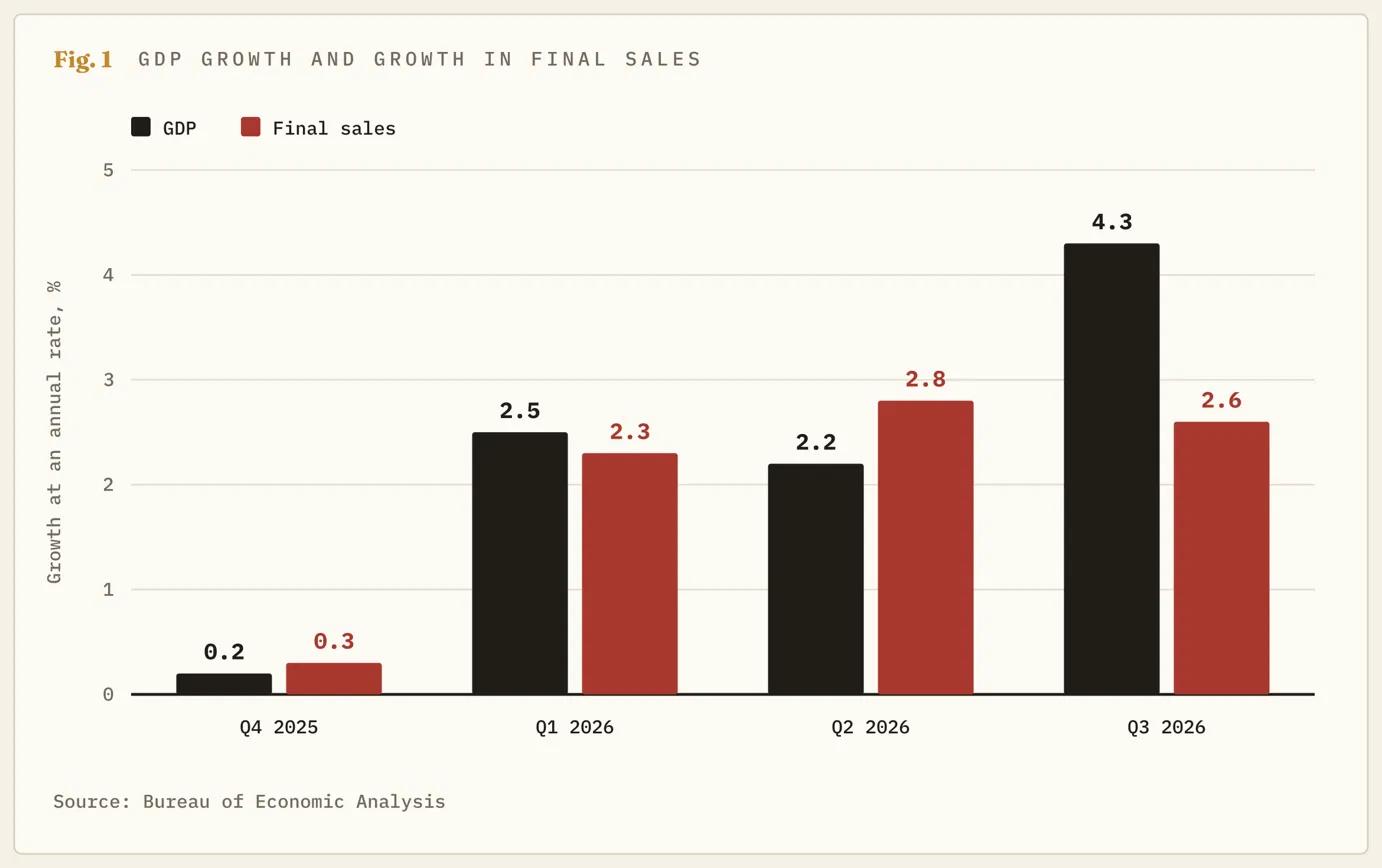
The US economy grew at an annual rate of 4.3% in the third quarter, its fastest in three years and nearly double the spring's 2.2%. Over the same two quarters, sales of what the country produced grew 2.8% in the spring and 2.6% in the summer. The economy sold a little less and was recorded as growing almost twice as fast, and all of that difference is in one line of the accounts.
That line is the change in company stockpiles, and it added 1.64 points to the 4.3%. Very little went into storage, since stockpiles ended the summer 0.2% larger than they began it. What changed is that companies stopped running them down, and Gross Domestic Product (GDP) counts that as growth once and can't count it again. That matters because the Federal Reserve (Fed) is raising interest rates to fight inflation, and 4.3% growth makes the economy look better able to take them than 2.6% does.
All of the speed-up is in one line
The Bureau of Economic Analysis (BEA) breaks growth into contributions that add up to the total. Between the second and third quarters, the total rose by 2.1 points, from 2.2% to 4.3%. The stockpile line alone moved by 2.17 points, from subtracting 0.53 in the spring to adding 1.64 in the summer.
Take that line out, and what remains is the BEA's measure of final sales, meaning everything the country produced and sold. Final sales grew 0.3% at the end of 2025, then 2.3%, 2.8% and 2.6% in the three quarters since. On that measure, the economy has grown at about the same pace all year, and the summer was not its best quarter.
In the same accounts, the split between goods and services tells the story again. Services added 2.50 points to growth and goods added 1.70. Of the goods figure, 1.64 was the stockpile line, and 0.06 was goods that were sold.
Stopping a run-down counts as growth, once
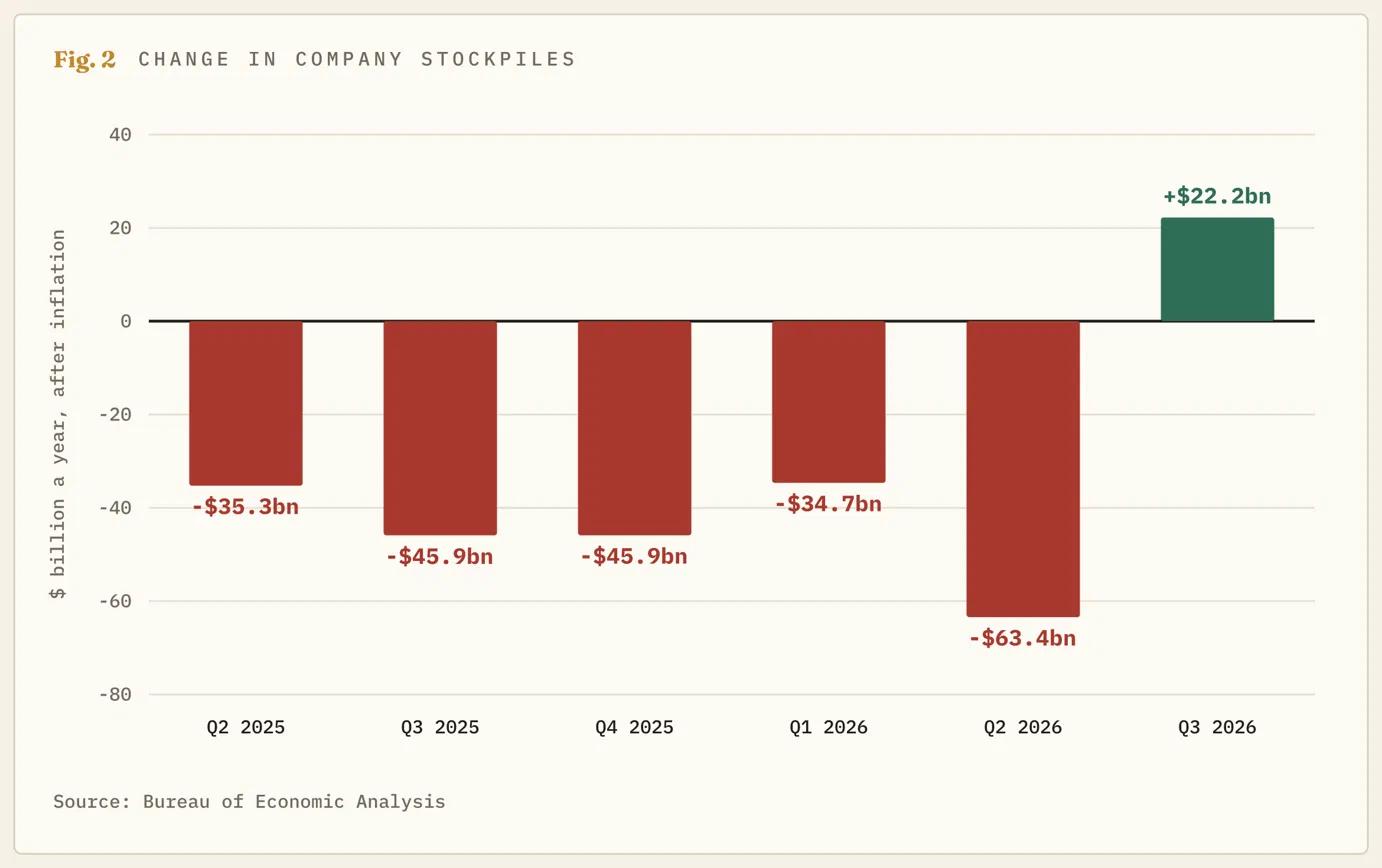
GDP measures what is produced, not what is sold, and stockpiles are the difference between the two. For five quarters in a row, companies sold more than they produced and met the gap from their shelves. In the spring, that gap was running at $63.4 billion a year after inflation.
Over the summer, production caught up, and companies made $22.2 billion a year more than they sold. Output had to rise by $85.7 billion to make that switch without a single extra sale, which is a third of the quarter's $257.2 billion increase in GDP. The stockpiles themselves grew by $5.6 billion over the three months, on a base of about $3 trillion.
From here, the arithmetic turns against the 4.3%. The stockpile line measures the change in the pace of stock-building, so companies that keep adding at the summer's pace would contribute nothing to fourth-quarter growth. Matching the summer's boost would take a build of about $108 billion a year, nearly five times the current one.
On the record, a repeat is rare. Since 1990, the stockpile line has added 1.5 points or more in 19 other quarters, and in 15 of them it subtracted from growth in the following quarter.
A second boost needs American goods to start selling
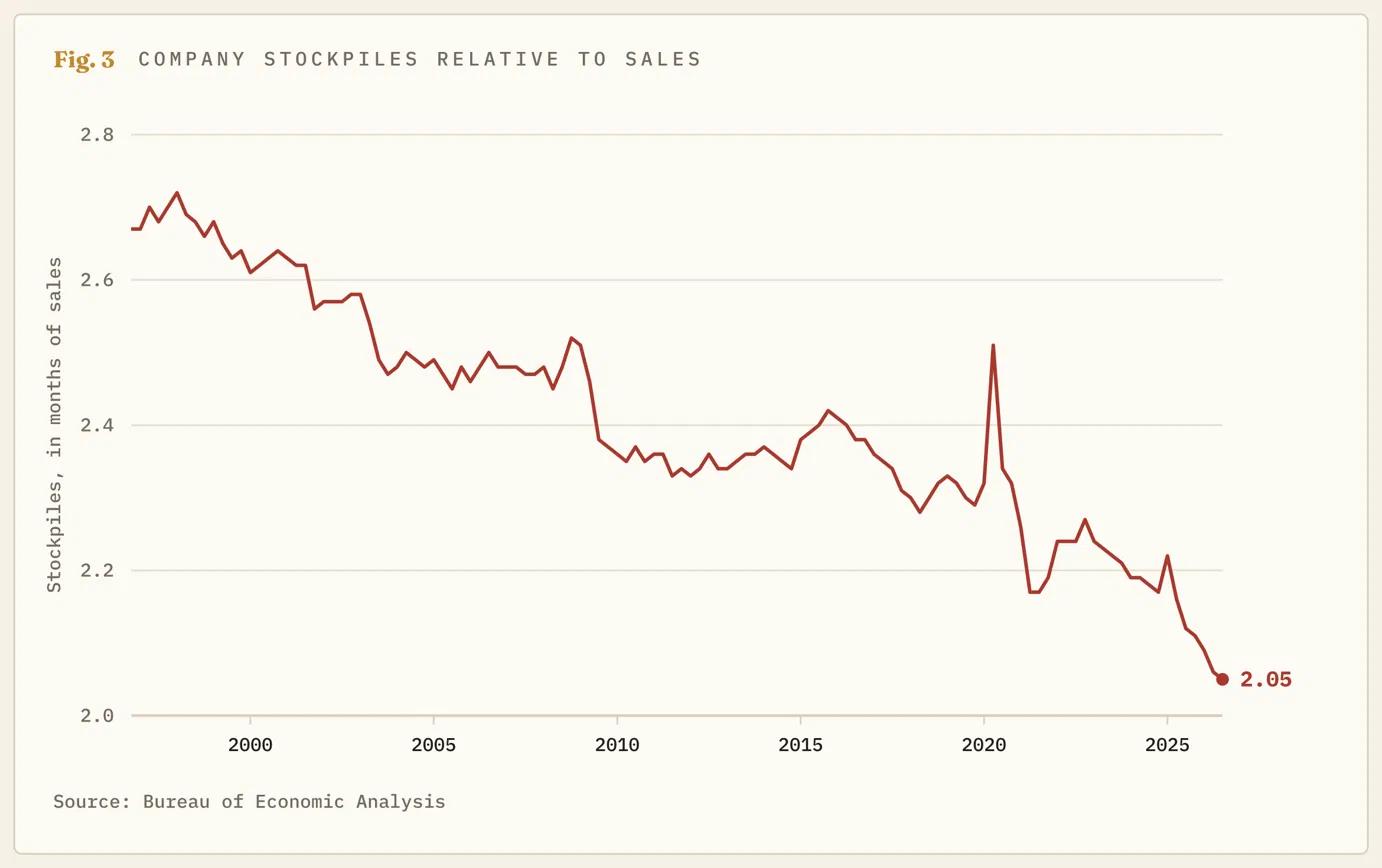
The best argument for the 4.3% is that the run-down had to stop and a rebuild may follow. Stockpiles now cover about two months of sales, the lowest in BEA figures that go back to 1996. Spending by households and businesses grew 5.8% in the quarter, its fastest since 2021, so companies would likely need more stock if that demand holds.
For that to lift growth, the demand has to reach American producers, and in the summer most of the increase went abroad. Imports rose 19.2% year over year, with computers and parts making up more than half of the rise. The largest build in stockpiles was at wholesalers of long-lasting goods, which is where imported equipment would likely sit before delivery.
So far, the fourth quarter hasn't supplied the pickup. Household spending after inflation was flat in October, and the Federal Reserve Bank of Atlanta's running estimate of fourth-quarter growth is 2.9%.
What the Fed is raising rates on
Traders expect the Fed to raise its rate by a quarter-point on December 9, to 4.00%-4.25%, and again by March. Inflation is the reason for both, but a 4.3% economy is what makes the second increase look affordable. An economy selling 2.6% more makes it a closer call.
The test is the first estimate of fourth-quarter GDP, due early in the new year. If the stockpile line adds little and final sales hold near 2.6%, growth would likely come in at 2%-3%, and the summer would read as the quarter the run-down ended. In that case, the lean is toward fewer Fed increases after December than traders now expect.
That reading breaks if final sales speed up toward 4%, or if companies start building stockpiles at several times the summer's pace because orders are coming in. Either outcome would mean the 4.3% was the start of a faster economy and the expected path for rates is right. Until one of them shows up, 4.3% is the growth rate of an economy that sold 2.6% more.
Author
Joshua Gibson
FXStreet
Joshua joins the FXStreet team as an Economics and Finance double major from Vancouver Island University with twelve years' experience as an independent trader focusing on technical analysis.