Tokyo inflation is forecast to jump to 3% with the Yen under 160.00
- USD/JPY dips to 159.00 on BoJ board member Tamura's speech and recovers.
- Tamura wants rates near 2% soon, but December BoJ hike odds are about 71%.
- Tokyo's November CPI is due Thursday, forecast at 3% after October's 2.6%.


Tokyo's November inflation figures are forecast to jump to 3% from 2.6%, and they arrive after a call for faster rate rises failed to move the Yen for long. USD/JPY dipped to about 159.00 on a speech by Bank of Japan (BoJ) board member Tamura and is back between 159.00 and 159.50, inside Wednesday's range. It hasn't traded above 160.00 since November 13.
BoJ board member Tamura said in Kofu on Thursday that he wants the rate at about 2% as soon as possible. It is 1.25% now, and at one quarter-point rise a quarter, the fastest the BoJ has gone, 2% would arrive in June 2027, a month before his term ends. Traders put a December rise at about 71%, and the Yen's gain on the speech was gone within the session.
The gain didn't last because the rate gap is on the Dollar's side. The Fed's rate is 3.75%-4.00% against Japan's 1.25%, and the Fed is expected to raise first, on December 9. Wednesday's US figures, with growth revised up to 4.3% and core inflation at 3.3%, left USD/JPY flat as well, since Finance Minister Katayama warned against one-sided moves when the pair last crossed 160.00.
On the calendar
Tokyo's November Consumer Price Index (CPI) is due at 23:30 GMT on Thursday. The measure excluding fresh food is forecast at 3% after 2.6%, and the one excluding food and energy at 3% after 2.4%. Both feed the BoJ's December 18 decision, the Japanese side of the rate gap.
Friday is a shortened US session with nothing on the data calendar, and Fed officials go quiet from Saturday. The December 9 Fed decision is priced above 90% for a quarter-point rise, which would take the US rate to 4.00%-4.25% nine days before the BoJ decides.
On the charts
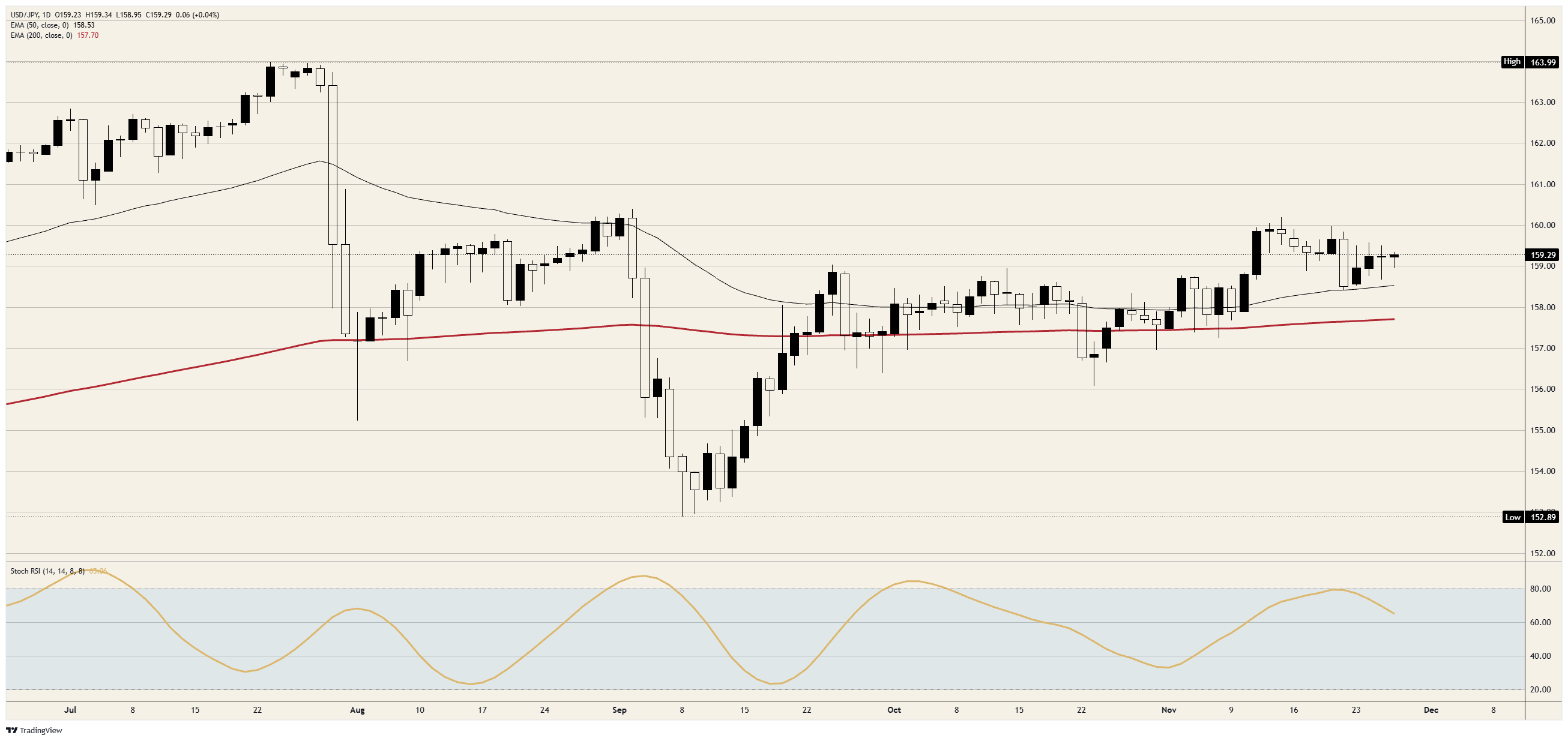
USD/JPY has recovered more than half of the drop from late July's high just under 164.00 to the September 8 low just under 153.00. Every daily close since November 10 has been above its 50-day Exponential Moving Average (EMA), near 158.50, and the 200-day is just under 158.00. Daily momentum has turned down from the edge of overbought.
USD/JPY daily chart
Japanese Yen FAQs
The Japanese Yen (JPY) is one of the world’s most traded currencies. Its value is broadly determined by the performance of the Japanese economy, but more specifically by the Bank of Japan’s policy, the differential between Japanese and US bond yields, or risk sentiment among traders, among other factors.
One of the Bank of Japan’s mandates is currency control, so its moves are key for the Yen. The BoJ has directly intervened in currency markets sometimes, generally to lower the value of the Yen, although it refrains from doing it often due to political concerns of its main trading partners. The BoJ ultra-loose monetary policy between 2013 and 2024 caused the Yen to depreciate against its main currency peers due to an increasing policy divergence between the Bank of Japan and other main central banks. More recently, the gradually unwinding of this ultra-loose policy has given some support to the Yen.
Over the last decade, the BoJ’s stance of sticking to ultra-loose monetary policy has led to a widening policy divergence with other central banks, particularly with the US Federal Reserve. This supported a widening of the differential between the 10-year US and Japanese bonds, which favored the US Dollar against the Japanese Yen. The BoJ decision in 2024 to gradually abandon the ultra-loose policy, coupled with interest-rate cuts in other major central banks, is narrowing this differential.
The Japanese Yen is often seen as a safe-haven investment. This means that in times of market stress, investors are more likely to put their money in the Japanese currency due to its supposed reliability and stability. Turbulent times are likely to strengthen the Yen’s value against other currencies seen as more risky to invest in.
Author
Joshua Gibson
FXStreet
Joshua joins the FXStreet team as an Economics and Finance double major from Vancouver Island University with twelve years' experience as an independent trader focusing on technical analysis.