Silver Price Forecast: XAG/USD recovers strongly as oil prices hit hardly
- Silver price rebounds strongly to near $50.35 as oil prices corrects further.
- Investors shift their focus to US mid-term elections and key US economic data.
- According to expectations, the probability of the Democrats taking the Senate at 72.0%.
Silver price (XAG/USD) is up 2.45% to near $50.35 in the European trade on Monday. The white metal bounces back strongly after hitting a fresh almost a year low of $48.86 on Friday, as oil prices have extended their correction.
As of writing, the WTI Oil price has corrected slightly below $100 from its five-month high of $104.03 posted on Friday.
Lower oil prices ease fears of acceleration in global inflationary pressures, a scenario that might diminish expectations of prolonged monetary tightening by central banks. Such a case bodes well for non-yielding assets, like Silver.
Oil prices come under pressure after signals from the United States (US) that it would prefer pursuing a diplomatic resolution with Iran than resuming military attacks.
Meanwhile, investors await US mid-term elections, and key US economic data, notably Nonfarm Payrolls (NFP), that could shape expectations for the Federal Reserve’s (Fed) monetary policy outlook.
US midterms set to reshape fiscal outlook as markets eye tight race for Congress
Strategists at Deutsche Bank note that, looking in more depth at the week ahead, “tomorrow’s midterms will determine control of Congress for the final two years of President Trump’s term.” They highlight that current polling “suggests Democrats are favoured to gain the three seats needed for a House majority, while the Senate remains a much closer contest,” with the final outcome in either chamber potentially taking “several days to become clear if the margins are tight.”
In terms of market-implied probabilities, Deutsche Bank point out that “Polymarket currently put the probability of the Democrats taking the Senate at 72.0%. Well renowned pollster Nate Silver currently suggests a 75% probability.”
From a near-term fiscal perspective, Deutsche Bank’s economists caution that “the lame-duck session after the election could prove at least as consequential as the composition of the new Congress,” with “government funding expiring on December 11 and Republicans likely to seek a reconciliation bill that could include additional defence spending and potentially address the debt limit.”
Silver Technical Analysis
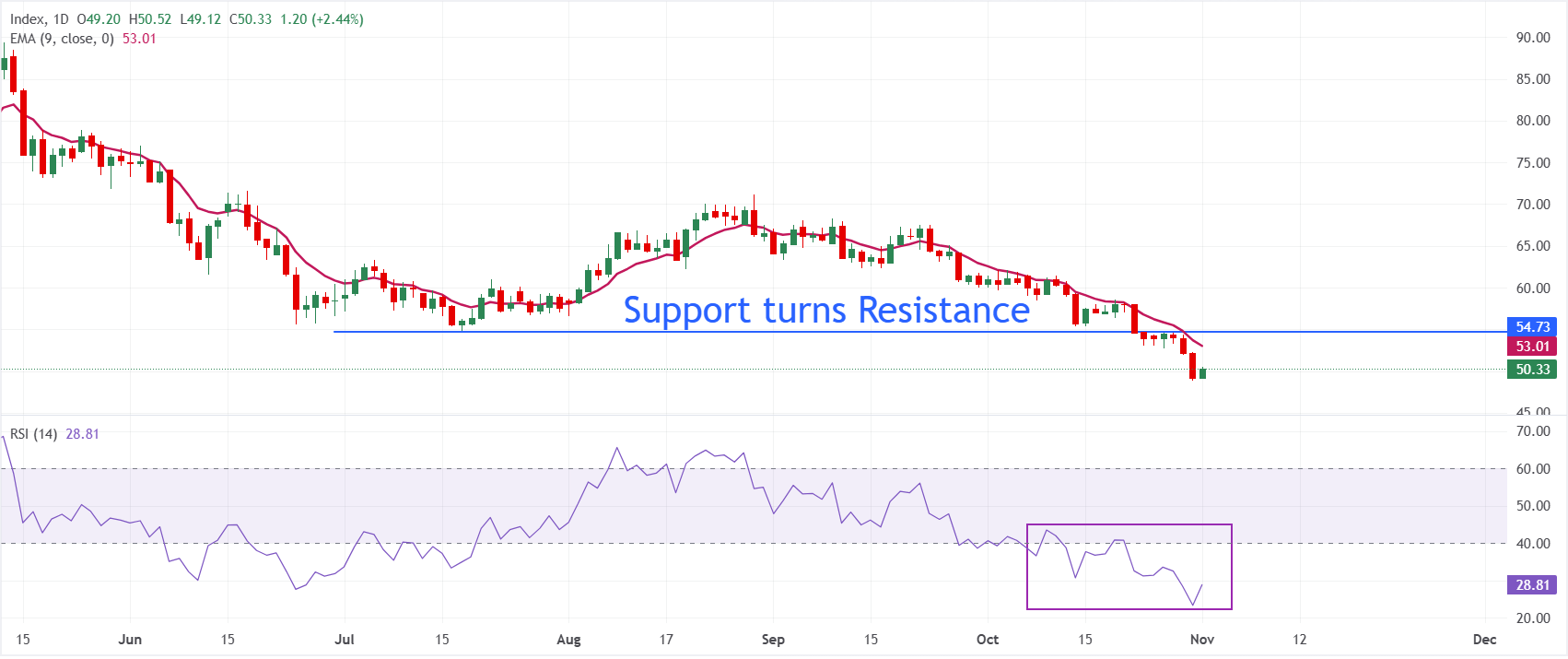
In the daily chart, XAG/USD trades at $50.35, extending a bearish near-term bias as price holds clearly beneath the 9-day Exponential Moving Average (EMA) at $53.02. The metal remains pressured by this overhead dynamic barrier, while the Relative Strength Index (RSI) at 28.90 sits in oversold territory, hinting that downside momentum is stretched but not yet decisively reversing.
On the topside, initial resistance is located at the 9-day EMA around $53.02, and a sustained break above this level would be needed to ease the current bearish tone. On the downside, while there is no nearby structural price floor in the dataset, the oversold RSI reading near 28.90 suggests that sellers could begin to lose conviction on further dips, potentially slowing the slide rather than establishing a clear support zone.
(The technical analysis of this story was written with the help of an AI tool. Know more.)
Silver FAQs
Silver is a precious metal highly traded among investors. It has been historically used as a store of value and a medium of exchange. Although less popular than Gold, traders may turn to Silver to diversify their investment portfolio, for its intrinsic value or as a potential hedge during high-inflation periods. Investors can buy physical Silver, in coins or in bars, or trade it through vehicles such as Exchange Traded Funds, which track its price on international markets.
Silver prices can move due to a wide range of factors. Geopolitical instability or fears of a deep recession can make Silver price escalate due to its safe-haven status, although to a lesser extent than Gold's. As a yieldless asset, Silver tends to rise with lower interest rates. Its moves also depend on how the US Dollar (USD) behaves as the asset is priced in dollars (XAG/USD). A strong Dollar tends to keep the price of Silver at bay, whereas a weaker Dollar is likely to propel prices up. Other factors such as investment demand, mining supply – Silver is much more abundant than Gold – and recycling rates can also affect prices.
Silver is widely used in industry, particularly in sectors such as electronics or solar energy, as it has one of the highest electric conductivity of all metals – more than Copper and Gold. A surge in demand can increase prices, while a decline tends to lower them. Dynamics in the US, Chinese and Indian economies can also contribute to price swings: for the US and particularly China, their big industrial sectors use Silver in various processes; in India, consumers’ demand for the precious metal for jewellery also plays a key role in setting prices.
Silver prices tend to follow Gold's moves. When Gold prices rise, Silver typically follows suit, as their status as safe-haven assets is similar. The Gold/Silver ratio, which shows the number of ounces of Silver needed to equal the value of one ounce of Gold, may help to determine the relative valuation between both metals. Some investors may consider a high ratio as an indicator that Silver is undervalued, or Gold is overvalued. On the contrary, a low ratio might suggest that Gold is undervalued relative to Silver.
Author

Sagar Dua
FXStreet
Sagar Dua is associated with the financial markets from his college days. Along with pursuing post-graduation in Commerce in 2014, he started his markets training with chart analysis.

















