Canadian Dollar jumps as Fed Chair Warsh says Fed hikes are working
- USD/CAD drops to a session low just above 1.4000 while Fed Chair Warsh speaks.
- The BoC raised to 2.50% the same day and says it may need to raise again.
- Statistics Canada reports August GDP Friday, a day after US GDP and PCE.
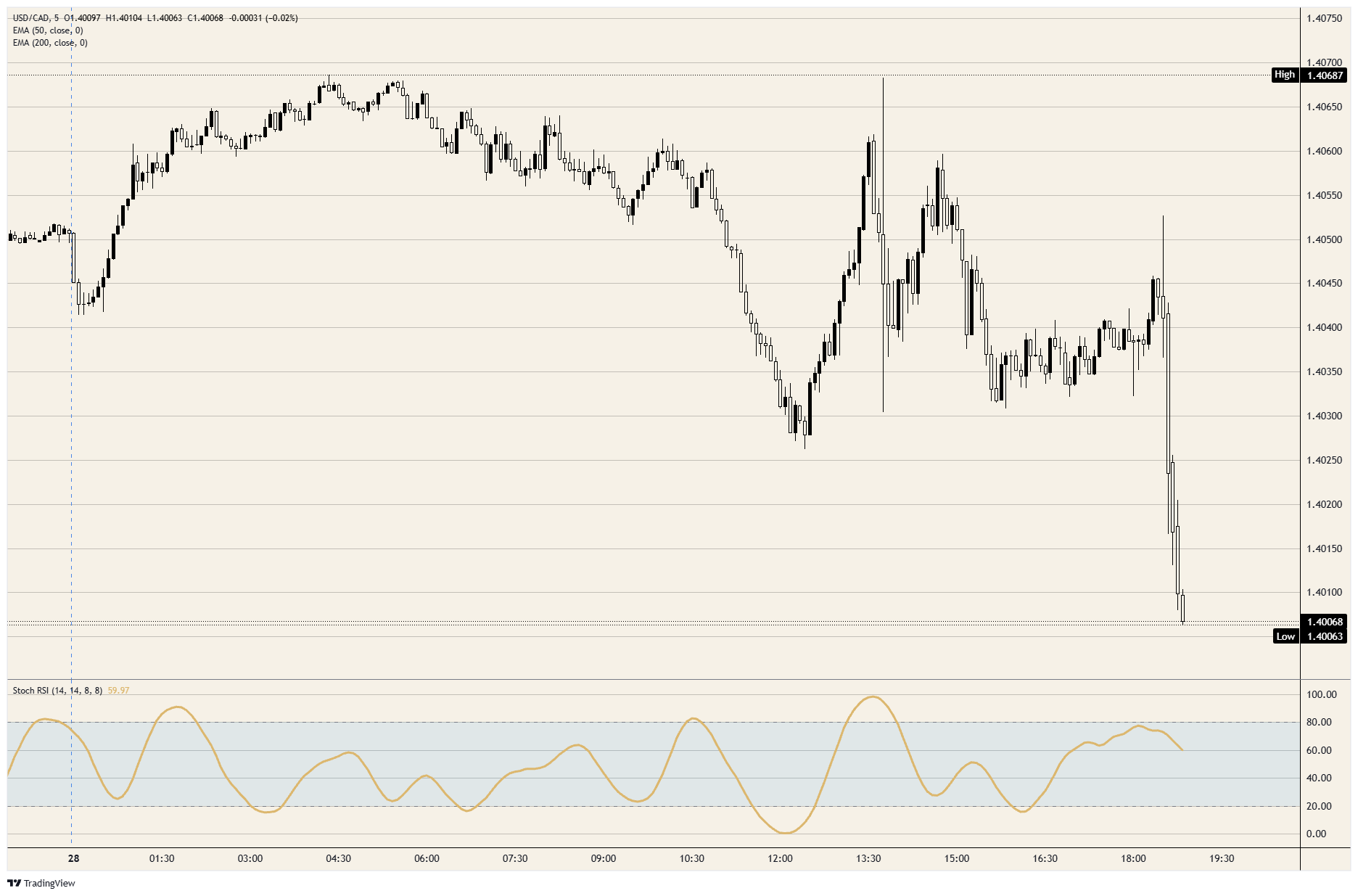
The low USD/CAD set before the BoC hike didn't survive Fed Chair Warsh's press conference. The pair fell from the top of its post-BoC range to just above 1.4000 in four five-minute bars as he spoke, its session low. It's still trading at that low.
Fed Chair Warsh said the Fed has shown its willingness to act and that the committee hasn't grown any easier. After Wednesday's two decisions, the Fed's lead over the Bank of Canada (BoC) is 1.25-1.50 points, and his answers focused on whether a December hike would widen it again.
BoC Governor Macklem said the 2.50% rate on the Canadian side of USD/CAD's gap doesn't hold back growth even after Wednesday's hike. Fed Chair Warsh said nearly all of his colleagues see the US side, at 3.75%-4.00%, starting to work.
On the calendar
Statistics Canada's August Gross Domestic Product (GDP) lands on Friday at 12:30 GMT, with the agency's own early estimate at a 0.2% rise. The BoC's next decision is on December 9, the same day as the Fed's.
On the US side, third-quarter GDP and September's Personal Consumption Expenditures Price Index (PCE) are out at 12:30 GMT on Thursday. Fed Chair Warsh said the upcoming data will help the Fed decide where it wants policy to be.
On the charts
Since the BoC release the pair had held a tight range in the lower half of Wednesday's trading, and the press-conference drop went straight through the bottom of it. USD/CAD started Wednesday near 1.4050, climbed to a high just shy of 1.4100 early in the session, and is now well below both.
USD/CAD 5-minute chart
Fed FAQs
Monetary policy in the US is shaped by the Federal Reserve (Fed). The Fed has two mandates: to achieve price stability and foster full employment. Its primary tool to achieve these goals is by adjusting interest rates. When prices are rising too quickly and inflation is above the Fed’s 2% target, it raises interest rates, increasing borrowing costs throughout the economy. This results in a stronger US Dollar (USD) as it makes the US a more attractive place for international investors to park their money. When inflation falls below 2% or the Unemployment Rate is too high, the Fed may lower interest rates to encourage borrowing, which weighs on the Greenback.
The Federal Reserve (Fed) holds eight policy meetings a year, where the Federal Open Market Committee (FOMC) assesses economic conditions and makes monetary policy decisions. The FOMC is attended by twelve Fed officials – the seven members of the Board of Governors, the president of the Federal Reserve Bank of New York, and four of the remaining eleven regional Reserve Bank presidents, who serve one-year terms on a rotating basis.
In extreme situations, the Federal Reserve may resort to a policy named Quantitative Easing (QE). QE is the process by which the Fed substantially increases the flow of credit in a stuck financial system. It is a non-standard policy measure used during crises or when inflation is extremely low. It was the Fed’s weapon of choice during the Great Financial Crisis in 2008. It involves the Fed printing more Dollars and using them to buy high grade bonds from financial institutions. QE usually weakens the US Dollar.
Quantitative tightening (QT) is the reverse process of QE, whereby the Federal Reserve stops buying bonds from financial institutions and does not reinvest the principal from the bonds it holds maturing, to purchase new bonds. It is usually positive for the value of the US Dollar.
Author

Joshua Gibson
FXStreet
Joshua joins the FXStreet team as an Economics and Finance double major from Vancouver Island University with twelve years' experience as an independent trader focusing on technical analysis.