AUD/USD Price Forecast: Hawkish remarks from RBA’s Hunter lift Australian Dollar
- AUD/USD rises to near 0.6943 as the Australian Dollar outperforms.
- RBA’s Hunter signals that the central bank is committed to bringing inflation back to the target.
- Investors await the FOMC Minutes and China’s CPI data for June.

The Australian Dollar (AUD) trades 0.23% higher to near 0.6943 against the US Dollar (USD) during the Asian trading session on Wednesday. The Aussie pair gains as the Australian Dollar outperforms its major currency peers, except the New Zealand Dollar (NZD), with the Reserve Bank of Australia (RBA) keeping the door open for further monetary policy tightening, if needed, to bring inflation back to the central bank’s target.
Australian Dollar Price Today
The table below shows the percentage change of Australian Dollar (AUD) against listed major currencies today. Australian Dollar was the strongest against the Japanese Yen.
| USD | EUR | GBP | JPY | CAD | AUD | NZD | CHF | |
|---|---|---|---|---|---|---|---|---|
| USD | -0.03% | 0.03% | 0.15% | -0.02% | -0.21% | -0.50% | 0.03% | |
| EUR | 0.03% | 0.05% | 0.17% | -0.00% | -0.18% | -0.49% | 0.05% | |
| GBP | -0.03% | -0.05% | 0.13% | -0.03% | -0.25% | -0.52% | -0.03% | |
| JPY | -0.15% | -0.17% | -0.13% | -0.18% | -0.34% | -0.65% | -0.15% | |
| CAD | 0.02% | 0.00% | 0.03% | 0.18% | -0.18% | -0.48% | 0.02% | |
| AUD | 0.21% | 0.18% | 0.25% | 0.34% | 0.18% | -0.30% | 0.18% | |
| NZD | 0.50% | 0.49% | 0.52% | 0.65% | 0.48% | 0.30% | 0.49% | |
| CHF | -0.03% | -0.05% | 0.03% | 0.15% | -0.02% | -0.18% | -0.49% |
The heat map shows percentage changes of major currencies against each other. The base currency is picked from the left column, while the quote currency is picked from the top row. For example, if you pick the Australian Dollar from the left column and move along the horizontal line to the US Dollar, the percentage change displayed in the box will represent AUD (base)/USD (quote).
This year, the RBA has already delivered three interest rate hikes of 25 basis points (bps) and has pushed the Official Cash Rate (OCR) to 4.35%.
Going forward, investors will focus on China’s Consumer Price Index (CPI) data for June, which will be released on Thursday.
Meanwhile, the US Dollar trades marginally lower ahead of the Federal Open Market Committee (FOMC) minutes of the June policy meeting, which will be published at 18:00 GMT. Investors will pay close attention to FOMC minutes to get fresh cues regarding the Federal Reserve’s (Fed) monetary policy outlook.
AUD/USD technical analysis
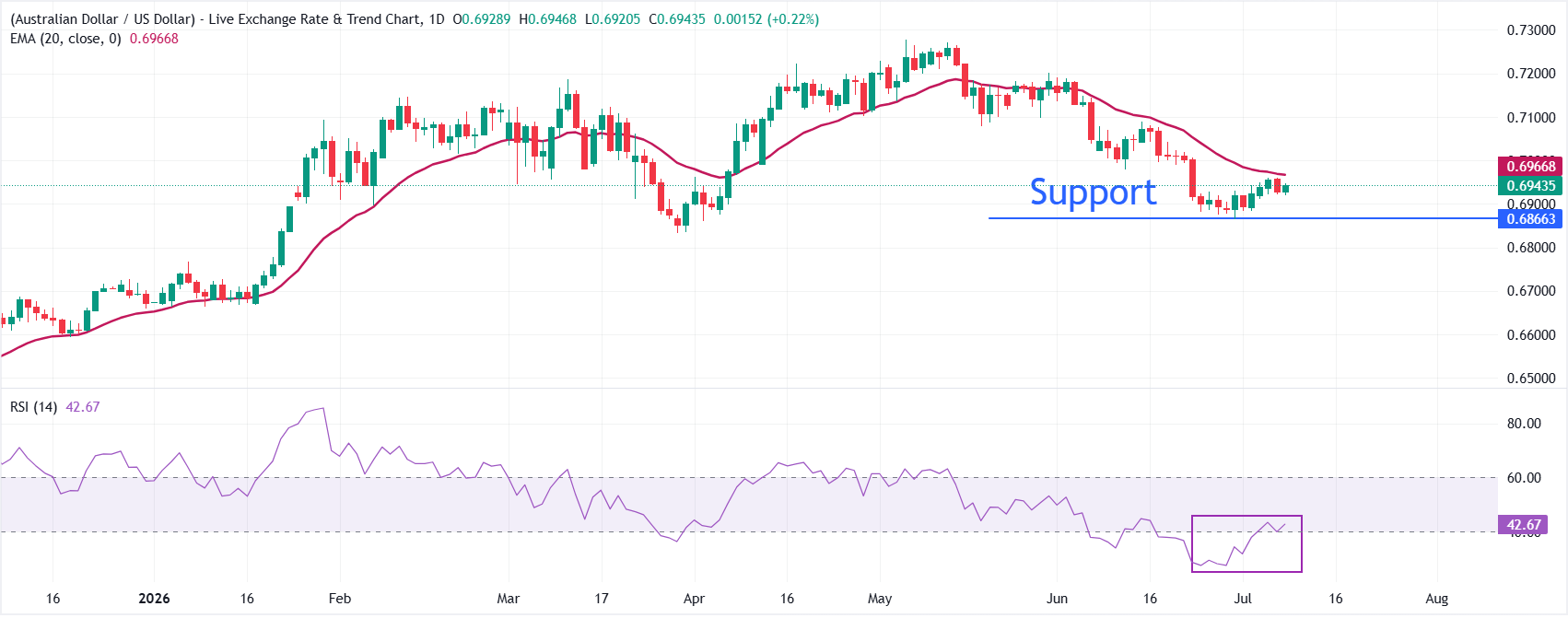
AUD/USD trades higher at around 0.6944 at press time. However, the near-term tone is mildly bearish as it holds below the 20-period exponential moving average (EMA), which is at 0.6967. The pair’s inability to reclaim this nearby EMA resistance suggests topside attempts remain capped, while the Relative Strength Index (RSI) at 42.75 stays below the midline, hinting at subdued but not extreme selling pressure.
On the topside, immediate resistance is clustered at the 20-period EMA at 0.6967, which needs to be overcome to shift the near-term bias toward recovery and open the way for a more sustained rebound. Looking down, the June 30 low at 0.6865 is the key support zone; a break below that would open further downside towards the March 30 low at 0.6833.
(The technical analysis of this story was written with the help of an AI tool. Know more.)
Australian Dollar FAQs
One of the most significant factors for the Australian Dollar (AUD) is the level of interest rates set by the Reserve Bank of Australia (RBA). Because Australia is a resource-rich country another key driver is the price of its biggest export, Iron Ore. The health of the Chinese economy, its largest trading partner, is a factor, as well as inflation in Australia, its growth rate and Trade Balance. Market sentiment – whether investors are taking on more risky assets (risk-on) or seeking safe-havens (risk-off) – is also a factor, with risk-on positive for AUD.
The Reserve Bank of Australia (RBA) influences the Australian Dollar (AUD) by setting the level of interest rates that Australian banks can lend to each other. This influences the level of interest rates in the economy as a whole. The main goal of the RBA is to maintain a stable inflation rate of 2-3% by adjusting interest rates up or down. Relatively high interest rates compared to other major central banks support the AUD, and the opposite for relatively low. The RBA can also use quantitative easing and tightening to influence credit conditions, with the former AUD-negative and the latter AUD-positive.
China is Australia’s largest trading partner so the health of the Chinese economy is a major influence on the value of the Australian Dollar (AUD). When the Chinese economy is doing well it purchases more raw materials, goods and services from Australia, lifting demand for the AUD, and pushing up its value. The opposite is the case when the Chinese economy is not growing as fast as expected. Positive or negative surprises in Chinese growth data, therefore, often have a direct impact on the Australian Dollar and its pairs.
Iron Ore is Australia’s largest export, accounting for $118 billion a year according to data from 2021, with China as its primary destination. The price of Iron Ore, therefore, can be a driver of the Australian Dollar. Generally, if the price of Iron Ore rises, AUD also goes up, as aggregate demand for the currency increases. The opposite is the case if the price of Iron Ore falls. Higher Iron Ore prices also tend to result in a greater likelihood of a positive Trade Balance for Australia, which is also positive of the AUD.
The Trade Balance, which is the difference between what a country earns from its exports versus what it pays for its imports, is another factor that can influence the value of the Australian Dollar. If Australia produces highly sought after exports, then its currency will gain in value purely from the surplus demand created from foreign buyers seeking to purchase its exports versus what it spends to purchase imports. Therefore, a positive net Trade Balance strengthens the AUD, with the opposite effect if the Trade Balance is negative.
Author

Sagar Dua
FXStreet
Sagar Dua is associated with the financial markets from his college days. Along with pursuing post-graduation in Commerce in 2014, he started his markets training with chart analysis.