AUD/USD Price Forecast: Gives back early gains as US Dollar rebounds
- AUD/USD gives up gains and flattens at around 0.6970.
- Investors await the US CPI and the Australian employment data for September.
- A surprise upside in the US CPI data could lift hawkish Fed expectations for the October meeting.

The Australian Dollar (AUD) surrenders its early gains and flattens at around 0.6970 against the US Dollar (USD) during the European trading session on Monday. The Aussie pair falls back as the US Dollar claws back its early losses with investors turning cautious ahead of the United States (US) Consumer Price Index (CPI) data for September scheduled for Wednesday.
As of writing, the US Dollar Index (DXY), which gauges the Greenback’s value against six major currencies, trades flat at around 102.20.
The US CPI data will likely influence Federal Reserve’s (Fed) interest rate expectations. Currently, the CME FedWatch tool shows traders are confident that the Fed will leave interest rates unchanged in the policy meeting later this month.
Analysts at MUFG/BTMU argue that, in the absence of a major upside surprise in the upcoming inflation data, the Fed is unlikely to shift policy at the next meeting. They state that “unless there is a significant upside surprise for underlying inflation, we expect the Fed to leave rates on hold this month,” reinforcing the market’s growing conviction that any further tightening is more likely to be pushed back rather than delivered immediately.
This week, the major trigger for the Australian Dollar will be the domestic employment data for September, which will be released on Thursday.
AUD/USD Technical Analysis
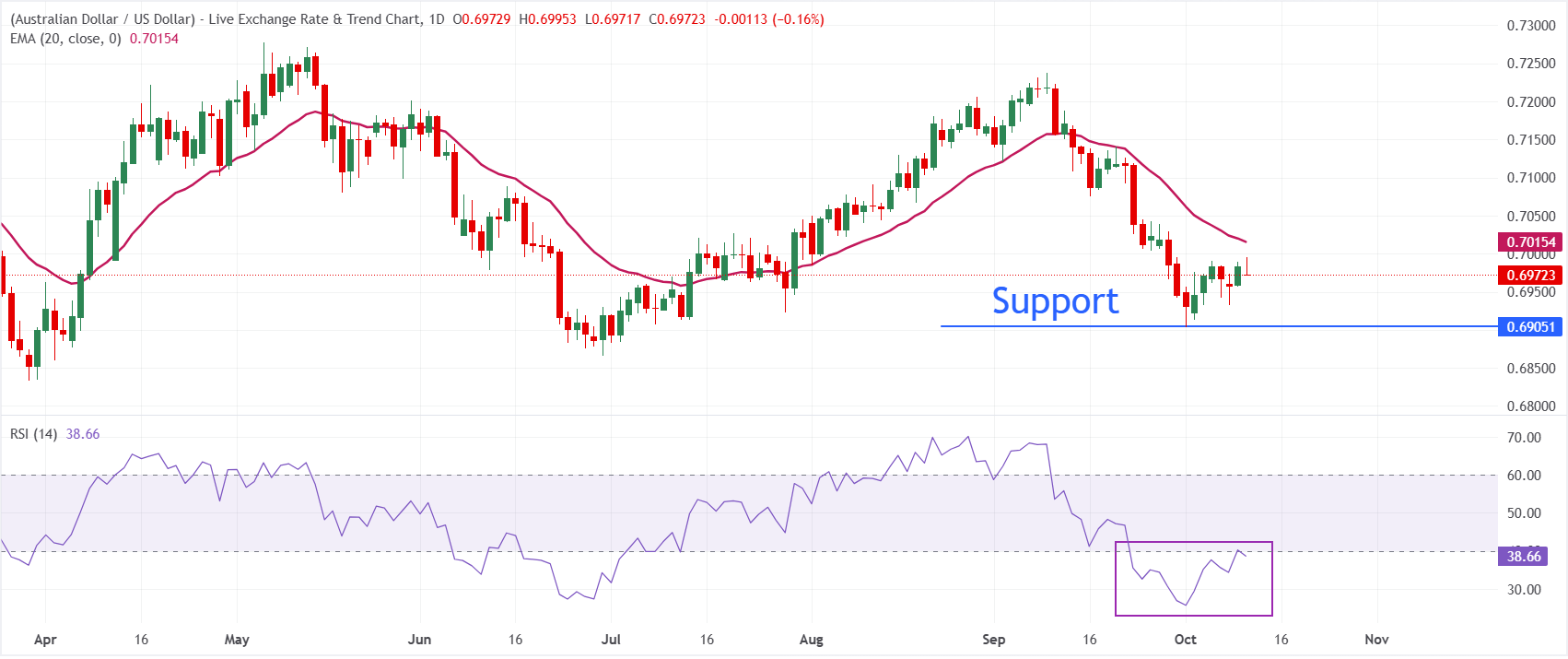
In the daily chart, AUD/USD trades at 0.6972, maintaining a bearish near-term bias as it holds beneath the 20-day exponential moving average (EMA) at 0.7015. The pair’s inability to reclaim this dynamic barrier suggests sellers retain control, while the Relative Strength Index (RSI) near 39 points to weak but not extreme downside momentum.
On the topside, the 20-day EMA at 0.7015 is the first resistance to beat for any meaningful recovery, with a sustained break above this hurdle needed to ease immediate bearish pressure. On the downside, key support levels are October 1 low near 0.6900 and June 30 low at 0.6865 respectively,.
(The technical analysis of this story was written with the help of an AI tool. Know more.)
Economic Indicator
Unemployment Rate s.a.
The Unemployment Rate, released by the Australian Bureau of Statistics, is the number of unemployed workers divided by the total civilian labor force, expressed as a percentage. If the rate increases, it indicates a lack of expansion within the Australian labor market and a weakness within the Australian economy. A decrease in the figure is seen as bullish for the Australian Dollar (AUD), while an increase is seen as bearish.
Read more.Next release: Thu Oct 15, 2026 00:30
Frequency: Monthly
Consensus: 4.6%
Previous: 4.6%
Source: Australian Bureau of Statistics
The Australian Bureau of Statistics (ABS) publishes an overview of trends in the Australian labour market, with unemployment rate a closely watched indicator. It is released about 15 days after the month end and throws light on the overall economic conditions, as it is highly correlated to consumer spending and inflation. Despite the lagging nature of the indicator, it affects the Reserve Bank of Australia’s (RBA) interest rate decisions, in turn, moving the Australian dollar. Upbeat figure tends to be AUD positive.
Author

Sagar Dua
FXStreet
Sagar Dua is associated with the financial markets from his college days. Along with pursuing post-graduation in Commerce in 2014, he started his markets training with chart analysis.

















