AUD/USD Price Forecast: Extends recovery to near 20-day EMA
- The Australian Dollar trades higher against its major currency peers.
- RBA minutes of the September meeting showed that officials are prepared for more hikes if needed.
- Investors await the US CPI data for September releasing at 12:30 GMT.

The Australian Dollar (AUD) outperforms its major currency peers on Wednesday, trading 0.3% higher at around 0.7010 against the US Dollar (USD) during the European session. The Australian currency trades higher as Reserve Bank of Australia (RBA) minutes of the September meeting showed that the central bank doesn’t hesitate to hike interest rates further this year.
Australian Dollar Price Today
The table below shows the percentage change of Australian Dollar (AUD) against listed major currencies today. Australian Dollar was the strongest against the Swiss Franc.
| USD | EUR | GBP | JPY | CAD | AUD | NZD | CHF | |
|---|---|---|---|---|---|---|---|---|
| USD | -0.01% | -0.05% | 0.03% | -0.02% | -0.33% | -0.15% | 0.04% | |
| EUR | 0.01% | -0.03% | 0.05% | -0.00% | -0.33% | -0.16% | 0.05% | |
| GBP | 0.05% | 0.03% | 0.08% | 0.00% | -0.28% | -0.12% | 0.09% | |
| JPY | -0.03% | -0.05% | -0.08% | -0.02% | -0.35% | -0.16% | 0.03% | |
| CAD | 0.02% | 0.00% | -0.01% | 0.02% | -0.31% | -0.14% | 0.06% | |
| AUD | 0.33% | 0.33% | 0.28% | 0.35% | 0.31% | 0.18% | 0.36% | |
| NZD | 0.15% | 0.16% | 0.12% | 0.16% | 0.14% | -0.18% | 0.20% | |
| CHF | -0.04% | -0.05% | -0.09% | -0.03% | -0.06% | -0.36% | -0.20% |
The heat map shows percentage changes of major currencies against each other. The base currency is picked from the left column, while the quote currency is picked from the top row. For example, if you pick the Australian Dollar from the left column and move along the horizontal line to the US Dollar, the percentage change displayed in the box will represent AUD (base)/USD (quote).
Aussie support underpinned as RBA minutes flag scope for further hikes and housing risks
Analysts at MUFG note that the key release overnight was the publication of the September RBA meeting minutes, when policymakers “raised the policy rate by 0.25 point to 4.60%.” The minutes “reinforced the message from the policy meeting that the RBA is prepared to hike rates further if required even though they have already lifted the policy rate by 100bps this year.”
At the same time, MUFG points out that “RBA officials displayed concern that the Australian Dollar could weaken going forward if overseas central banks played catch up by increasingly moving to raise rates which could add to upside risks in Australia.” The minutes also underline domestic vulnerabilities, with the RBA “wary of the risk that falling house prices could have a larger effect on household spending than assumed which could strength the case for keeping rates on hold in Australia.”
This week, the major trigger for the Australian Dollar will be the employment data on Thursday. The data is expected to show that the economy created 20K fresh jobs in September, lower than 39.5K in August. The Unemployment Rate is seen remaining steady at 4.6%.
Meanwhile, weakness in the US Dollar ahead of the United States (US) Consumer Price Index (CPI) data for September has also strengthened the Aussie pair.
According to estimates, the US headline inflation accelerated to 3.6% Year-on-Year (YoY) from 3.4% in August. The core CPI – which excludes volatile food and energy items – arrives at 2.5% YoY, higher than the previous reading of 2.4%.
AUD/USD Technical Analysis
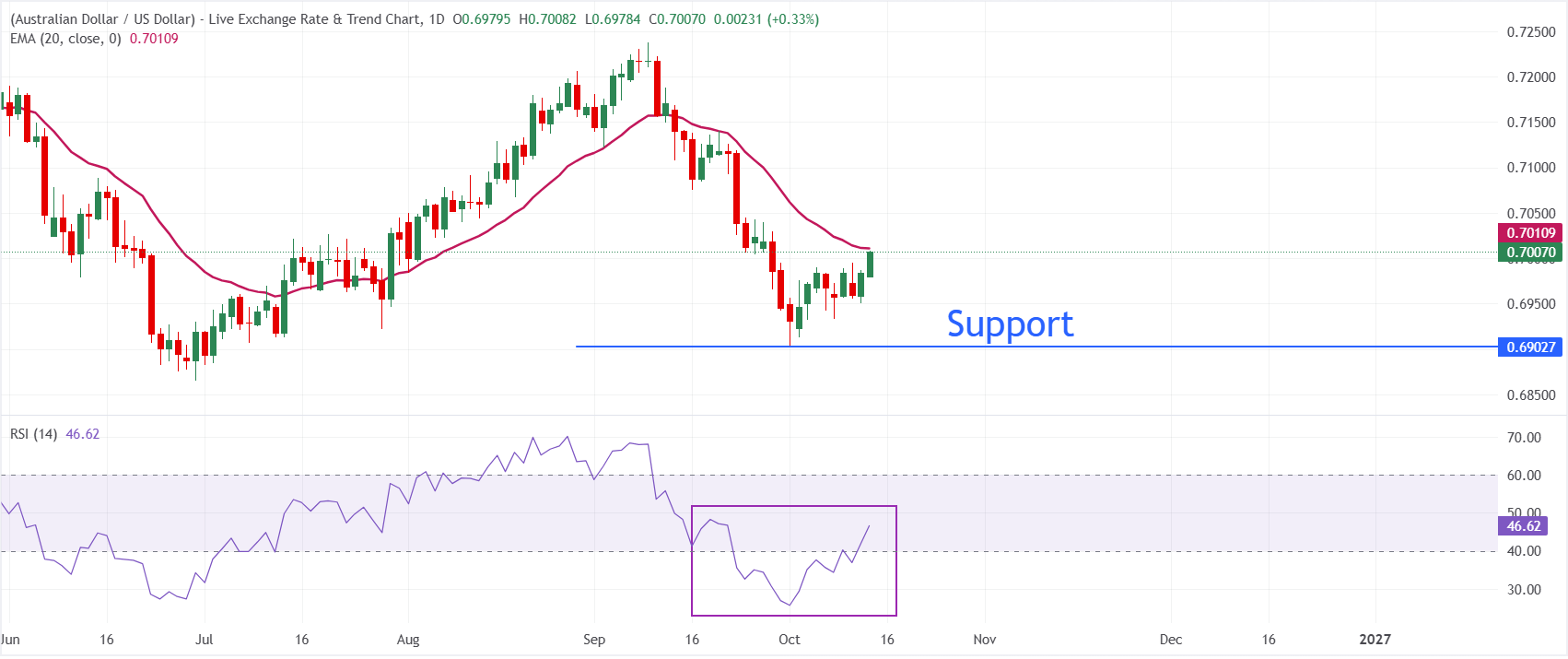
In the daily chart, AUD/USD trades at 0.7007. The pair has extended its recovery to near the 20-day Exponential Moving Average (EMA) at 0.7011. The pair has slipped back under this short-term trend gauge, suggesting rallies remain capped despite the Relative Strength Index (RSI) recovering toward a neutral 46 zone, which hints at moderating but still fragile downside momentum rather than a sustained bullish turn.
On the topside, immediate resistance is located at the 20-day EMA around 0.7011, where any recovery is likely to face initial supply and define the barrier that bulls must reclaim to alleviate the current pressure. On the downsie, the October 13 low at 0.6987 is the key support level. Below 0.6987, the October 1 low at 0.6904 would act as major support zone.
(The technical analysis of this story was written with the help of an AI tool. Know more.)
Economic Indicator
RBA Meeting Minutes
The minutes of the Reserve Bank of Australia meetings are published two weeks after the interest rate decision. The minutes give a full account of the policy discussion, including differences of view. They also record the votes of the individual members of the Committee. Generally speaking, if the RBA is hawkish about the inflationary outlook for the economy, then the markets see a higher possibility of a rate increase, and that is positive for the AUD.
Read more.Last release: Tue Oct 13, 2026 00:30
Frequency: Weekly
Actual: -
Consensus: -
Previous: -
Source: Reserve Bank of Australia
The Reserve Bank of Australia (RBA) publishes the minutes of its monetary policy meeting two weeks after the interest rate decision is announced. It provides a detailed record of the discussions held between the RBA’s board members on monetary policy and economic conditions that influenced their decision on adjusting interest rates and/or bond buys, significantly impacting the AUD. The minutes also reveal considerations on international economic developments and the exchange rate value.
Author

Sagar Dua
FXStreet
Sagar Dua is associated with the financial markets from his college days. Along with pursuing post-graduation in Commerce in 2014, he started his markets training with chart analysis.

















