British Pound gives back some early gains ahead of US CPI release
- The British Pound retreats from its day’s high to near 1.3260 against the US Dollar.
- Investors await the US CPI and the UK monthly GDP data.
- UK Chancellor Healey vows to fund cost-of-living support package through higher taxes or cut in spendings.

The British Pound (GBP) surrenders some of its early gains against the US Dollar (USD) on Wednesday, trading marginally higher at around 1.3260 during the European session. The GBP/USD pair retreats from its day’s high of 1.3274 as the US Dollar has recovered its early losses ahead of the United States (US) Consumer Price Index (CPI) data for September releasing at 12:30 GMT.
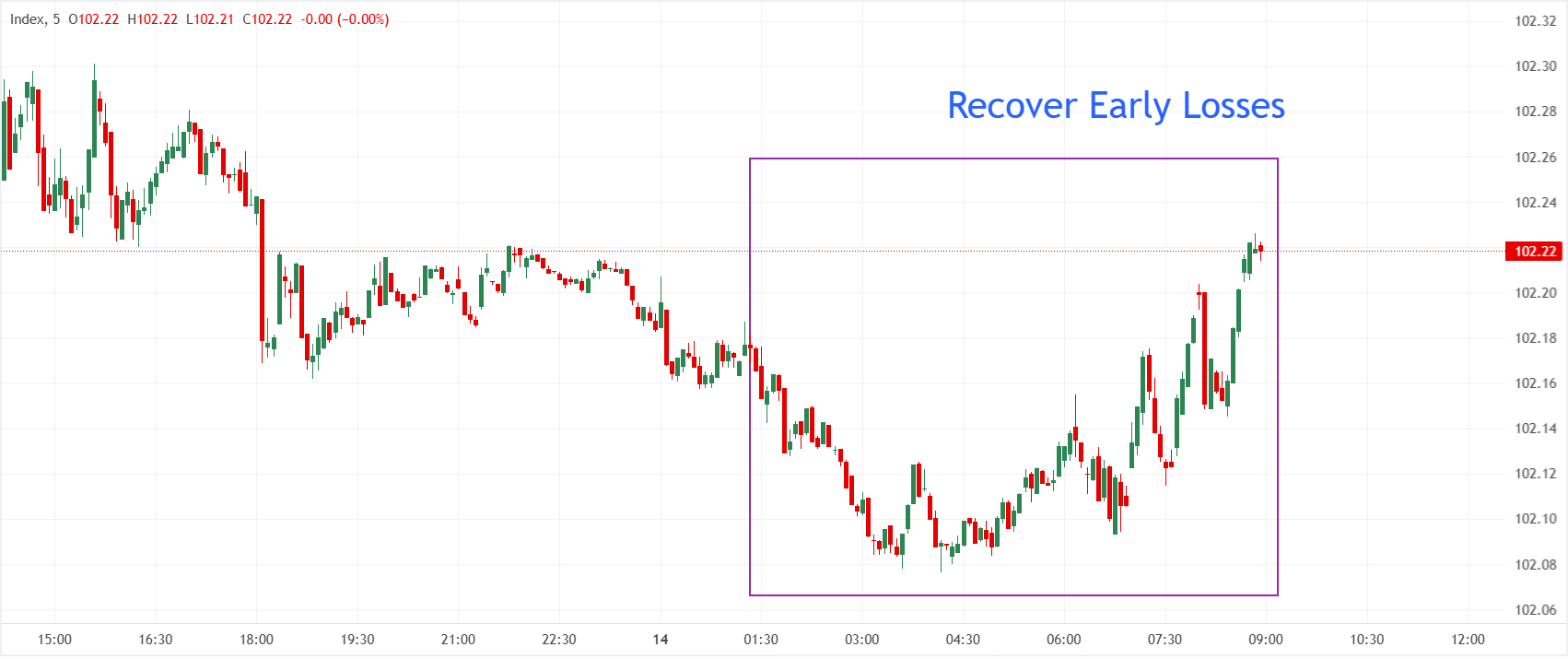
As of writing, the US Dollar Index (DXY), which gauges the Greenback’s value against six major currencies, trades flat at around 102.20 after clawing back early losses.
Analysts at Danske Bank expect a modest firming in the September data, forecasting “headline inflation at 0.5% m/m SA, 3.6% y/y (prior: 0.6% m/m, 3.4% y/y) and core inflation at 0.2% m/m SA, 2.5% y/y (prior: 0.3% m/m, 2.4% y/y), with energy prices being the main driver of the expected pickup in headline inflation.”
The inflation data is expected to influence Federal Reserve’s (Fed) interest rate expectations significantly. Currently, the CME FedWatch tool shows traders are confident that the Fed will leave interest rates unchanged in the policy meeting later this month and will deliver a hike in December.
On the British Pound front, United Kingdom (UK) Chancellor of the Exchequer John Healey pledges to fund cost-of-living support package through higher taxes or reductions in public spending rather than additional borrowing ahead of the budget announcement on October 28, Financial Times.
Going forward, the Pound Sterling will be influenced by the UK monthly Gross Domestic Product (GDP) data for August, which is scheduled for Thursday. The UK economy is expected to have contracted by 0.1% after expanding at a 0.4% pace in July.
GBP/USD Technical Analysis
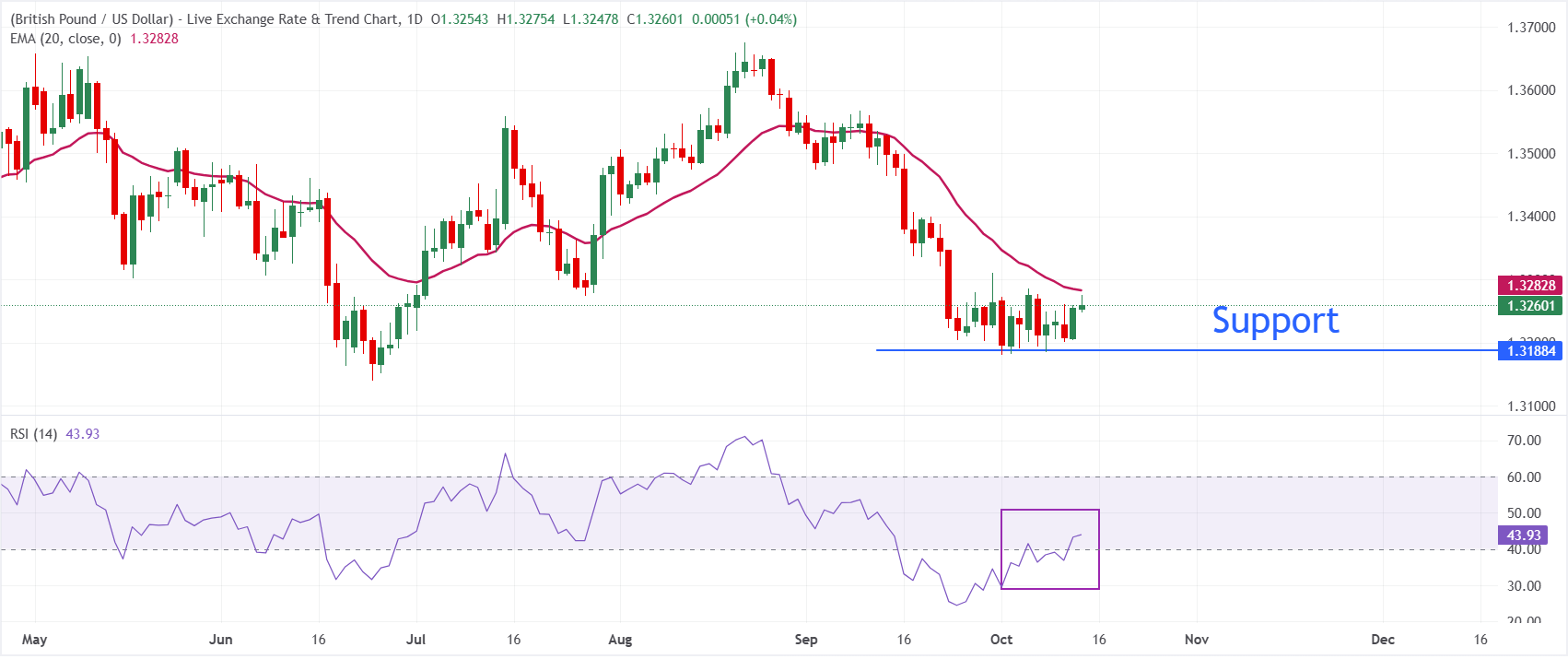
In the daily chart, GBP/USD trades at 1.3260, retaining a mildly bearish bias as spot holds beneath the 20-period exponential moving average (EMA) at 1.3283. The pair is attempting to stabilize after its recent slide, but price location below this short-term trend indicator suggests rallies remain capped for now, while the Relative Strength Index (14) around 43 hints at subdued bullish momentum rather than a decisive recovery.
On the topside, immediate resistance is defined by the 20-period EMA at 1.3283, which acts as the first barrier that bulls would need to reclaim to ease near-term downside pressure and open a path toward higher levels. With no clear technical support markers derived from the current dataset below spot, any further weakness would leave the pair relying on psychological round figures and prior swing lows, reinforcing the impression that sellers still have the structural advantage while price remains under the short-term EMA.
(The technical analysis of this story was written with the help of an AI tool. Know more.)
Economic Indicator
Gross Domestic Product (MoM)
The Gross Domestic Product (GDP), released by the Office for National Statistics on a monthly and quarterly basis, is a measure of the total value of all goods and services produced in the UK during a given period. The GDP is considered as the main measure of UK economic activity. The MoM reading compares economic activity in the reference month to the previous month. Generally, a rise in this indicator is bullish for the Pound Sterling (GBP), while a low reading is seen as bearish.
Read more.Next release: Thu Oct 15, 2026 06:00
Frequency: Monthly
Consensus: -0.1%
Previous: 0.4%
Source: Office for National Statistics
Author

Sagar Dua
FXStreet
Sagar Dua is associated with the financial markets from his college days. Along with pursuing post-graduation in Commerce in 2014, he started his markets training with chart analysis.

















