The most expensive 20 minutes in trading happen right after a loss
Ask most traders where their account really bleeds and they'll point to the losing trades. The stop-outs, the red days, the drawdowns. But if you go back through a detailed trading log and tag every genuinely bad decision — not every loss, but every decision you knew was wrong as you made it: the moved stop, the revenge entry, the doubled size, the winner closed early out of fear — a pattern emerges that surprises almost everyone who runs the exercise.
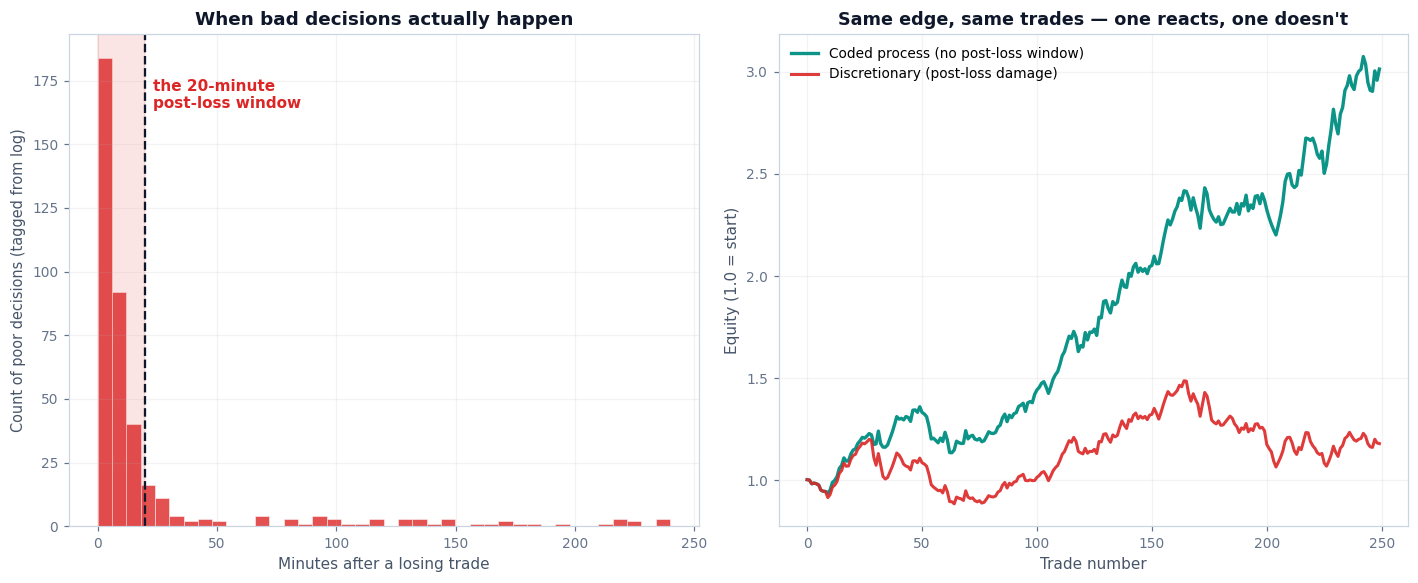
Those decisions don't scatter randomly across the years. They cluster, brutally, in the minutes right after a losing trade.
The loss was never the problem. A loss is a line item — sized in advance, expected, part of any process that takes risk. The problem is the second trade. The one taken angry, bigger than usual, without a real setup, because a loss lights something up in the human brain that demands to fix it immediately. That trade isn't trading. It's emotional first aid with a position attached.
The post-loss window
There's a reason this window is so dangerous, and it isn't a lack of knowledge. Every trader who revenge-trades knows, intellectually, that revenge-trading is a mistake. The knowledge is present. It simply isn't accessible at the moment it's needed.
The state a trader is in twenty seconds after a painful stop-out is not the state they were in when they wrote their trading plan on a calm Sunday evening. Cortisol is up. The prefrontal, deliberate part of decision-making is quieter; the reactive part is louder. The trader who most needs the rule is, at that exact moment, the trader least equipped to follow it. The tilted trader at 10:07 doesn't consult the calm trader from the weekend.
This is why the standard advice fails. "Be more disciplined." "Breathe." "Journal about it." All of it assumes the calm version of the trader is the one making the post-loss decision. He isn't. The version of you that needs the rule is never the version of you reading it.
Why willpower is the wrong tool
Discipline, framed as effort, is a finite resource that gets weakest precisely when volatility and losses make demands on it. Relying on willpower to survive the post-loss window is like relying on a stronger grip to hold a rope that gets more slippery the harder you're pulled. The tool degrades under the exact conditions it's needed.
Traders who eventually solve this tend to stop trying to fix the human, and instead remove the human from the decision.
The structural answer
A rules-based, pre-defined process doesn't experience a post-loss window, because it has no memory of the previous trade's emotional weight. Entries, stops, position sizing, and exits are decided before the session and executed to specification. The trade taken after a loss is generated by exactly the same logic as the trade taken after a win — because nothing in the process knows, or cares, which came before.
That's the part that takes longest to appreciate. A systematic approach doesn't take a loss and then "try harder" or "stay calm." It takes the loss the way it takes a win: as one outcome inside a distribution it already expected. There's no anger to manage because there's no agent present to feel it. The sequence of trades that used to be a minefield — loss, tilt, revenge, deeper loss — simply cannot form, because the reactive link in the chain has been removed.
The trader still exists. On a discretionary book, the tilted version shows up at 10:07 every time there's a loss to react to. Under a coded process, he still exists too — he just doesn't get a vote. The setup was decided when he wasn't in the room, and it executes whether he approves or not.
The hidden dividend
There's a second effect, quieter than the first and easy to miss. Removing the post-loss decision doesn't only remove the damage it caused — it removes the exhaustion.
The hours a discretionary trader spends recovering emotionally from red trades, replaying them, sitting with the frustration, talking themselves back to baseline — those hours are a real cost, even though they never show up on an equity curve. When the reactive trade is designed out of the process, that recovery time simply comes back. The account stops bleeding in the post-loss window, and the trader stops bleeding hours into it.
For traders on funded and prop accounts, this compounds in a specific way. A trailing drawdown limit is unforgiving of exactly the kind of oversized, unplanned trade that the post-loss window produces. One revenge entry at double size, in the wrong direction, can convert a normal red day into a blown evaluation. The structural fix isn't just psychological hygiene in that context — it's the difference between a survivable loss and an account-ending one.
The takeaway
If your worst trades cluster after your losses, the problem isn't your strategy. It's the twenty minutes of human reaction that follow a loss — a window where the trader who needs the rule and the trader capable of following it are two different people.
That's not a discipline problem to be willed away. It's a structural problem, and structural problems have structural answers: decide the next trade before the loss happens, and take the deciding out of the hands of the person the loss just rattled.
Author

Puravida Edge Analysis Team
Puravida Edge
The Puravida Edge Analysis Team researches systematic trading approaches for prop firm and funded traders, with a focus on volatility-based position sizing, drawdown control, and Monte Carlo risk modeling across futures and forex markets.