USD/JPY Forecast and News
Japanese pay grew faster than forecast in August and the Yen weakened anyway. USD/JPY trades near 158.00, back where it was before the release took it to its highest since September 25.
Technical Analysis
On the daily chart, USD/JPY holds just above the 50-day Simple Moving Average (SMA) at 157.70, but remains capped beneath the 200-day SMA at 158.53 and the 100-day SMA at 159.53, keeping the near-term bias bearish despite a modestly constructive tone in momentum. The Relative Strength Index (RSI) around 54 suggests recovering upside pressure, while the Moving Average Convergence Divergence (MACD) stays in positive territory, hinting at fading downside but not yet overcoming the overhead supply defined by the medium- and long-term averages.
On the topside, initial resistance is located at the 200-day SMA at 158.53, followed by the 100-day SMA near 159.53, with a stronger cap at the horizontal barrier of 160. On the downside, immediate support aligns with the 50-day SMA at 157.70, ahead of the 157 horizontal floor. deeper retreats would expose the next supports at 155 and 153.
(The technical analysis of this story was written with the help of an AI tool. Know more.)
Fundamental Analysis
| Time | Event | Impact | Actual | Consensus | Previous |
|---|
Nominal pay rose 3.8% YoY against a 3.7% forecast, but that was down from July, and real wage growth slowed for a second month to 1.5%. The same release revised July down to 4.3% from 4.7%, a cut four times the size of the beat.
Pay running ahead of prices is the case the Bank of Japan (BoJ) makes for further hikes, and a slowing trend did nothing to bring the next one forward. That leaves USD/JPY following the Dollar side of the pair for most of October.
Tokyo calls the Yen undervalued and promises a tax cut
Prime Minister Takaichi told parliament on Tuesday she will cut the consumption tax on food without issuing new bonds. The 10-year Japanese government bond yield held near 3.11% on Wednesday, close to its highest in three decades. Yields that rise on budget worries rather than rate expectations can weaken a currency instead of lifting it.
Finance Minister Katayama and US Treasury Secretary Bessent called the Yen's undervaluation a concern in late September. Wednesday's Federal Open Market Committee (FOMC) minutes recorded the New York Fed's currency intervention for the Treasury, the yen purchase made alongside Japan on July 31 with USD/JPY just under 164.00. Undervalued is the word two finance ministries use for a currency they have already spent money on once.
A BoJ quarter-point is a tenth of the gap it would narrow
The BoJ's rate is 1.25% after the September 18 hike, against the Fed's 3.75%-4.00%, and futures give the BoJ about 71% odds of another move by December. The Fed on October 28 and the BoJ on October 30 carry the same odds of a hike, near 17%.
Friday's University of Michigan (UoM) survey at 14:00 GMT includes US households' one-year inflation expectations, 4.6% last month. A higher reading would add to Fed hike bets and lift USD/JPY with them.
Yen levels around the moving averages
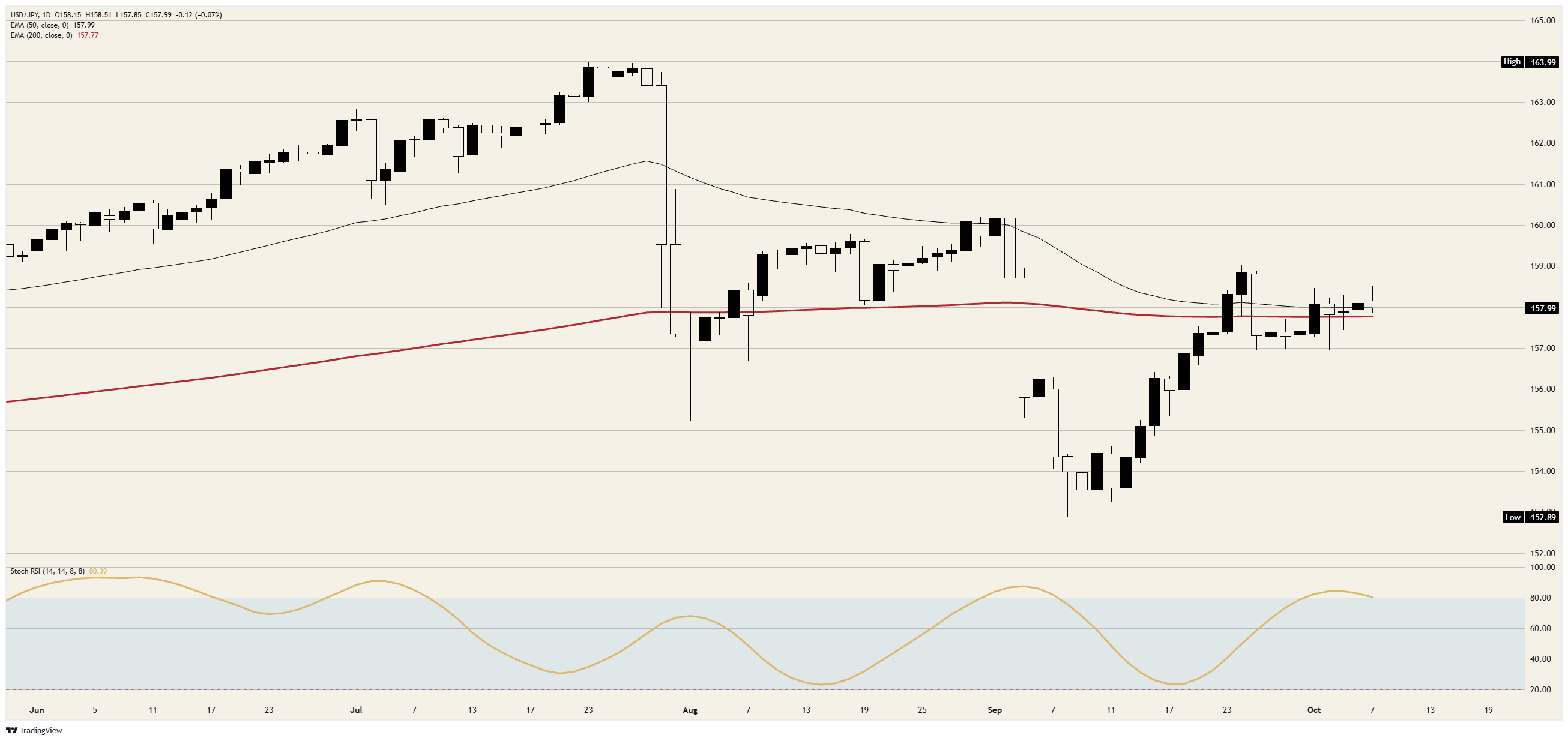
Resistance: Wednesday's high, just above 158.50, was the highest since September 25 and faded within the session. 159.00 stopped the September rebound on September 24.
Support: The 200-day Exponential Moving Average (EMA), just under 158.00, has been below every daily close since October 1. Monday's low, just under 157.50, is the line the long rests on.
Bias: The lean stays long while 157.50 holds on a closing basis, with 158.50, touched by a pip on Wednesday, still the first objective and 159.00 the second. The Stochastic Relative Strength Index (Stoch RSI) on the daily chart has turned down from about 85 to near 80, so a dip toward 157.50 would fit the call. A daily close below 157.00 takes the long off.
USD/JPY daily chart
About USD/JPY
The USD/JPY (US Dollar Japanese Yen) currency pair is one of the 'Majors', a group of the most important currency pairs in the world. The Japanese Yen, known for its low interest rate, is frequently used in carry trades, making it one of the most traded currencies worldwide. In the USD/JPY pair, the US Dollar is the base currency and the Japanese Yen serves as the counter currency.
Trading USD/JPY is also known as trading the "ninja" or the "gopher", although the latter nickname is more frequently associated with the GBP/JPY pair. USD/JPY usually has a positive correlation with other pairs like USD/CHF and USD/CAD, as all three use the US Dollar as the base currency. The value of the pair is often influenced by interest-rate differentials between the two central banks: the Federal Reserve (Fed) and the Bank of Japan (BoJ).
Related pairs
GBP/USD
The GBP/USD (or Pound Dollar) currency pair belongs to the group of 'Majors', referring to the most important and widely traded pairs in the world. The pair is also known as "the Cable", a term originating in the mid-19th century that refers to the first transatlantic telegraph connecting Great Britain and the United States. As a closely watched and widely traded currency pair, it features the British Pound as the base currency and the US Dollar as the counter currency. For that reason, macroeconomic data from both the United States and the United Kingdom significantly impacts its price. One notable event that affected the volatility of the pair was Brexit.
EUR/USD
The EUR/USD (or Euro Dollar) currency pair belongs to the group of 'Majors', a term used t o describe the most important currency pairs in the world. This group also includes GBP/USD, USD/JPY, AUD/USD, USD/CHF, NZD/USD and USD/CAD. The popularity of the Euro Dollar pair stems from its representation of two of the world's largest economies: the Eurozone and the United States.
The EUR/USD is one of the most widely traded currency pairs in the Forex market, where the Euro serves as the base currency and the US Dollar as the counter currency. It accounts for more than half of the total trading volume in the Forex market, making gaps almost inexistent, let alone sudden reversals caused by breakaway gaps.
The EUR/USD is usually quiet during the Asian session, as economic data influencing the pair is usually released during the European or US sessions. Activity increases as European traders begin their day, leading to heightened trading volume. This activity slows around midday during the European lunch break but picks up again when US markets come online.
Influential Institutions & People for the USD/JPY
The US Dollar Japanese Yen can be seriously affected by news or the decisions taken by two main central banks:
The Federal Reserve (Fed)
The Federal Reserve (Fed) is the central bank of the United States (US) and it has two main targets: to maintain the unemployment rate at its lowest possible levels and to keep inflation around 2%. The Federal Reserve System's structure is composed of the presidentially appointed Board of Governors and the partially appointed Federal Open Market Committee (FOMC). The FOMC organizes eight scheduled meetings in a year to review economic and financial conditions. It also determines the appropriate stance of monetary policy and assesses the risks to its long-run goals of price stability and sustainable economic growth. The FOMC Minutes, which are released by the Board of Governors of the Federal Reserve weeks after the latest meeting, are a guide to the future US interest-rate policy.
Fed official website, on X and Facebook
The Bank of Japan (BOJ)
The Bank of Japan (BoJ) is the central bank of Japan. Established under the Bank of Japan Act in 1882, it is a juridical entity and neither a government agency nor a private corporation. The BoJ sets monetary policy in the country. Its mandate is to issue banknotes and carry out currency and monetary control to ensure price stability, which means an inflation target of around 2%.
Policy Board: The Policy Board is the bank's highest decision-making body. It determines the guidelines for currency and monetary control, sets the basic principles for carrying out the bank's operations and oversees the performance of the bank's officers, excluding auditors and counselors.
History: The Bank of Japan was established under the Bank of Japan Act, promulgated in June 1882, and began operating as the nation's central bank on October 10, 1882. It was reorganized in 1942 under the Bank of Japan Act of 1942, which reflected the wartime context. The Act of 1942 was amended several times after World War II, and the establishment of the Policy Board as the bank's highest decision-making body occurred in June 1949. In June 1997, the Act of 1942 was revised completely under the principles of independence and transparency. The revised Act came into effect on April 1, 1998.
The official website, on X and YouTube
Kevin Warsh
Kevin Warsh took office as chairman of the Board of Governors of the Federal Reserve in May 2026, for a four-year term ending in 2030. His term as a member of the Board of Governors will expire in May 2040. Warsh, born in Albany (New York) on April 13, 1970, is an American financier and attorney who already served as a member of the Fed Board of Governors from 2006 to 2011 and was significantly involved in the central bank's response to the financial crisis. Before that, he served as a special assistant to the president for economic policy and the executive secretary of the National Economic Council under President George W. Bush.
Kazuo Ueda
Kazuo Ueda was born in Makinohara, Japan, on September 20, 1951. He is the 32nd and current Governor of the BoJ. He graduated from the University of Tokyo with a Bachelor of Science and Mathematics and received a PhD in economics from the Massachusetts Institute of Technology (MIT).
He is a professor emeritus at the University of Tokyo and also worked as a professor at Kyoritsu Women's University. In February 2023, former Prime Minister Fumio Kishida nominated Ueda as the governor of the BoJ. He is widely regarded as an expert on monetary policy but was considered a surprise appointment by analysts. He wasn't even considered a dark-horse candidate, as the BoJ governor role has traditionally gone to long-serving Finance Ministry bureaucrats or central bank officials. Ueda is the first academic economist to lead the BoJ in the post-World War II era.