Ripple expands in Brazil as XRP holds steady despite geopolitical volatility
- XRP holds modest weekly gains above $1.52 despite the Middle East war-driven volatility across global markets.
- Ripple announced the expansion of its payment offerings in Brazil and is preparing to apply for a Virtual Asset Service Provider license.
- XRP experiences mild inflows into ETFs following eight consecutive days of muted activity.

Ripple (XRP) hovers above $1.52 at the time of writing on Wednesday, as cryptocurrency prices steady despite the ongoing war in the Middle East. The remittance token is showing an improving technical outlook, holding onto weekly gains from the opening of $1.45.
Despite the steady price increase, higher support remains key to sustaining XRP’s recovery, with the short-term target around $1.70 and the medium-term target at roughly $1.95.
Ripple expands payments offerings in Brazil
Ripple announced on Tuesday that it is deepening its footprint in Brazil to accelerate institutional adoption. The endeavour will ride on new product capabilities spanning cross-border payments, digital asset custody services, prime brokerage, and treasury management.
The blockchain company added that it plans to apply for a Virtual Asset Service Provider (VASP) license under the country’s new regulatory framework, issued by the Central Bank of Brazil (BCB).
The Ripple Payments service has processed over $100 billion in global cross-border transfer volume spanning over 60 markets. Ripple stated that the platform “is the end-to-end solution for moving money across borders – giving institutions a faster, more transparent way to send, receive, and settle funds in both fiat and stablecoins.”
Institutional interest returns as retail demand cools
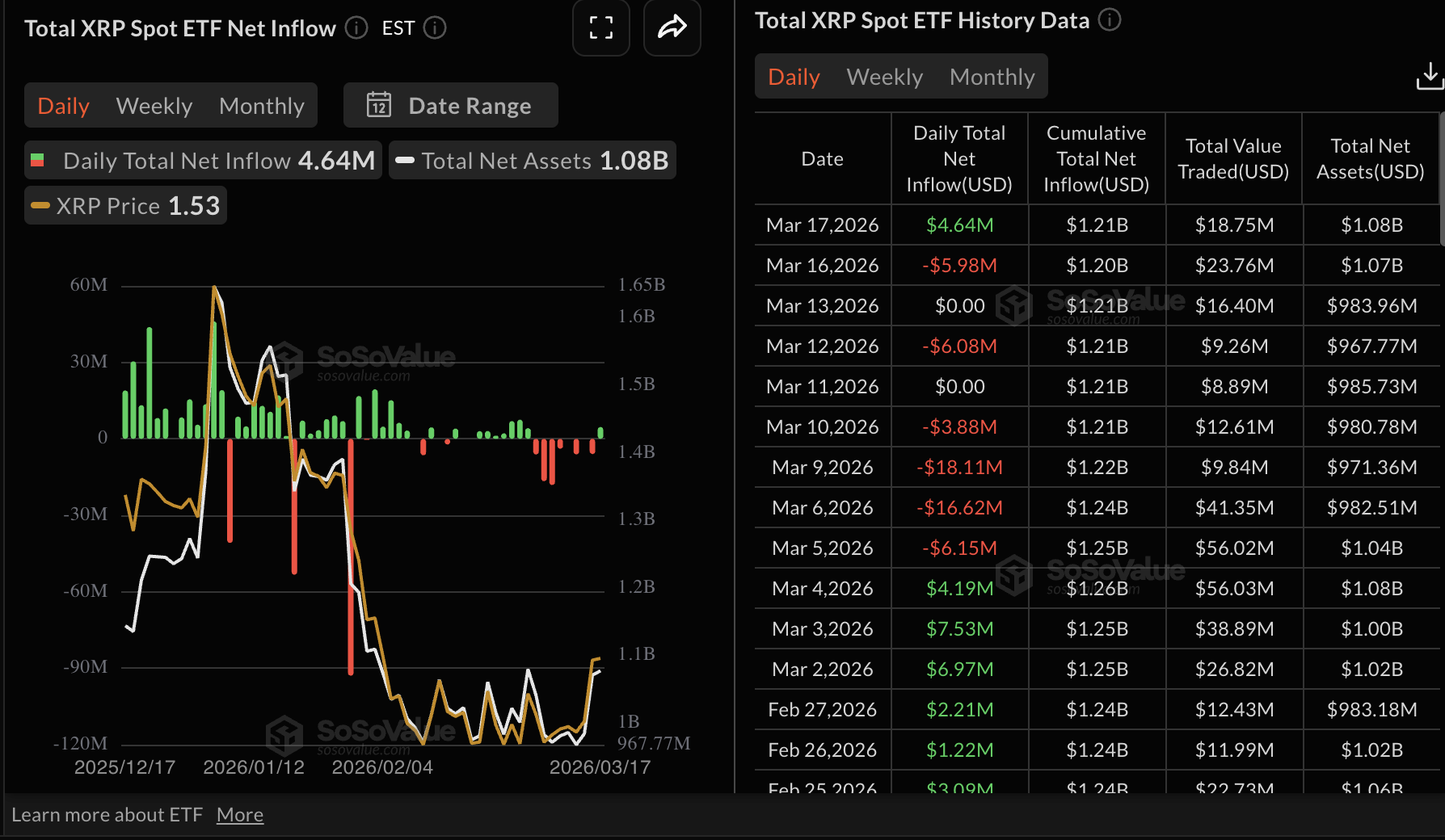
XRP spot Exchange-Traded Funds (ETFs) saw a resurgence of inflows on Tuesday, following eight days of muted activity. According to SoSoValue data, inflows totalled $4.6 million, marking a significant improvement from the nearly $6 million of outflows recorded on Monday.
Cumulative inflows have increased slightly to $1.21 billion while net assets under management total $1.08 billion. Nevertheless, steady inflows are required to reinforce positive market sentiment. Therefore, traders need to temper their expectations until a trend is established.
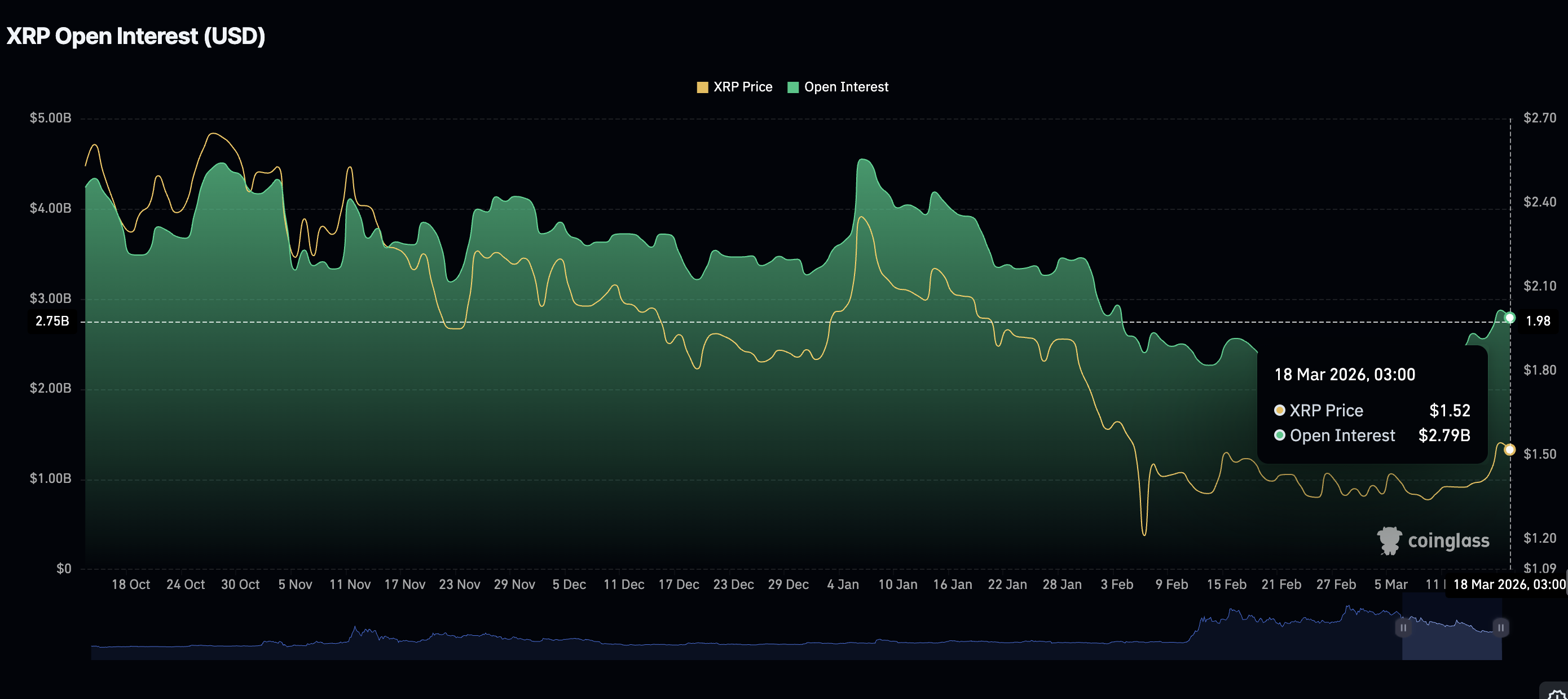
Meanwhile, the derivatives market appears to be cooling, with futures Open Interest (OI) sliding to $2.79 billion on Wednesday, from $2.87 billion on Tuesday. The OI had steadily increased from lows of $2.11 billion on March 4, suggesting a growing interest from retail investors as the XRP price ticked up from the $1.34 monthly low.
Technical outlook: XRP holds key support
XRP is trading above $1.52 amid a mild bullish bias, reinforced by the Moving Average Convergence Divergence (MACD) indicator, which remains above its signal line and in positive territory on the daily chart. Slightly expanding green histogram bars suggest building upside momentum after the recent push from the $1.45 area.
It is worth noting that the dominant descending resistance trendline that capped every recovery attempt from the record high of $3.66 remains intact and continues to define the overarching bearish structure despite the latest bounce.
Still, initial resistance lies at $1.61, aligning with Tuesday's high, followed by the 100-day Exponential Moving Average (EMA) at $1.70 and the 200-day EMA at $1.95.
-1773826254991-1773826254994.png)
On the downside, immediate support is seen around the pivotal level at $1.50, the latest consolidation shelf, followed by the weekly open at $1.45. The Money Flow Index (MFI) reading is around 70, easing slightly near overbought levels, signaling a potential pullback. A daily close below $1.45 would negate the nascent bullish bias and expose a deeper correction toward Friday's low at $1.38.
Cryptocurrency metrics FAQs
The developer or creator of each cryptocurrency decides on the total number of tokens that can be minted or issued. Only a certain number of these assets can be minted by mining, staking or other mechanisms. This is defined by the algorithm of the underlying blockchain technology. On the other hand, circulating supply can also be decreased via actions such as burning tokens, or mistakenly sending assets to addresses of other incompatible blockchains.
Market capitalization is the result of multiplying the circulating supply of a certain asset by the asset’s current market value.
Trading volume refers to the total number of tokens for a specific asset that has been transacted or exchanged between buyers and sellers within set trading hours, for example, 24 hours. It is used to gauge market sentiment, this metric combines all volumes on centralized exchanges and decentralized exchanges. Increasing trading volume often denotes the demand for a certain asset as more people are buying and selling the cryptocurrency.
Funding rates are a concept designed to encourage traders to take positions and ensure perpetual contract prices match spot markets. It defines a mechanism by exchanges to ensure that future prices and index prices periodic payments regularly converge. When the funding rate is positive, the price of the perpetual contract is higher than the mark price. This means traders who are bullish and have opened long positions pay traders who are in short positions. On the other hand, a negative funding rate means perpetual prices are below the mark price, and hence traders with short positions pay traders who have opened long positions.
(The technical analysis of this story was written with the help of an AI tool.)
Author

John Isige
FXStreet
John Isige is a seasoned cryptocurrency journalist and markets analyst committed to delivering high-quality, actionable insights tailored to traders, investors, and crypto enthusiasts. He enjoys deep dives into emerging Web3 tren