Why Bitcoin’s scarcity does not guarantee a price increase

While a limited supply and the absence of a central governing authority sustain interest in Bitcoin, they don’t protect it from a decline in value. Evan Ceolini, head of the cryptocurrency exchange aggregator SwapSpace, suggests evaluating the value of the network separately from the price of the coin itself. In his HackerNoon blog, he explains why the robustness of the protocol can coexist with high market volatility.
Such a suggestion is based on the fact that the BTC issuance rules are known in advance. The total supply is capped at approximately 21 million coins, and the subsidy awarded to miners is halved every 210,000 blocks. Following the halving event in April 2024, the subsidy stands at 3.125 BTC per block, and the next reduction to 1.5625 BTC is expected in 2028.
Ceolini identifies the predictability of issuance as the most significant feature of this model. Network participants can verify the issuance schedule, which is not subject to the decisions of any single issuer. However, scarcity alone doesn't guarantee a price increase, and any reduction in new supply must be considered in the context of demand. Furthermore, the ability of network participants to independently verify the rules holds its own distinct value. Nevertheless, the reliability of the protocol should not be conflated with the reliability of a company to which an investor might entrust their coins. That said, the obligations of an intermediary and the operational integrity of the blockchain represent two different categories of risk.
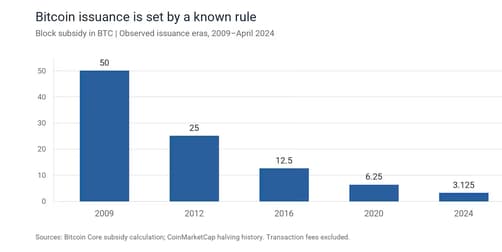
Source: Evan Ceolini’s Hackernoon blog
Access to Bitcoin has expanded in recent years. In January 2024, the SEC authorized the listing and trading of shares in several spot Bitcoin exchange-traded products, providing investors with an additional, regulated investment vehicle. At the same time, the regulator explicitly noted that the approval of these products does not constitute an endorsement of Bitcoin itself, nor does it eliminate the risks associated with it. sec.gov
Ceolini also draws attention to the quality of trade execution, noting that large trading volumes of exchanges and trading services doesn't guarantee that a large position can be sold at the price displayed on the screen. The actual execution price depends on market depth, the size of the order, and the specific conditions of the platform in question.
He considers the comparison to digital gold useful for explaining the properties of BTC, but limited when it comes to valuing it. This distinction is supported by research from the World Gold Council, published in August 2024. Based on historical data, the organization demonstrated that Bitcoin is significantly more volatile than gold and can behave like a high-risk asset during periods of market stress. Therefore, a shared characteristic of scarcity does not imply an identical defensive function within an investment portfolio.
Technological considerations also factor into the valuation. In October 2026, Google reported on an experiment using its "Willow" processor, which showed progress in reducing errors in quantum computing — though the company noted that further scaling of the technology remains necessary.
Still, in a comment to Bitcoin.com on November 3, Ceolini noted that a growing awareness of the quantum threat doesn't necessarily mean it is fully priced into BTC. "Awareness alone does not mean that this risk is fully reflected in the spot price of Bitcoin," he stated. In his view, there is currently no compelling evidence of a specific, quantifiable discount applied for risks related to protocol governance and upgrades. It is more accurate to view this potential threat as a recognized, yet difficult to quantify, long-term factor.
In an earlier market analysis for SwapSpace, Ceolini suggested assessing the sustainability of a recovery by looking at capital inflows and user activity. Among the indicators he cited were a steady increase in the supply of stablecoins, the expansion of activity across a greater number of networks and applications, and the sustained demand even after the market correction. In his view, a growth in asset prices alone is not sufficient to confirm a broad market recovery.
Author

Julia Magas
Independent Analyst
Julia Magas is an analyst and writer specializing in cryptocurrency and fintech market trends. Her work has been featured in leading financial publications such as Nasdaq, InvestorPlace, Cointelegraph, and Investing.