Tokenized RWA market value hit $19B in Q1, driven by Gold and Treasuries
- Tokenized RWA assets surged nearly 256% in 15 months to $19.32 billion in the first quarter of 2026.
- Tokenized Treasuries grew by 226% in the same period, adding $9 billion to remain the largest asset class in the sector.
- Tokenized Gold spot trading volume crossed the $90 billion mark in March, reflecting growing demand and improved accessibility.

Tokenized Real World Assets (RWAs) appear to be cracking out of their shells, with the latest CoinGecko report showing significant growth in market capitalization and trading volume across different asset classes.
The sector has transitioned from the narrative of the ‘next big thing’ in the crypto industry, more than tripling in value from January 2025 to the end of the first quarter of 2026.
RWAs 256% surge outpaces stablecoins
The overall RWA sector has experienced steady growth since the beginning of 2025, with the market capitalization surging from $5.42 billion to $19.32 billion by March 31, 2026, a 256.7% increase.
Tokenized Treasuries are the largest asset class in the sector, after adding $9 billion, a 225.5% increase over the 15-month period. This accounts for more than half of the sector’s market capitalization growth. Despite the growth, CoinGecko’s report highlights a slight drop in tokenized Treasuries’ market share from 73.7% to 67.2%, accommodating the expansion of tokenization to other asset classes.
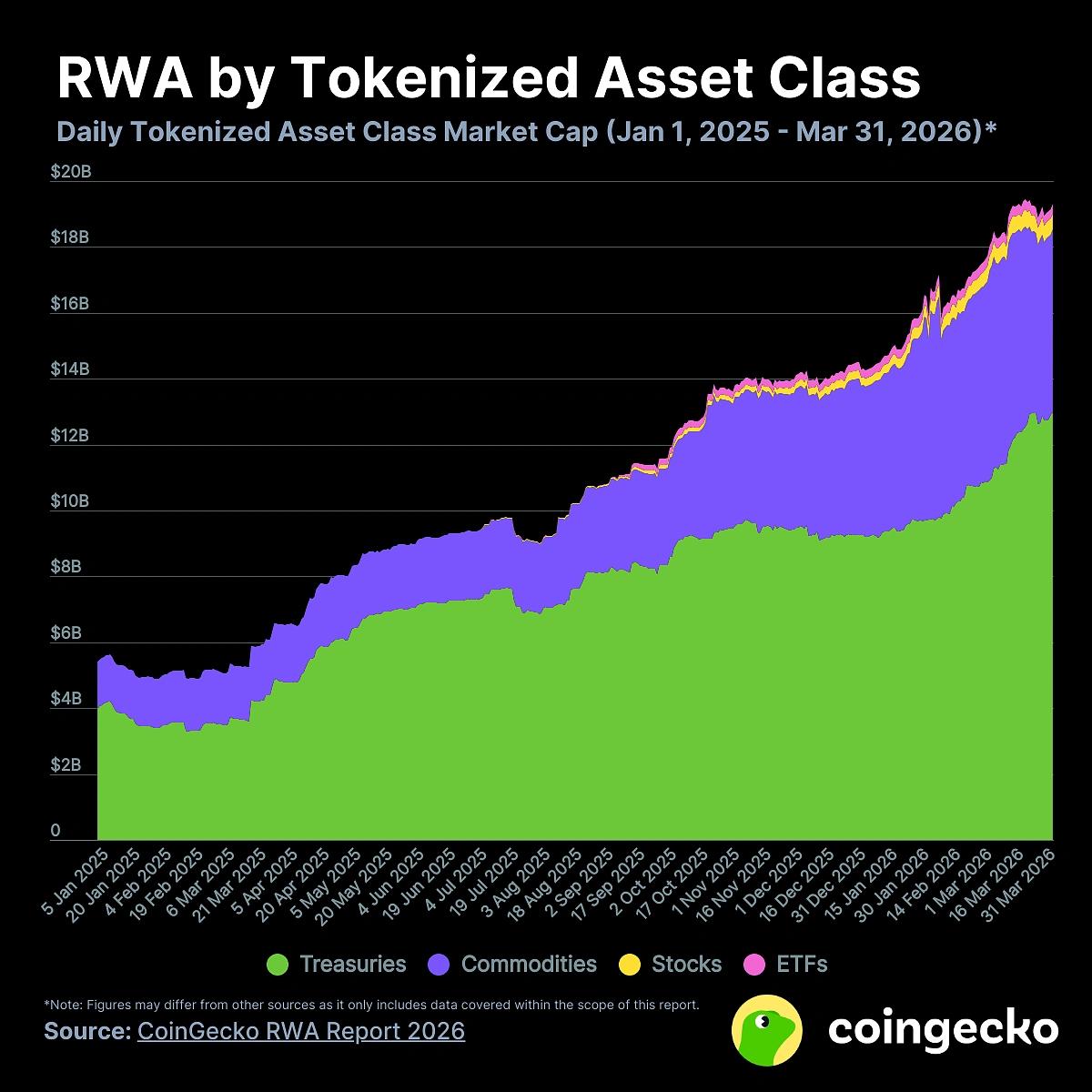
“As of the end of Q1 2026, tokenized commodities account for 28.7% of the sector, while tokenized stocks have captured a 2.5% share and tokenized ETFs hold 1.5%,” the CoinGecko report states.
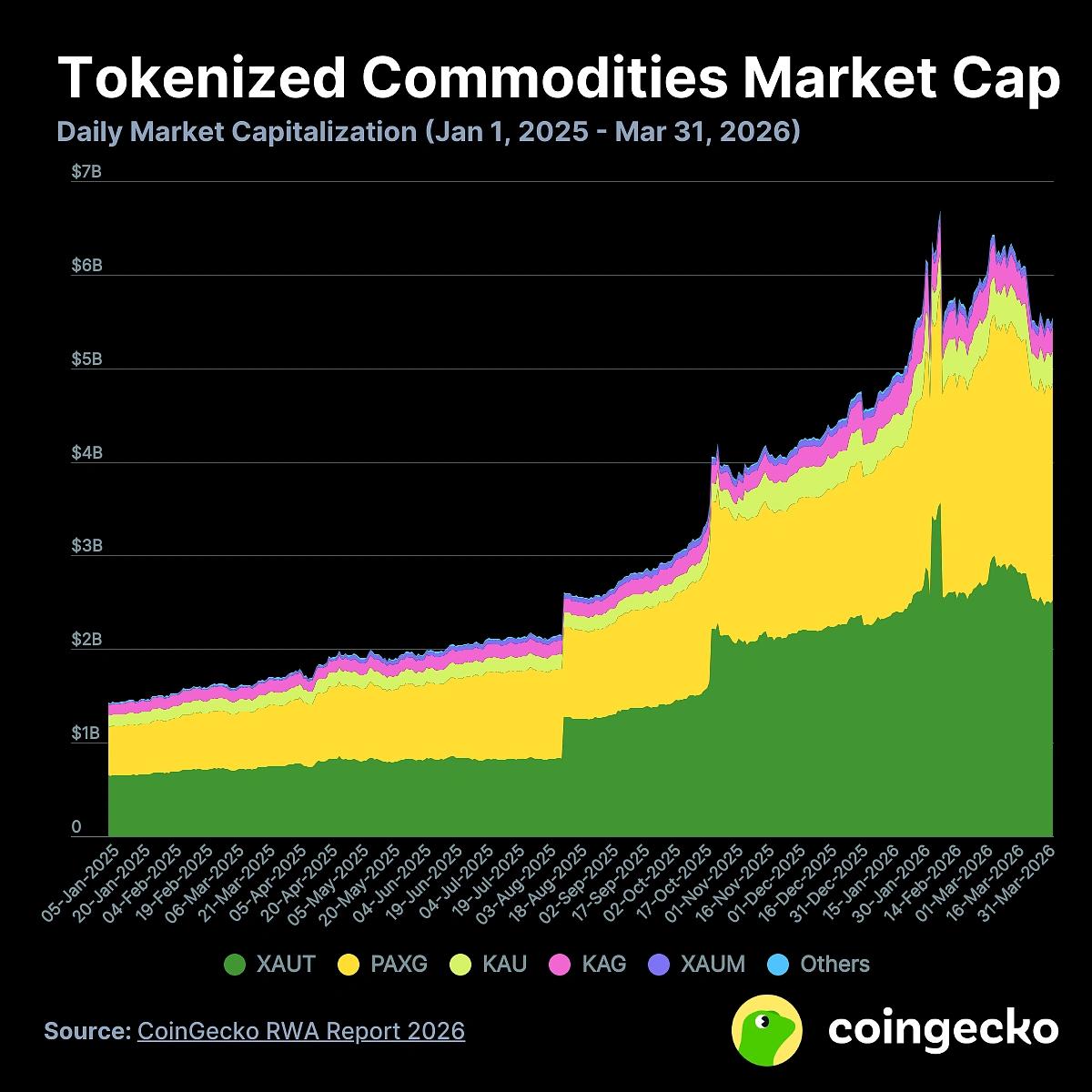
The tokenized commodities’ market capitalization logged standout performance during the same period, hitting $5.55 billion – a 289% jump from $1.43 billion – driven by a global rally in precious metals.
Gold-backed tokens, particularly Tether’s XAUT and Paxos’ PAXG, account for the lion’s share of the tokenized commodities market capitalization at 89.1% by contributing $1.87 billion and $1.80 billion, respectively.
Tokenized Gold trading volume hits $90B
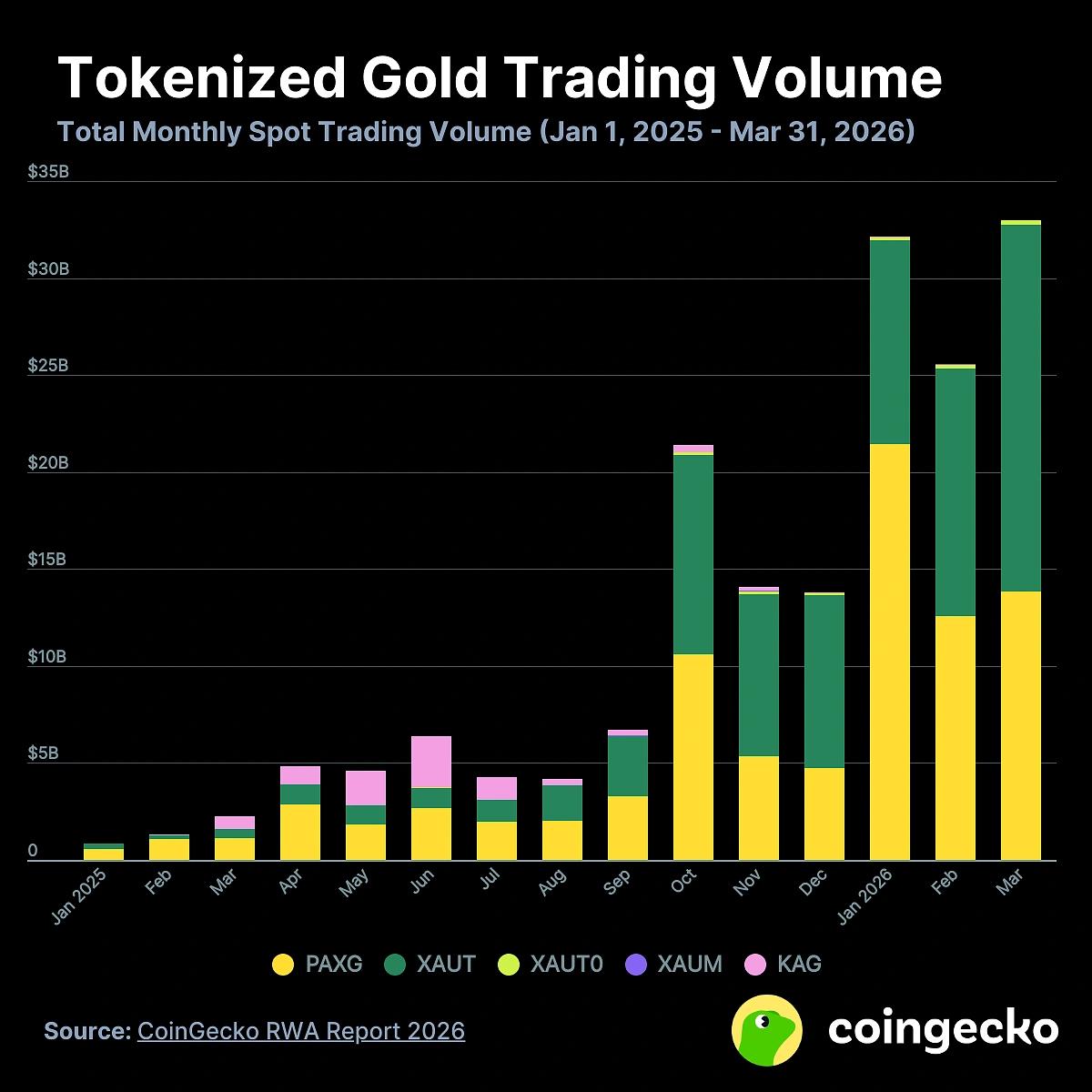
Appetite for exposure to Gold-backed tokens pushed spot trading volume to $90.7 billion in Q1 2026 alone, dwarfing the cumulative $84.64 billion for 2025. The surge in demand for tokenized Gold was largely driven by steady price increases amid geopolitical tensions and greater accessibility on centralized exchanges (CEXs) such as Binance.
However, the report shows that tokenized Gold spot trading volume continues to fluctuate month to month, reflecting investor sensitivity to market conditions. For example, the volume surged above $21 billion in October, when Gold hit a new record high, and then fell to roughly $14 billion in the following month.
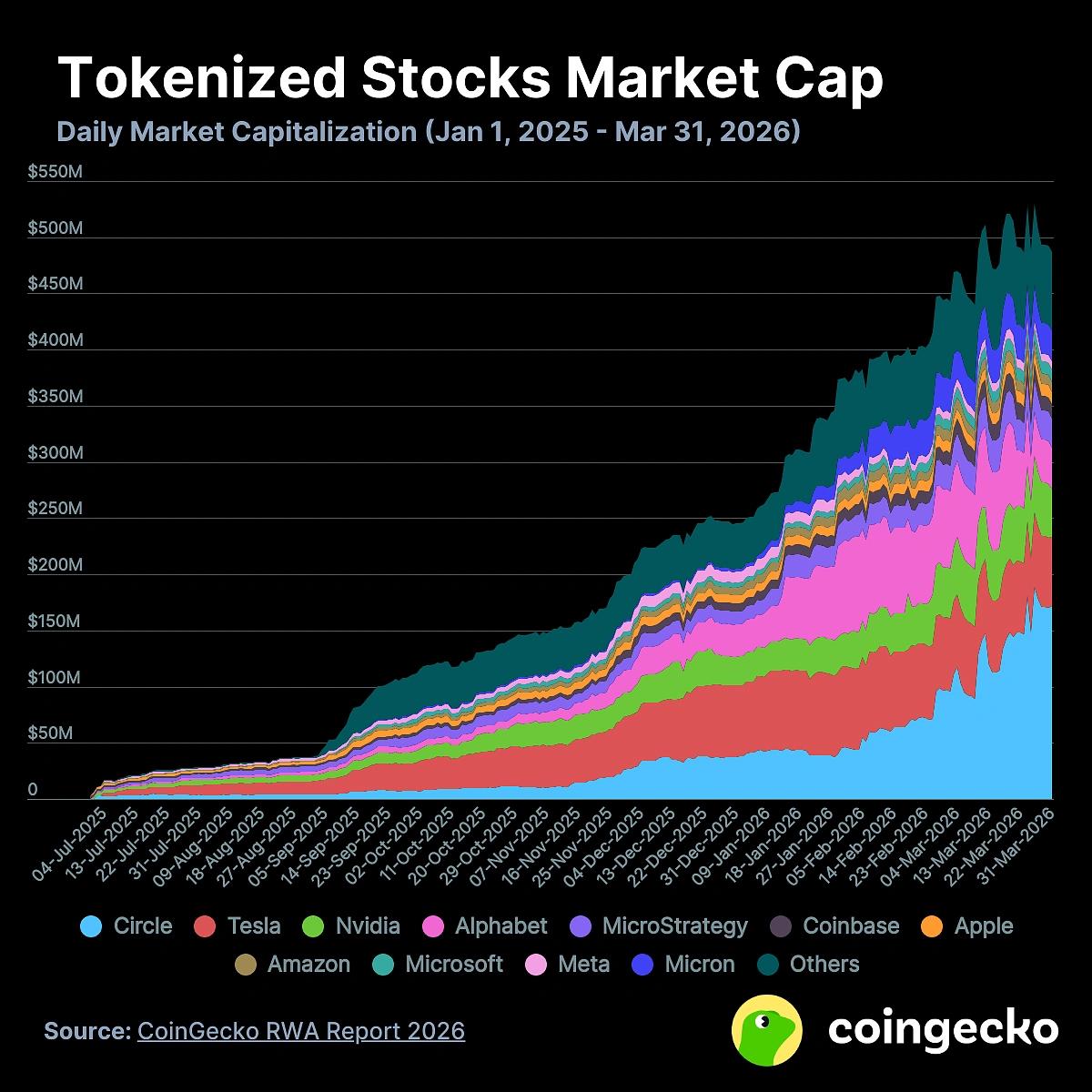
Tokenized stocks have scaled from a $2 million market capitalization in mid-2025 to nearly $487 million. The sector is largely dominated by Big Tech equities and blockchain tickers, providing investors with 24/7 liquidity.
Circle (CRCL) leads the sector with $173 million in market capitalization, with the majority of exposure coming through Ondo Finance’s CRCLON and Backed Finances CRCLLX. Other significant contenders include Tesla (TSLA) at $61.7 million, Nvidia (NVDA) at $42.6 million and Alphabet (GOOG) at $36.9 million. Despite the hype, tokenized trading volume still accounts for less than 1% of the total TradFi market volume, which leaves room for growth.
The report concludes by highlighting other notable asset classes in the sector, including tokenized Exchange-Traded Funds (ETFs), which reached nearly $0.3 billion by the end of Q1 2026 from $0.62 million in July. RWA perpetuals have also emerged as an alternative investment vehicle, gaining significant traction alongside the broader tokenization narrative.
Bitcoin, altcoins, stablecoins FAQs
Bitcoin is the largest cryptocurrency by market capitalization, a virtual currency designed to serve as money. This form of payment cannot be controlled by any one person, group, or entity, which eliminates the need for third-party participation during financial transactions.
Altcoins are any cryptocurrency apart from Bitcoin, but some also regard Ethereum as a non-altcoin because it is from these two cryptocurrencies that forking happens. If this is true, then Litecoin is the first altcoin, forked from the Bitcoin protocol and, therefore, an “improved” version of it.
Stablecoins are cryptocurrencies designed to have a stable price, with their value backed by a reserve of the asset it represents. To achieve this, the value of any one stablecoin is pegged to a commodity or financial instrument, such as the US Dollar (USD), with its supply regulated by an algorithm or demand. The main goal of stablecoins is to provide an on/off-ramp for investors willing to trade and invest in cryptocurrencies. Stablecoins also allow investors to store value since cryptocurrencies, in general, are subject to volatility.
Bitcoin dominance is the ratio of Bitcoin's market capitalization to the total market capitalization of all cryptocurrencies combined. It provides a clear picture of Bitcoin’s interest among investors. A high BTC dominance typically happens before and during a bull run, in which investors resort to investing in relatively stable and high market capitalization cryptocurrency like Bitcoin. A drop in BTC dominance usually means that investors are moving their capital and/or profits to altcoins in a quest for higher returns, which usually triggers an explosion of altcoin rallies.
Author

John Isige
FXStreet
John Isige is a seasoned cryptocurrency journalist and markets analyst committed to delivering high-quality, actionable insights tailored to traders, investors, and crypto enthusiasts. He enjoys deep dives into emerging Web3 tren