Three things to watch for BTC this week
- BTC holds steady at 64.7k, up 2.5% in 7 days and 10% in July.

Attention this week is on:
- US-Iran developments and the impact on oil prices and inflationary pressures.
- US tech earnings could create near-term volatility.
- BTC ETFs record a second week of net inflows. Is the wind changing?
The world's largest cryptocurrency is hovering around $64.7k at the time of writing, up 0.5% over the past 24 hours and 3.2% over the past week. Bitcoin has gained around 10% so far in July after declining over the previous two months.
1. US – Iran developments in focus
Despite the recovery seen this month, the near-term outlook has become more challenging for Bitcoin and other risk assets after tensions between the U.S. and Iran escalated over the weekend, with both sides continuing to exchange strikes.
Oil prices jumped by 15% last week as tensions escalated and concerns grew over supply disruptions, as shipping through the Strait of Hormuz remains severely restricted.
However, comments from Iran's foreign ministry suggesting Tehran remains open to negotiations have raised hopes of a diplomatic solution, allowing oil prices to ease back after briefly climbing towards $90 per barrel.
Even so, elevated oil prices continue to fuel inflation concerns. Cleveland Federal Reserve President Beth Hammack became the latest policymaker to suggest that further interest rate increases may still be required if inflation fails to cool sufficiently.
Markets are pricing an 82% probability of a Fed rate hike this year, up from 73% a week ago. This is important because BTC and cryptocurrencies often perform better in low interest-rate environments, due to increased liquidity.
2. Looking ahead – US tech earnings
The U.S. economic calendar is quiet this week, with Friday's PMI data the main release. As a result, markets will likely focus on developments in the Middle East. Any further easing in oil prices could help improve sentiment towards Bitcoin and risk assets.
Meanwhile, earnings from technology heavyweights Alphabet, Tesla and Intel could also act as a short-term catalyst for risk assets more broadly.
Bitcoin's 30-day rolling correlation with the S&P 500 currently stands at 0.66, suggesting the cryptocurrency continues to trade relatively in line with wider equity market mood. Impressive earnings and guidance could ease AI jitters, boost tech stocks and BTC.
3. BTC ETF inflows offer early signs of stabilisation
Institutional demand is also showing tentative signs of improvement.
Spot Bitcoin ETFs recorded $75 million of net inflows last week, marking a second consecutive week of positive flows after two months of sustained outflows.
Combined with the $197 million recorded the previous week, ETFs have attracted around $273 million over the past fortnight.
While this represents a considerable improvement, it follows roughly $8 billion of net outflows over the previous two months, suggesting institutional demand has stabilised rather than fully recovered.
The recent rebound also appears fragile, having been supported by one softer U.S. jobs report and cooler-than-expected CPI and PPI inflation data.
For Bitcoin to build a more durable recovery, investors will likely need to see sustained ETF inflows alongside a more supportive macro backdrop for risk assets.
Bitcoin technical analysis
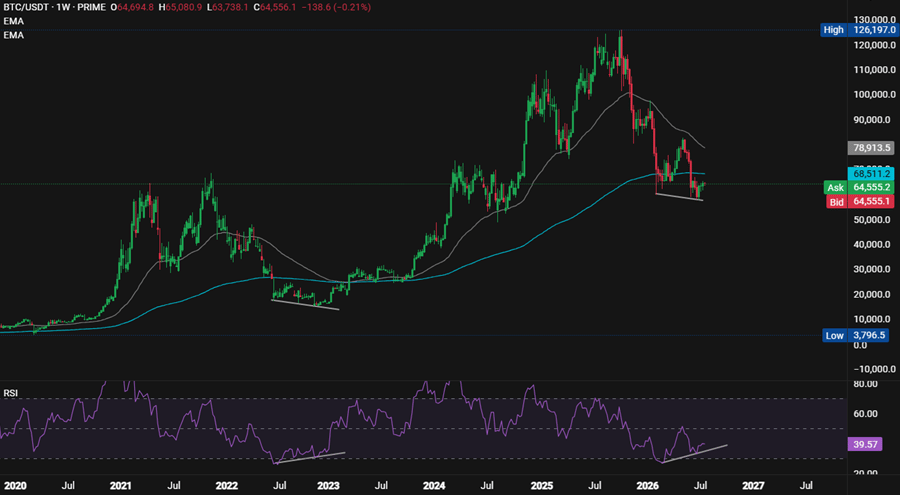
On the weekly chart, BTC/USDT has fallen sharply from the 126k record high, dropping below the 200-week EMA. However, the chart has developed a bullish RSI divergence, similar to the bullish divergence seen in 2022, which marked the cycle low.
While RSI divergence is an encouraging technical development, alone, it does not guarantee a reversal. Bitcoin still needs to reclaim key resistance levels before a broader bullish trend can be confirmed.
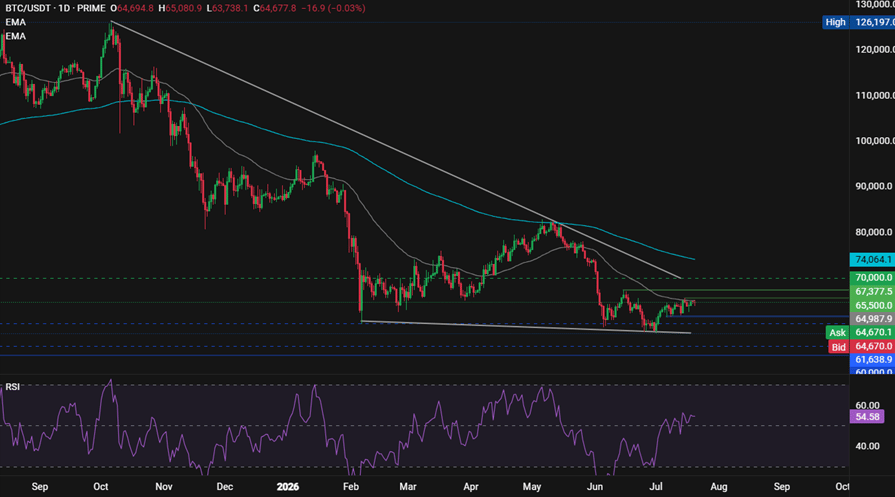
On the daily chart, the 50 EMA at $65k is a key near-term resistance. A move above here would expose $67.5k, the June 15 swing high. A break above this level creates a higher high, bringing the falling trendline resistance and the 200 EMA at $74k into focus.
Failure to reclaim the 50 EMA could see Bitcoin drift back towards the $60k psychological level. A break below $57.7k, the 2026 low, would create a fresh lower low, exposing support around $55k and then $50k, levels from 2024.
Start trading with PrimeXBT
Author

PrimeXBT Research Team
PrimeXBT
PrimeXBT is a leading Crypto and CFD broker that offers an all-in-one trading platform to buy, sell and store Cryptocurrencies and trade over 100 popular markets, including Crypto Futures, Copy Trading and CFDs on Crypto, Forex, I