The Clarity Act: Finally, a path out of the SEC enforcement chaos

Operating a crypto-related business in the United States over the past decade has felt a lot less like being in a fast-paced technology environment and more like stepping on eggshells, with a series of hits and misses with regulatory authorities. Luckily, that is about to change with the Clarity Act.
Markets move quickly, but many traders will likely remember the court-related woes that XRP, to name the most prominent example, faced over the years: “We've been living – particularly with a not well-intended SEC under Gary Gensler – with chaos. It's just regulation through enforcement, and you didn't know where they were going to focus their enforcement battle," Ripple's CEO Brad Garlinghouse said during a fireside chat at the Consensus 2026 conference.
Donald Trump’s administration and the leadership change at the Securities and Exchange Commission (SEC) partly changed that “regulation by enforcement” approach to a more crypto-friendly framework. Still, that approach needed some regulatory backing, and that’s where the Genius Act – which became law in 2025– and the Clarity Act – which advanced to a full Senate floor vote last week – are key.
Why is the Clarity Act a game-changer?
Days before Senate Banking Committee Chairman Tim Scott advanced the Clarity Act to a full floor vote, I clearly stated why the crypto market needed the bill to pass and what it meant, not only for business operators such as stablecoin issuers and exchange companies, but also for individual participants.
The advancement marks a major milestone toward a comprehensive crypto framework and, more importantly, I believe it dealt the first definitive and structural defeat to the destructive era of “regulation by enforcement.”
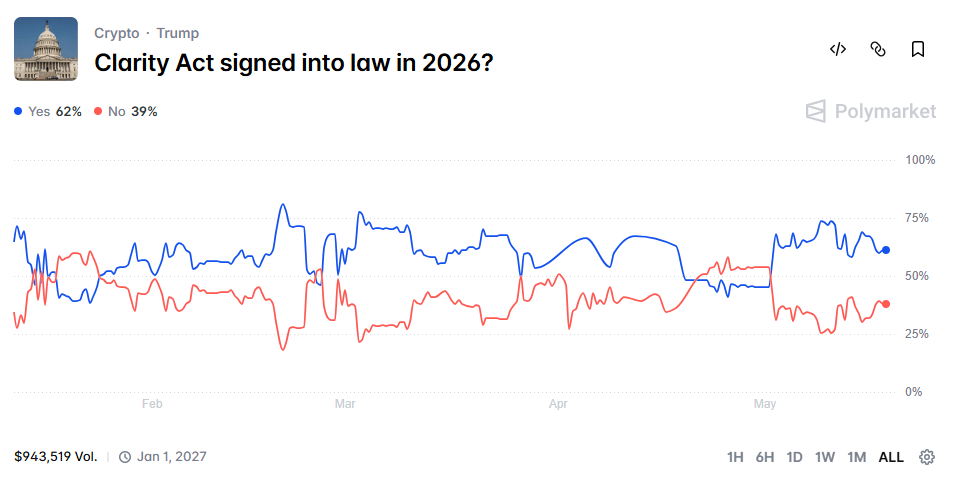
However, to appreciate the Clarity Act’s latest milestone, one must dissect the structure of the US market oversight. The SEC and the Commodity Futures Trading Commission (CFTC) frequently relied on decades-old laws, specifically the Securities Act of 1933, the Exchange Act of 1934, and the Commodity Exchange Act of 1936, to provide the much-needed oversight of digital assets.
As a result, market participants were left in the dark, deducing rules from public enforcement actions. This massive structural deficit implicated many crypto companies in legal standoffs that could have been entirely avoided had a comprehensive framework been in place.
The Clarity Act, despite facing a much larger challenge on the Senate floor, and the persistent aggressive lobbying from the American Bankers Association (ABA) and the Bank Policy Institute (BPI), objectively draws a bold statutory line in the sand, stripping the SEC of its arbitrary veto power such as the application of the 1994 Howey test to decentralized software tokens and handing the key to digital commodities oversight to the CFTC.
This move is far from a bureaucratic shuffling. It marks the beginning of a new era for the US crypto industry built on solid pillars of compliance, predictability and consumer protection.
Ripple, Coinbase and Kraken, to name a few, have all been victims of a regulatory vacuum that has led to millions of dollars in losses from legal battles that could have been avoided. By providing a formal regulatory structure, the Clarity Act would breathe life into a market that had to constantly fight for survival.
Under the Clarity Act, the CFTC has exclusive regulatory oversight over digital commodities. Tokens approved by the SEC to have spot Exchange-Traded Funds (ETFs) like Bitcoin (BTC), Ethereum (ETH) and Ripple (XRP) are automatically classified as commodities under the new guidelines. The SEC, on the other hand, retains oversight over digital assets that are fundamentally tied to the equity, financial performance or debt obligations of centralized corporate entities. See here for more details on the Clarity Act pillars.
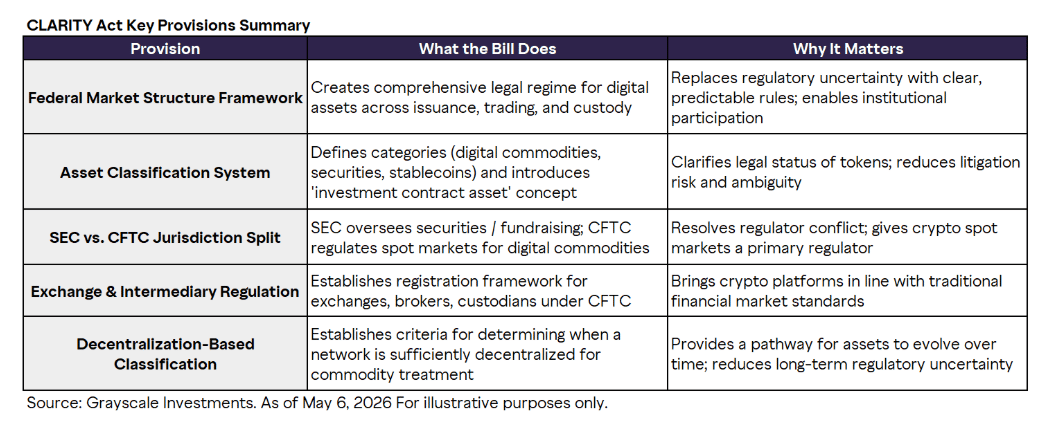
The fork on the road
The US crypto landscape is at an inflection point, with some parties, especially the ABA and BPI, seemingly afraid of the impact that the Clarity Act could have on the traditional banking system.
The need to prevent liquidity drains from the banking sector flowing into crypto via stablecoins that offer yield on deposits is, to some extent, justified, but should not come at the expense of building the US as a global hub for digital assets, advancing innovation and protecting consumers.
Where I stand, the bill goes beyond stablecoin yields while taking into account the compromise text that accelerated it to the full Senate floor. It allows for the implementation of the Bank Secrecy Act and the Office of Foreign Assets Control (OFAC) screening architectures directly into the systems that power crypto markets, bringing digital asset markets on par with their traditional counterparts.
The advancement of the bill to the full Senate floor is a win for investors and the Decentralized Finance (DeFi) sector, which relies heavily on self-custody. It is a boost for builders, who will no longer have to look over their shoulders due to regulatory uncertainty but gaze toward the horizon of innovation.
But, ultimately, this is a milestone for investors because the SEC and the CFTC will finally have a predictable framework to oversee the crypto market and protect consumers.
Bitcoin, altcoins, stablecoins FAQs
Bitcoin is the largest cryptocurrency by market capitalization, a virtual currency designed to serve as money. This form of payment cannot be controlled by any one person, group, or entity, which eliminates the need for third-party participation during financial transactions.
Altcoins are any cryptocurrency apart from Bitcoin, but some also regard Ethereum as a non-altcoin because it is from these two cryptocurrencies that forking happens. If this is true, then Litecoin is the first altcoin, forked from the Bitcoin protocol and, therefore, an “improved” version of it.
Stablecoins are cryptocurrencies designed to have a stable price, with their value backed by a reserve of the asset it represents. To achieve this, the value of any one stablecoin is pegged to a commodity or financial instrument, such as the US Dollar (USD), with its supply regulated by an algorithm or demand. The main goal of stablecoins is to provide an on/off-ramp for investors willing to trade and invest in cryptocurrencies. Stablecoins also allow investors to store value since cryptocurrencies, in general, are subject to volatility.
Bitcoin dominance is the ratio of Bitcoin's market capitalization to the total market capitalization of all cryptocurrencies combined. It provides a clear picture of Bitcoin’s interest among investors. A high BTC dominance typically happens before and during a bull run, in which investors resort to investing in relatively stable and high market capitalization cryptocurrency like Bitcoin. A drop in BTC dominance usually means that investors are moving their capital and/or profits to altcoins in a quest for higher returns, which usually triggers an explosion of altcoin rallies.
Author

John Isige
FXStreet
John Isige is a seasoned cryptocurrency journalist and markets analyst committed to delivering high-quality, actionable insights tailored to traders, investors, and crypto enthusiasts. He enjoys deep dives into emerging Web3 tren