XRP slides below $1.40 as risk-off mood persists
- XRP slides below the pivotal $1.40 threshold, risking an extension of its decline amid deteriorating market sentiment.
- XRP derivatives shed last week’s gains amid a sharp drop in futures Open Interest to $2.78 billion on Monday.
- XRP momentum indicators weaken further with the RSI in bearish territory and the MACD maintaining a sell signal.

Ripple (XRP) remains pressured below $1.40 at the time of writing on Monday, reflecting a broader sell-off in the crypto market. Attempts to break the $1.50 supply level failed last week as investors reacted to rising inflation in the United States (US) and the persistent conflict in the Middle East.
XRP faces cooling retail demand as sentiment deteriorates
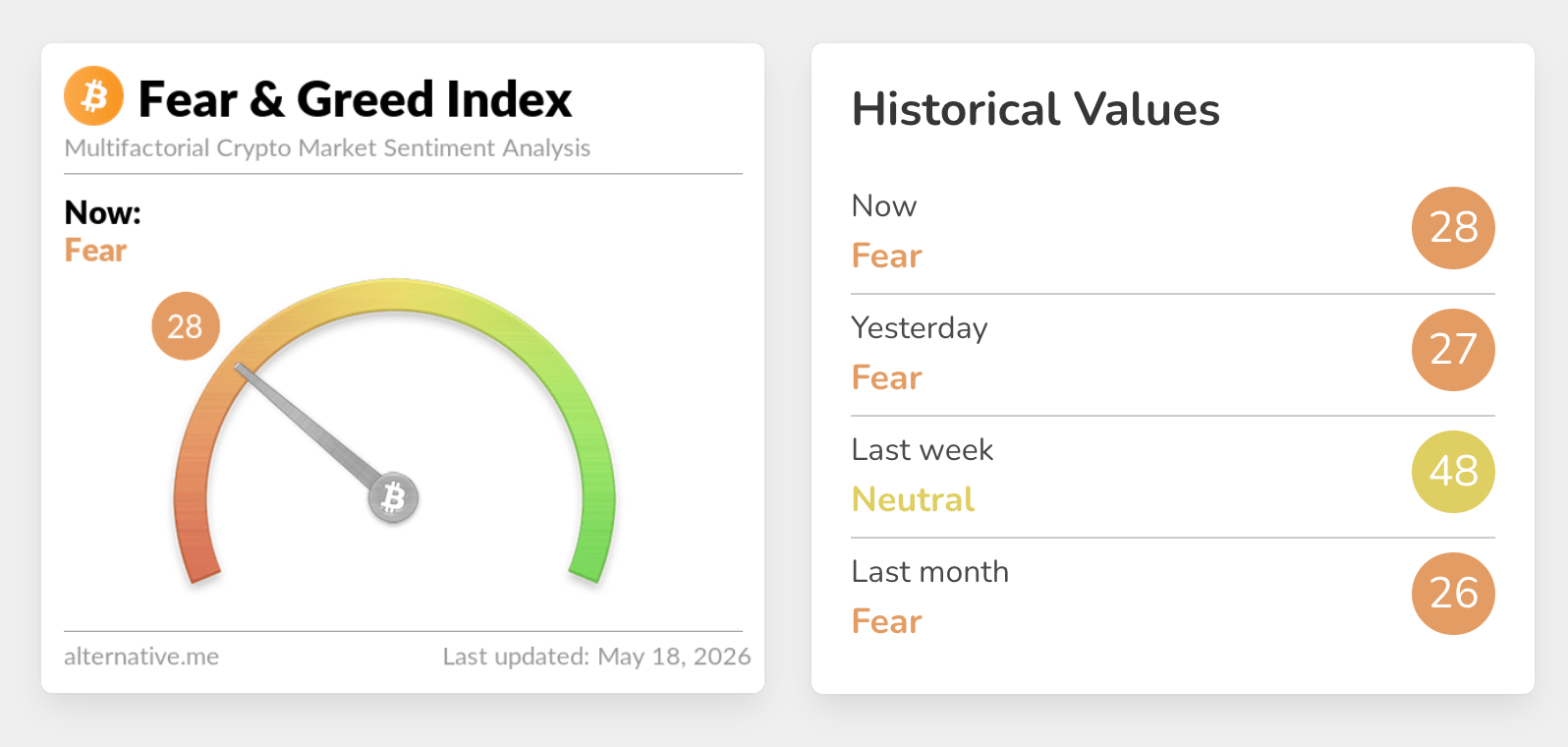
The crypto Greed & Fear Index aligns with the fading risk appetite, dropping sharply to 28 in the fear territory on Monday, compared to an average of 48 in the neutral territory observed last week.
Growing risk-off sentiment could further weaken XRP, breaking the structure from neutral as observed over the last few weeks back to strongly bearish.
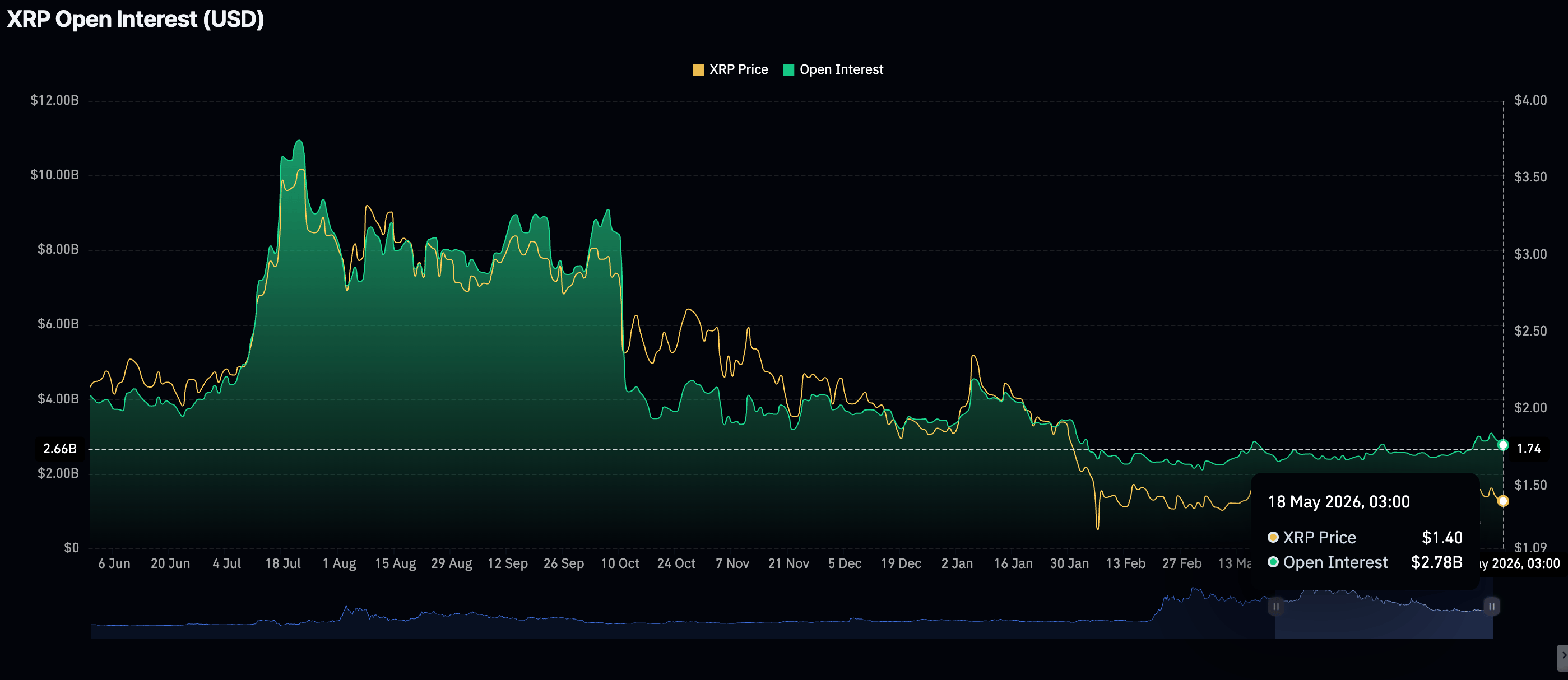
The derivatives market reflects the narrowing sentiment, as futures Open Interest (OI) declines to $2.78 billion on Monday, from $2.86 billion the previous day.
According to CoinGlass data, the OI surpassed $3 billion on Friday, marking the highest level since late January. If the current lack of investor interest continues, it may further destabilize the market, intensifying selling pressure during this prolonged drawdown.
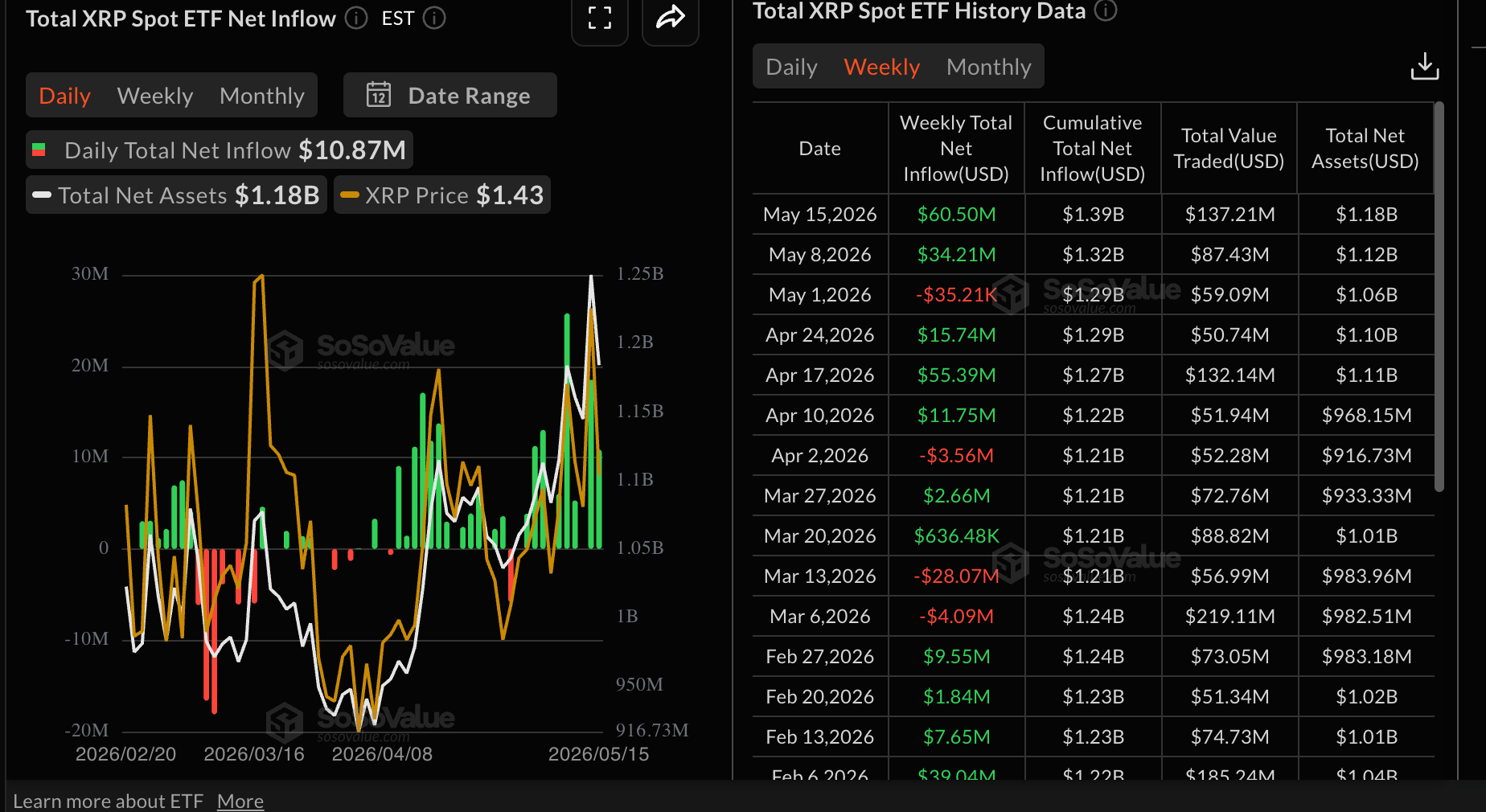
Meanwhile, demand for XRP spot Exchange-Traded Funds (ETFs) remained steady, beating Bitcoin (BTC) and Ethereum (ETH) to post inflows totaling $61 million last week.
Cumulative inflows average $1.39 billion, increasing from $1.32 billion the previous week. Total assets under management increased slightly to $1.18 billion from $1.12 billion over the same period.
The ETFs' performance this week could help shape sentiment around the remittance token, with steady inflows driving a positive turnaround above the pivotal $1.40 level.
Price analysis: XRP wobbles as sellers tighten grip
XRP trades above $1.38 but remains under pressure as it holds below the reclaimed support-turned-resistance from the broken ascending trendline around $1.39. The price also trades beneath the 50-day, 100-day and 200-day Exponential Moving Averages (EMAs) at $1.42, $1.49 and $1.70, respectively, keeping the broader tone bearish.
The Relative Strength Index (RSI) has slipped back toward the mid-40s on the daily chart, hinting at fading bullish momentum after the recent failure to sustain gains, while the Moving Average Convergence Divergence (MACD) histogram has turned further negative, reinforcing the view that rallies are likely to be absorbed for now.
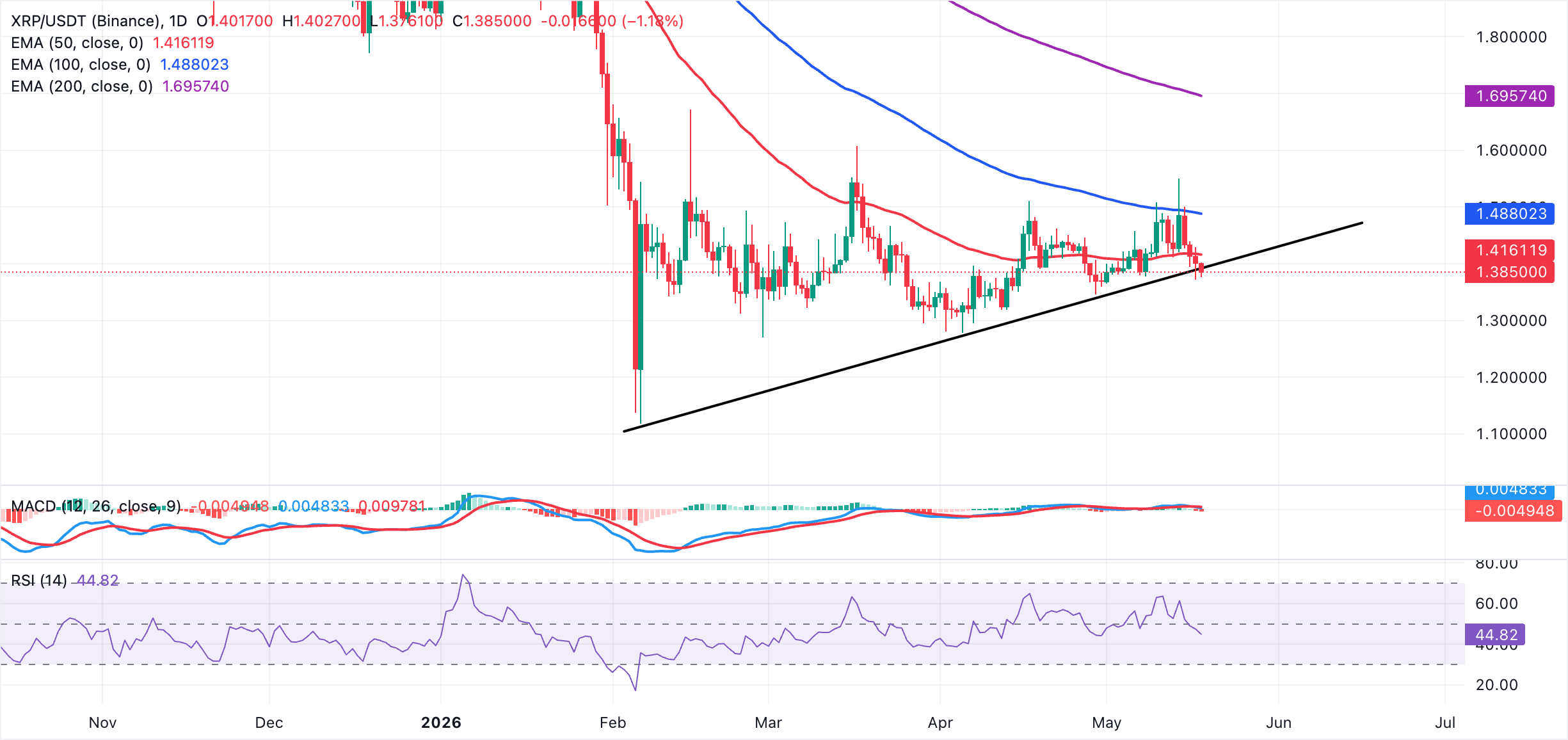
On the topside, immediate resistance lies at the former uptrend support zone near $1.39, with a daily close above it needed to ease short-term pressure. Further up, the 50-day EMA at $1.42 is the next obstacle, ahead of the 100-day EMA at $1.49, while the 200-day EMA at $1.70 marks a more distant bearish cap. Initial support lies slightly below the spot at $1.35, where fresh demand could emerge. However, if the sell-off persists, the next key demand level is at $1.30.
(The technical analysis of this story was written with the help of an AI tool.)
Bitcoin, altcoins, stablecoins FAQs
Bitcoin is the largest cryptocurrency by market capitalization, a virtual currency designed to serve as money. This form of payment cannot be controlled by any one person, group, or entity, which eliminates the need for third-party participation during financial transactions.
Altcoins are any cryptocurrency apart from Bitcoin, but some also regard Ethereum as a non-altcoin because it is from these two cryptocurrencies that forking happens. If this is true, then Litecoin is the first altcoin, forked from the Bitcoin protocol and, therefore, an “improved” version of it.
Stablecoins are cryptocurrencies designed to have a stable price, with their value backed by a reserve of the asset it represents. To achieve this, the value of any one stablecoin is pegged to a commodity or financial instrument, such as the US Dollar (USD), with its supply regulated by an algorithm or demand. The main goal of stablecoins is to provide an on/off-ramp for investors willing to trade and invest in cryptocurrencies. Stablecoins also allow investors to store value since cryptocurrencies, in general, are subject to volatility.
Bitcoin dominance is the ratio of Bitcoin's market capitalization to the total market capitalization of all cryptocurrencies combined. It provides a clear picture of Bitcoin’s interest among investors. A high BTC dominance typically happens before and during a bull run, in which investors resort to investing in relatively stable and high market capitalization cryptocurrency like Bitcoin. A drop in BTC dominance usually means that investors are moving their capital and/or profits to altcoins in a quest for higher returns, which usually triggers an explosion of altcoin rallies.
Author

John Isige
FXStreet
John Isige is a seasoned cryptocurrency journalist and markets analyst committed to delivering high-quality, actionable insights tailored to traders, investors, and crypto enthusiasts. He enjoys deep dives into emerging Web3 tren