XRP nears critical support as risk-off sentiment outweighs ETF inflows
- XRP decline deepens toward the critical $1.00 level as risk-off sentiment persists.
- US-listed spot ETFs record weekly inflows but fail to offset derivative pressure as Open Interest drops to 2.23 billion XRP.
- XRP trades within a weak technical structure defined by falling momentum indicators and overhead EMAs.

Ripple (XRP) is trading at $1.06 on Monday, maintaining its position within a broader bearish trend. The token’s technical outlook continues to deteriorate, pressured by declining retail participation.
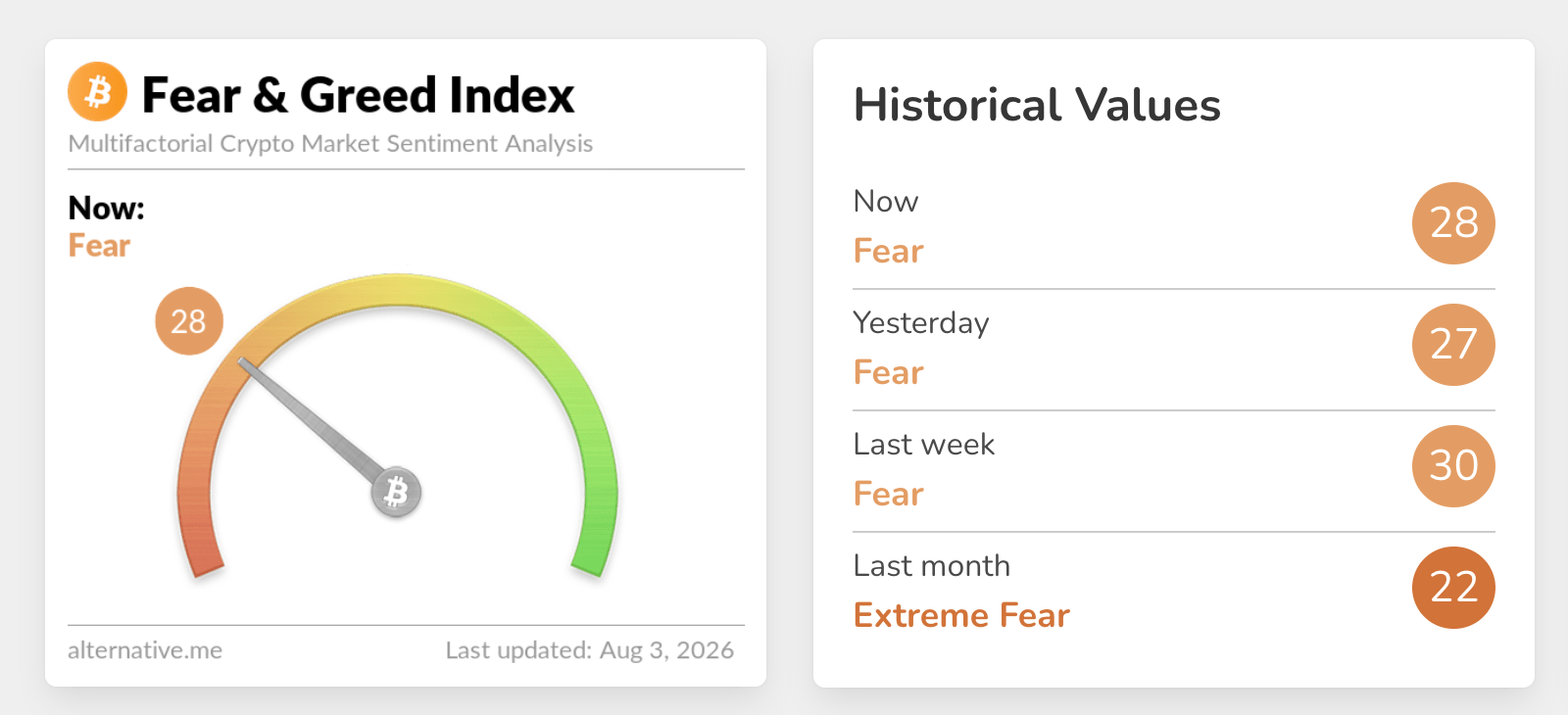
Appetite for risk assets remains lethargic, as reflected in the Fear & Greed Index, which is embedded in the Fear territory at 28. If sentiment continues to deteriorate, XRP could struggle to sustain recovery, prompting investor selling and risking an extended sell-off below the critical $1.00 level.
XRP ETF demand strengthens as retail participation cools
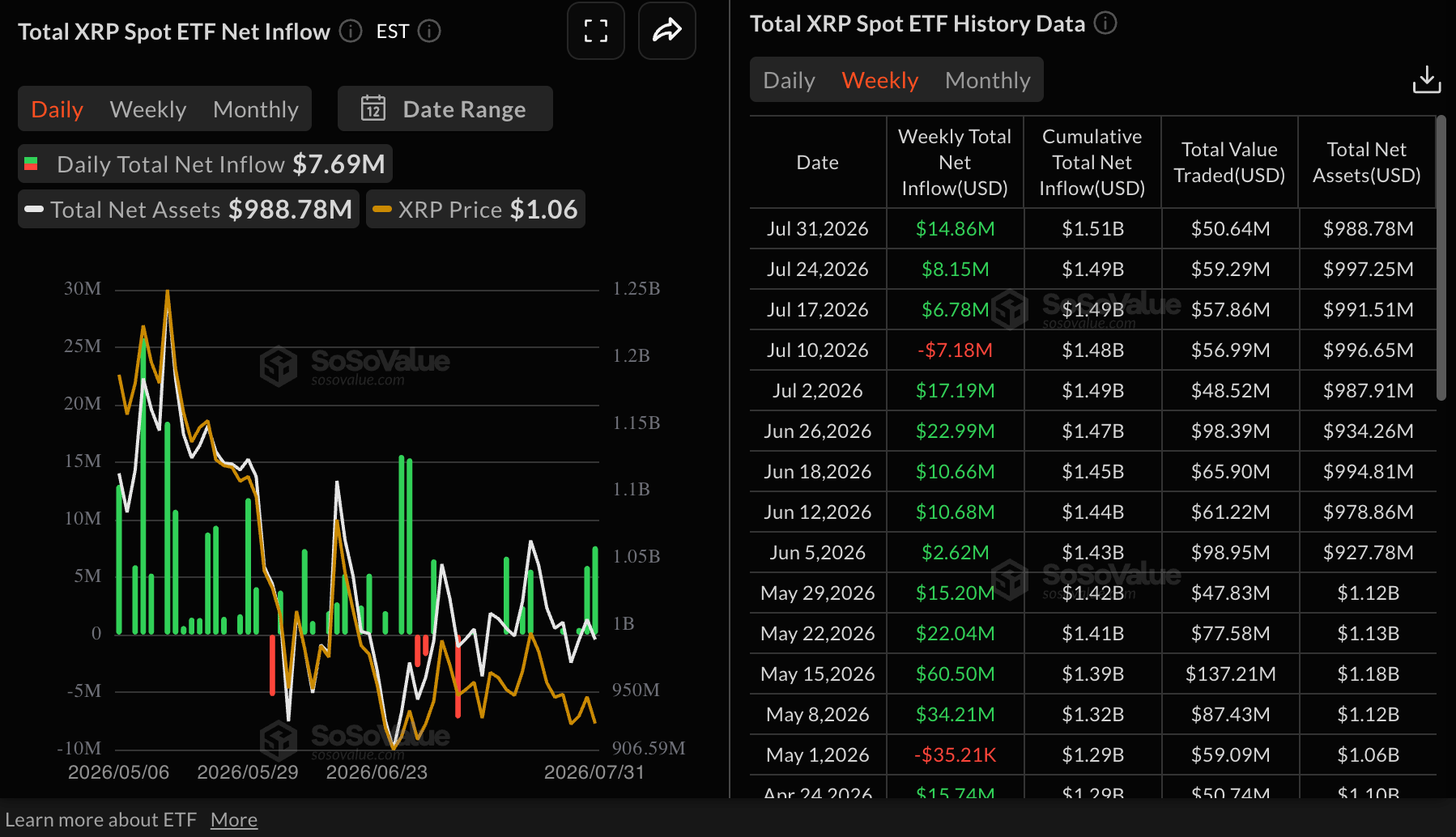
XRP spot Exchange-Traded Funds (ETFs) attracted inflows totaling $14.86 million last week through Friday, rising from $8.15 million the previous week. As a result, cumulative inflows climbed to $1.51 billion while net assets declined only marginally to $989 million from $997 million over the same period. Should institutions keep increasing risk exposure, XRP could regain momentum for a steady recovery in the short-term to medium-term.
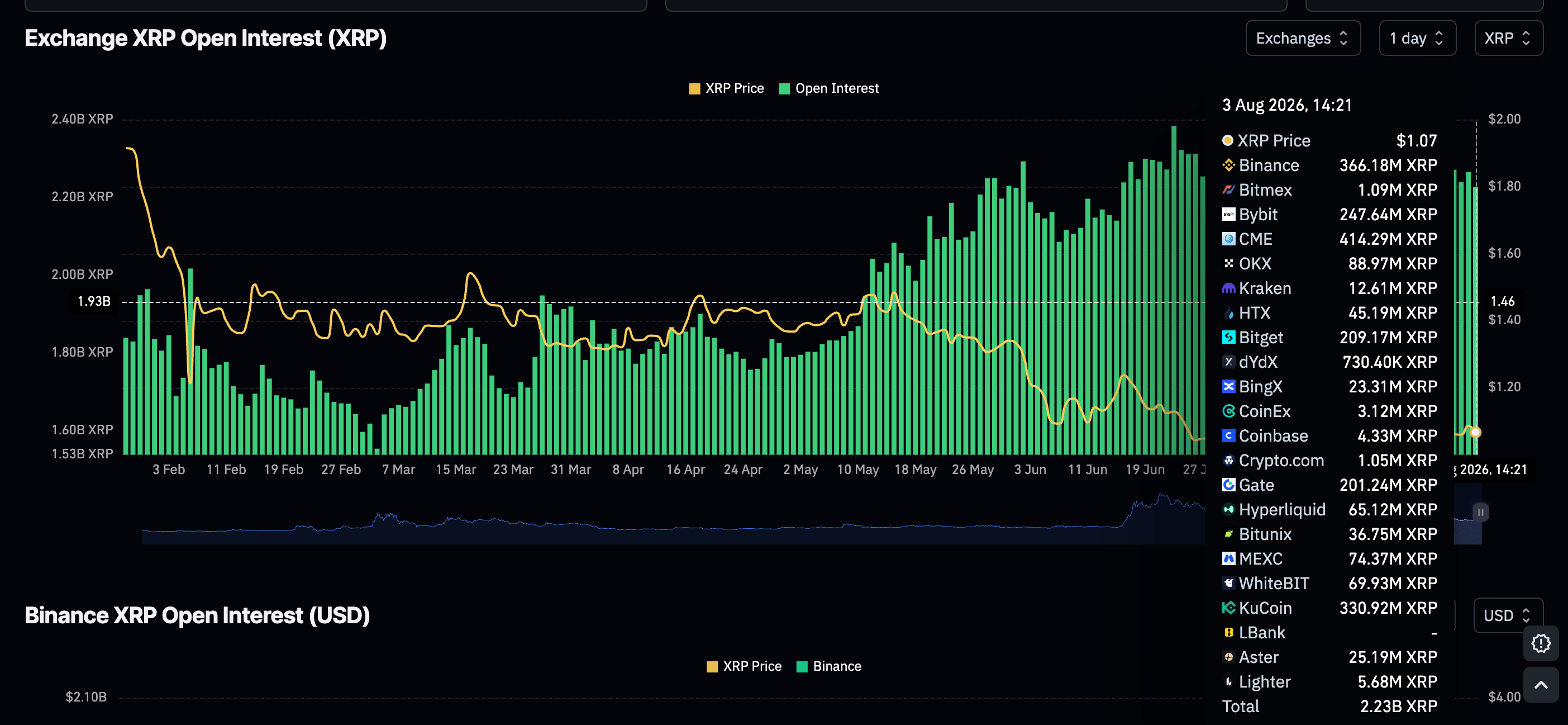
Retail demand is on the back foot, as evidenced by perpetual futures Open Interest (OI) fading to 2.23 billion XRP on Monday, from 2.26 billion XRP the day before. CoinGlass data shows a broader sell-off from 2.37 billion XRP on July 37, undermining investor appetite.
On the other hand, the attack on Coldcard hardware wallets is weighing on the crypto market after holders collectively lost roughly 1,367 BTC, about $89 million. The attackers leveraged a firmware flaw in the cold storage wallets dormant since 2021.
“The week’s genuine shock came from custody rather than price. A firmware flaw in Coldcard hardware wallets, dormant since 2021, was exploited to drain roughly 1,367 BTC, about $89 million, from thousands of self-custodied addresses, with researchers warning that every vulnerable single-signature wallet remains at risk,” Yusuf Fakhro, Partner at ARP Digital, said in a commentary.
Technical analysis: XRP sustains bearish out as headwinds intensify
XRP trades at $1.06, extending the correction from July highs around $1.18. The broader structure remains capped as price holds below the 50, 100 and 200 Exponential Moving Averages (EMAs) clustered between $1.08 and $1.10 on the 4-hour chart.
Still, the Moving Average Convergence Divergence (MACD) histogram is marginally positive and the Relative Strength Index (RSI) hovers near 45, hinting at mildly constructive momentum that is not yet strong enough to challenge the overhead EMA barrier.
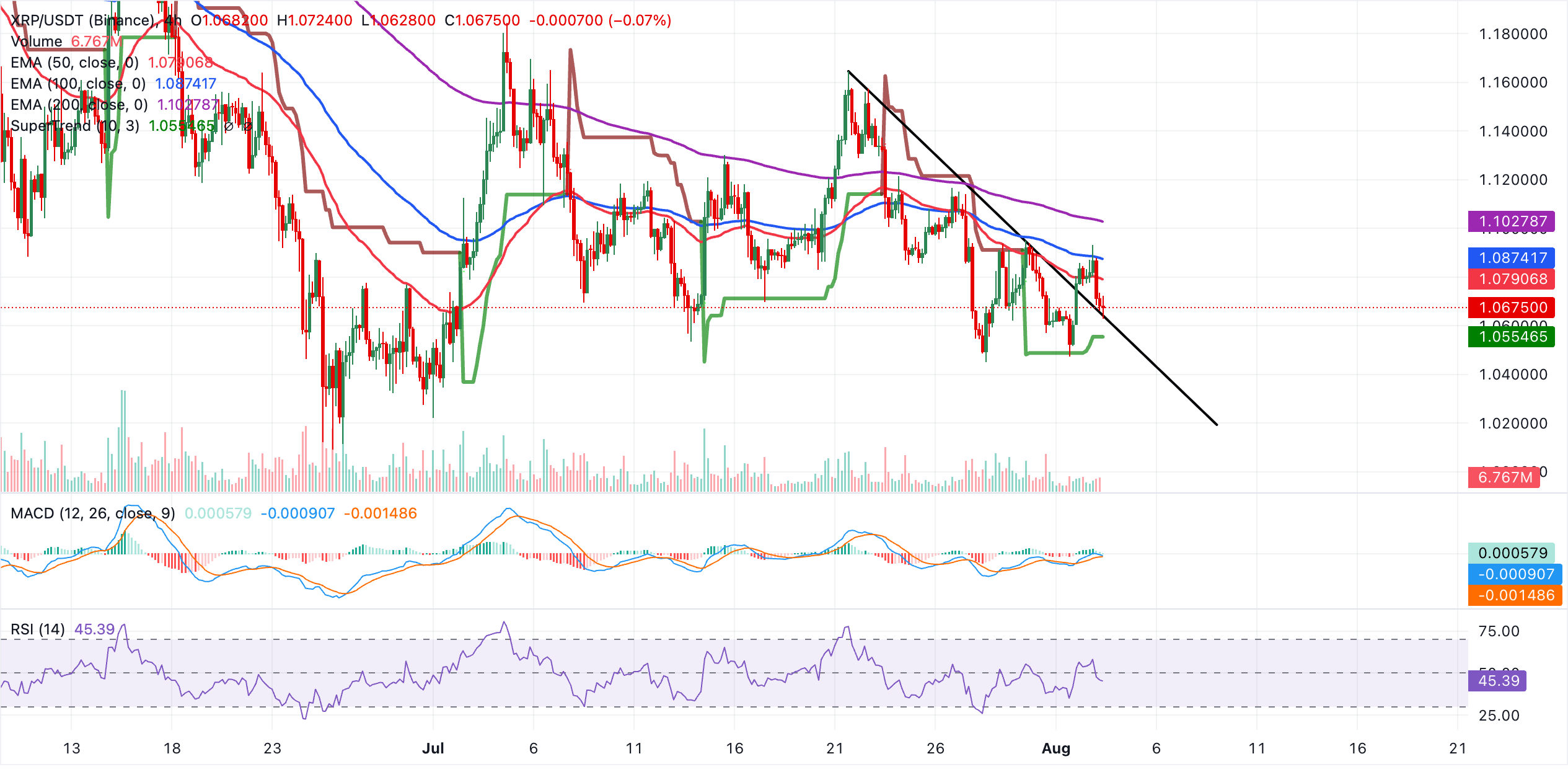
Initial resistance lies at the 50 EMA at $1.08, followed by the 100 EMA at $1.09, while the 200 EMA near $1.10 marks a more significant cap for any recovery attempt. On the downside, immediate support lies at the reclaimed trendline region around $1.06, with the SuperTrend indicator providing further demand near $1.05. A break below this zone would likely expose XRP to deeper corrective pressure in the near term.
(The technical analysis of this story was written with the help of an AI tool. Know more.)
Cryptocurrency prices FAQs
Token launches influence demand and adoption among market participants. Listings on crypto exchanges deepen the liquidity for an asset and add new participants to an asset’s network. This is typically bullish for a digital asset.
A hack is an event in which an attacker captures a large volume of the asset from a DeFi bridge or hot wallet of an exchange or any other crypto platform via exploits, bugs or other methods. The exploiter then transfers these tokens out of the exchange platforms to ultimately sell or swap the assets for other cryptocurrencies or stablecoins. Such events often involve an en masse panic triggering a sell-off in the affected assets.
Macroeconomic events like the US Federal Reserve’s decision on interest rates influence crypto assets mainly through the direct impact they have on the US Dollar. An increase in interest rate typically negatively influences Bitcoin and altcoin prices, and vice versa. If the US Dollar index declines, risk assets and associated leverage for trading gets cheaper, in turn driving crypto prices higher.
Halvings are typically considered bullish events as they slash the block reward in half for miners, constricting the supply of the asset. At consistent demand if the supply reduces, the asset’s price climbs.
Author

John Isige
FXStreet
John Isige is a seasoned cryptocurrency journalist and markets analyst committed to delivering high-quality, actionable insights tailored to traders, investors, and crypto enthusiasts. He enjoys deep dives into emerging Web3 tren