XRP extends correction as risk-off mood deepens and whales pare exposure
- XRP slides below $1.30 for the first time since early April amid broader risk-off sentiment and growing US-Iran tensions.
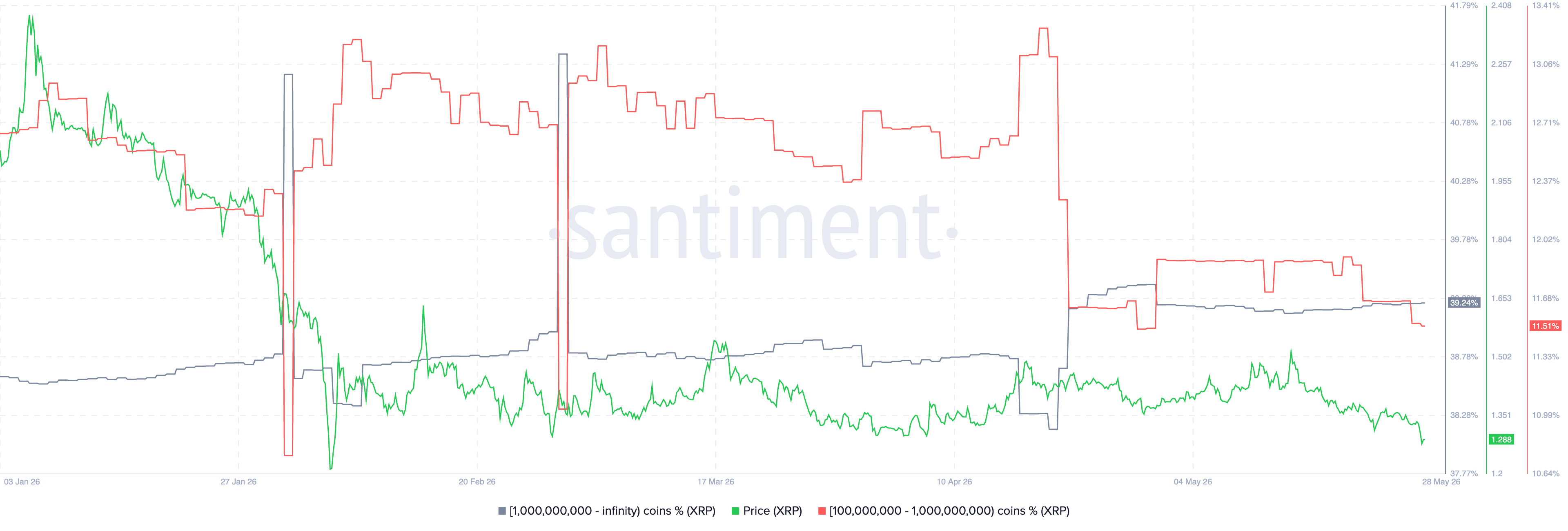
- Supply Distribution metric indicates a notable decline in the percentage of XRP held by addresses with balances between 100 million and 1 billion tokens.
- XRP retains a weakening technical structure with the RSI falling toward oversold territory and the MACD maintaining a sell signal.

Ripple (XRP) extends its correction below $1.30 at the time of writing on Thursday, as risk-off sentiment spreads across the crypto market. Reports of the United States (US) targeting Iranian drones and a launch site around the Strait of Hormuz and Iran retaliating by launching an attack against an American base are likely to be weighing on sentiment and optimism of a peace agreement between the two countries.
Moreover, US President Donald Trump said on Wednesday that he will not be rushed into making a deal, suggesting that an agreement may not be imminent despite Iran’s state TV reporting progress toward finalizing the Memorandum of Understanding (MOU) with the US. According to the report, Iran will restore the number of commercial transit ships through the Hormuz Strait to pre-war levels within a month.
Risk-averse sentiment prevails as whales reduce exposure
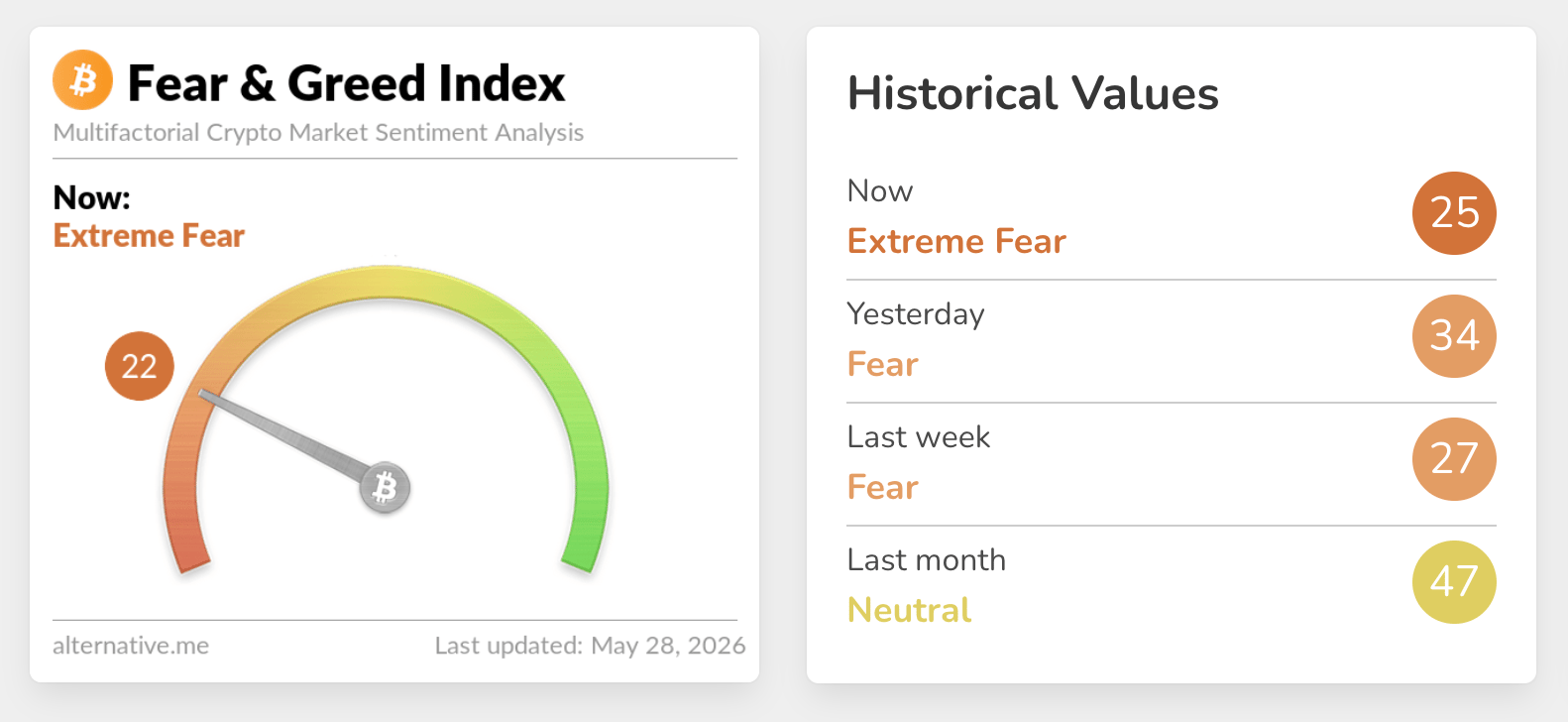
Sentiment in the broader crypto market continues to deteriorate, as reflected in the Fear & Greed Index, which fell to 22 in the Extreme Fear territory on Thursday, down from 25 the day before. Should sentiment remain weak, it would be difficult to uphold price increases, raising the odds of a persistent sell-off.
The Supply Distribution on-chain metric reflects a noticeable drop in appetite for risk assets, with the proportion of XRP held by addresses with balances between 100 million and 1 billion tokens falling to 11.51% of the total supply on Thursday, from 11.92% on May 20. If the decline is sustained, increasing supply will keep weighing on demand, raising the odds of a stronger bearish trend.
Price analysis: XRP extends correction
XRP trades at $1.29, holding below the broken rising trendline, with the former support now acting as resistance near $1.31, reinforcing a bearish near-term bias. Exponential moving averages (EMAs) are all stacked above price, with the 50-day EMA around $1.39, the 100-day EMA near $1.46 and the 200-day EMA close to $1.67, suggesting rallies remain capped within a broader corrective phase.
The SuperTrend indicator, currently hovering around $1.43, also sits overhead, while the Relative Strength Index (RSI) above 33 on the daily chart points to persistent weak momentum rather than an immediate reversal.
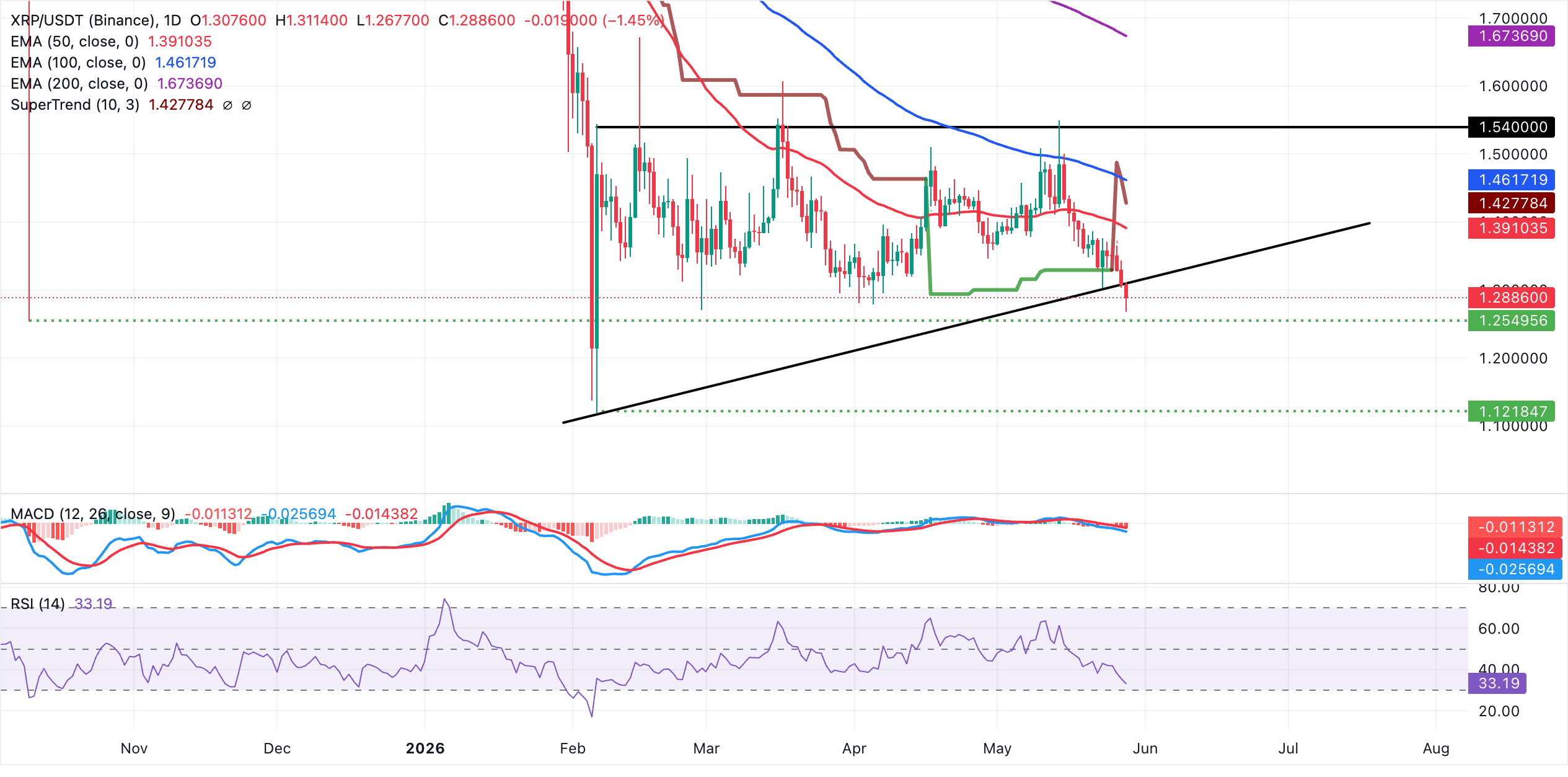
On the topside, initial resistance emerges at the ascending trendline break around $1.31, with further supply aligning at the 50-day EMA near $1.39. Above that, the SuperTrend band at roughly $1.43 and the 100-day EMA around $1.46 form a thicker barrier before the 200-day EMA near $1.67 comes into play as a more distant cap. If the sell-off persists, XRP could seek support at $1.25 with further decline likely to keep bears in control unless the pair can decisively climb back above the immediate resistance band.
(The technical analysis of this story was written with the help of an AI tool.)
Bitcoin, altcoins, stablecoins FAQs
Bitcoin is the largest cryptocurrency by market capitalization, a virtual currency designed to serve as money. This form of payment cannot be controlled by any one person, group, or entity, which eliminates the need for third-party participation during financial transactions.
Altcoins are any cryptocurrency apart from Bitcoin, but some also regard Ethereum as a non-altcoin because it is from these two cryptocurrencies that forking happens. If this is true, then Litecoin is the first altcoin, forked from the Bitcoin protocol and, therefore, an “improved” version of it.
Stablecoins are cryptocurrencies designed to have a stable price, with their value backed by a reserve of the asset it represents. To achieve this, the value of any one stablecoin is pegged to a commodity or financial instrument, such as the US Dollar (USD), with its supply regulated by an algorithm or demand. The main goal of stablecoins is to provide an on/off-ramp for investors willing to trade and invest in cryptocurrencies. Stablecoins also allow investors to store value since cryptocurrencies, in general, are subject to volatility.
Bitcoin dominance is the ratio of Bitcoin's market capitalization to the total market capitalization of all cryptocurrencies combined. It provides a clear picture of Bitcoin’s interest among investors. A high BTC dominance typically happens before and during a bull run, in which investors resort to investing in relatively stable and high market capitalization cryptocurrency like Bitcoin. A drop in BTC dominance usually means that investors are moving their capital and/or profits to altcoins in a quest for higher returns, which usually triggers an explosion of altcoin rallies.
Author

John Isige
FXStreet
John Isige is a seasoned cryptocurrency journalist and markets analyst committed to delivering high-quality, actionable insights tailored to traders, investors, and crypto enthusiasts. He enjoys deep dives into emerging Web3 tren