XRP declines persist amid weakening derivatives, ETF interest
- XRP extends its decline from the weekly high of $1.61 by over 9%, testing support at $1.45.
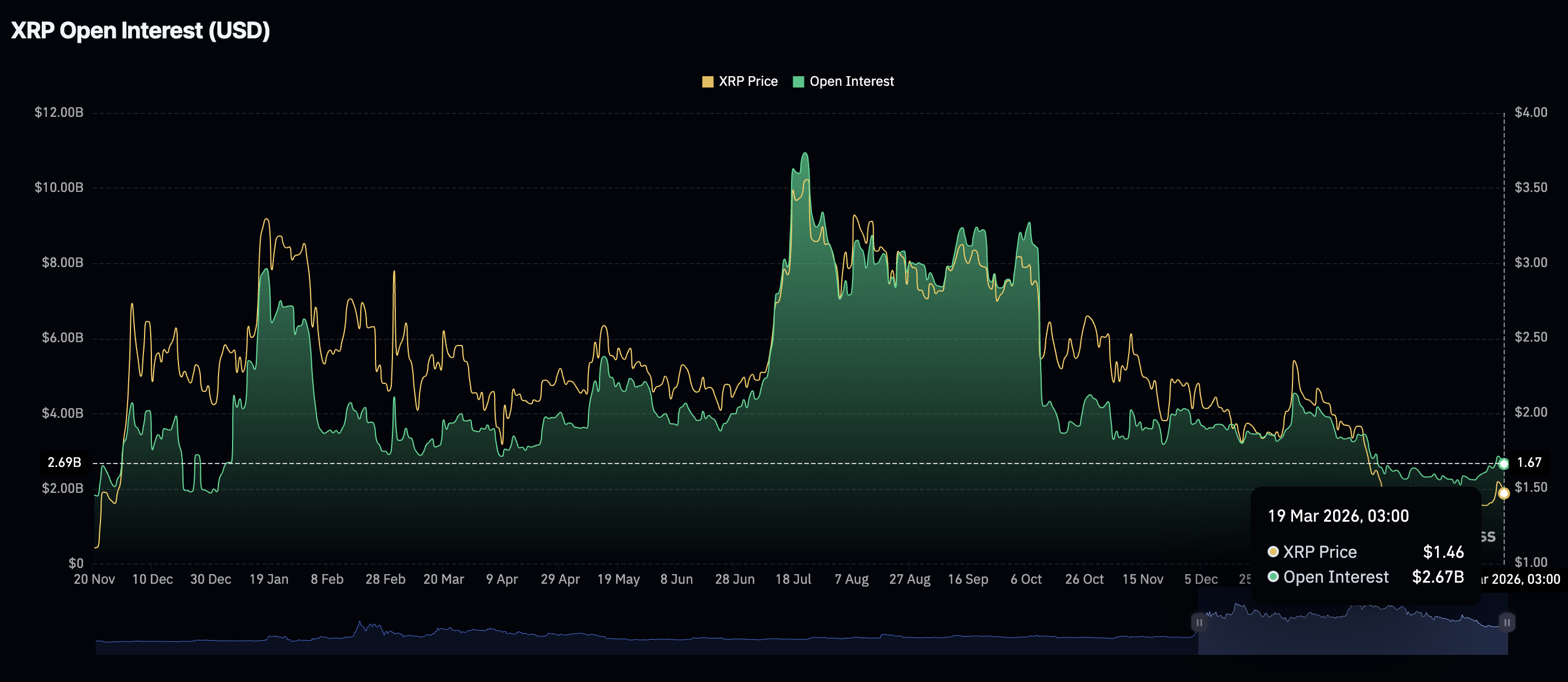
- XRP derivatives face capital exit as futures Open Interest narrows to $2.67 billion on Thursday.
- The technical outlook has deteriorated, pressured by persistent negative market sentiment and a reduction in ETF-related interest.

Ripple (XRP) is edging lower for the third consecutive day, trading around $1.46 at the time of writing on Thursday. A more than 9% decline from weekly highs of $1.61 reinforces the deteriorating market sentiment after Federal Reserve (Fed) Chair Jerome Powell’s remarks on Wednesday, suggesting that there are no foreseeable interest rate cuts unless there is a clear downtrend in inflation.
XRP under pressure as retail and institutional demand fades
The XRP derivatives market is once again facing a slump in retail interest, as futures Open Interest (OI), which reflects the notional value of outstanding futures contracts, shrinks to $2.67 billion on Thursday from $2.79 billion the previous day.
Looking back, the increase in OI from $2.11 billion, the lowest level in March, to a weekly high of $2.87 billion on Tuesday coincided with XRP rising to $1.61, underscoring the importance of retail demand. Therefore, monitoring OI patterns could help traders gauge interest in XRP and plan accordingly.
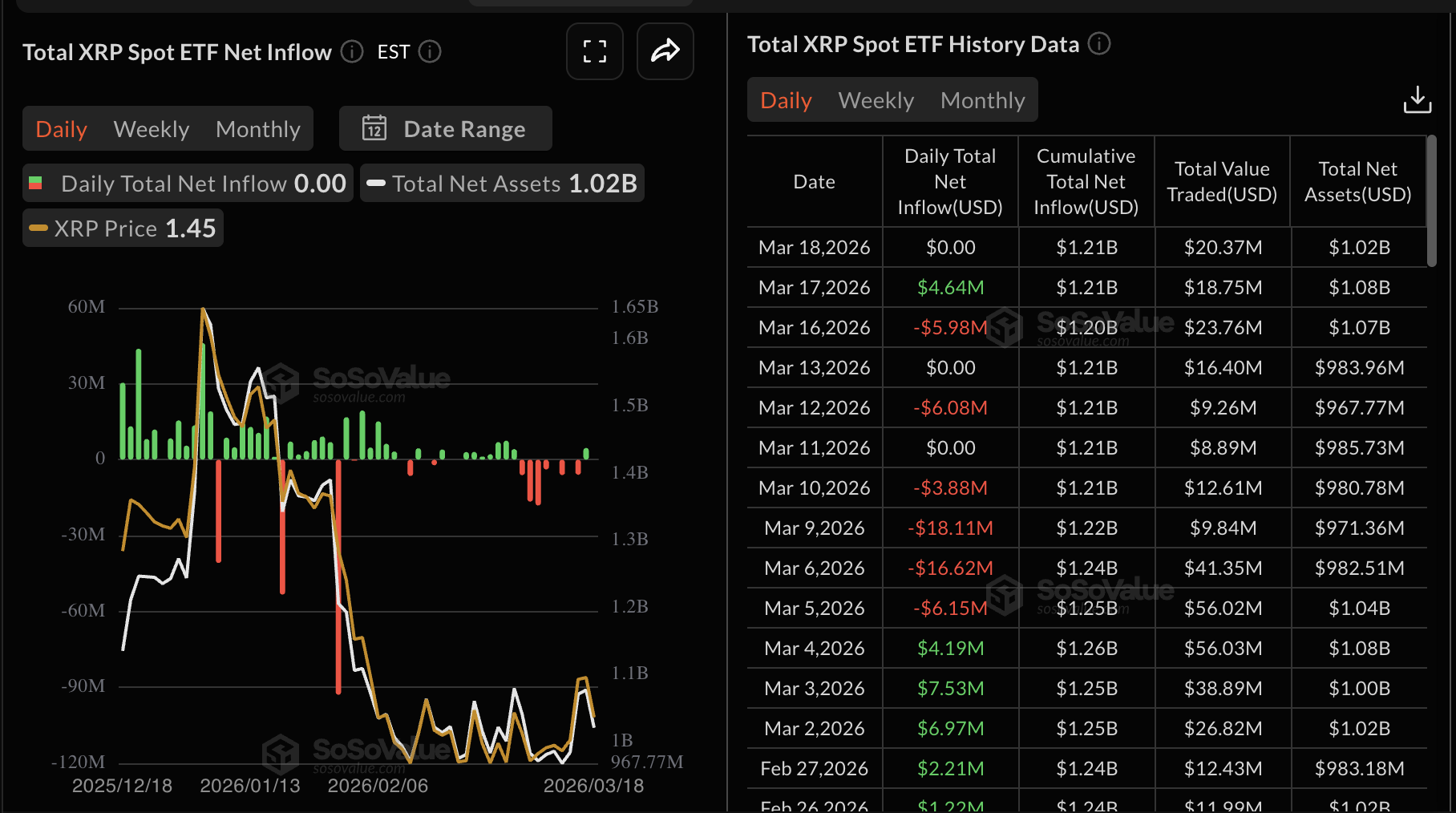
Institutional-related interest remains shaky, as reflected by muted activity in XRP spot Exchange-Traded Funds (ETFs) on Wednesday. SoSoValue data shows that US-listed ETFs recorded zero flows, leaving cumulative inflows at $1.21 billion and total assets under management at $1.02 billion.
So far this week, outflows total $1.34 million through Wednesday, undermining institutional interest in XRP digital investment products.
Technical outlook: XRP risks a deeper pullback as technicals falter
XRP is trading around $1.46 amid a neutral-to-bearish outlook as the price extends its decline from the weekly high of $1.61. The remittance token sits below a sequence of falling moving averages, with the 50-day Exponential Moving Average (EMA) near $1.51, the 100-day EMA around $1.69, and the 200-day EMA close to $1.94, which confirms a broader downtrend.
The Moving Average Convergence Divergence (MACD) indicator remains above its signal line on the daily chart, though recent contraction in the histogram bars shows fading upside momentum after the XRP spike to $1.61. Moreover, the Relative Strength Index (RSI) around 52 is moving toward neutral territory, aligning with the ongoing correction.
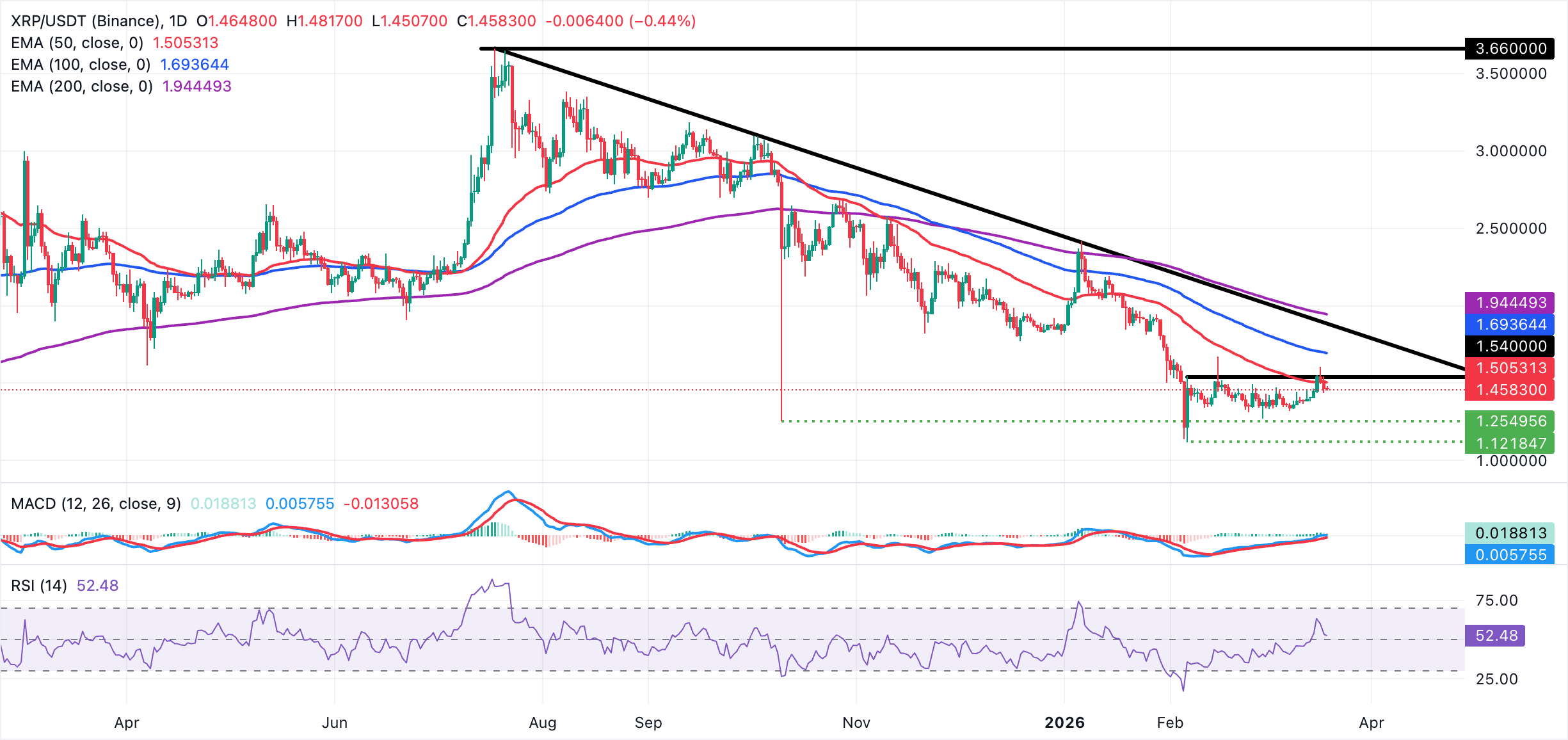
XRP remains capped well below the long-standing descending resistance trend line, which continues to frame the broader structure as corrective rather than bullish.
On the downside, initial support lies around $1.45. A break below this level would expose deeper support toward $1.40, where the recent low aligns with the broader consolidation floor. Looking up, immediate resistance is seen at $1.50, followed by $1.61, the latest swing peak that halted the prior advance.
Ripple FAQs
Ripple is a payments company that specializes in cross-border remittance. The company does this by leveraging blockchain technology. RippleNet is a network used for payments transfer created by Ripple Labs Inc. and is open to financial institutions worldwide. The company also leverages the XRP token.
XRP is the native token of the decentralized blockchain XRPLedger. The token is used by Ripple Labs to facilitate transactions on the XRPLedger, helping financial institutions transfer value in a borderless manner. XRP therefore facilitates trustless and instant payments on the XRPLedger chain, helping financial firms save on the cost of transacting worldwide.
XRPLedger is based on a distributed ledger technology and the blockchain using XRP to power transactions. The ledger is different from other blockchains as it has a built-in inflammatory protocol that helps fight spam and distributed denial-of-service (DDOS) attacks. The XRPL is maintained by a peer-to-peer network known as the global XRP Ledger community.
XRP uses the interledger standard. This is a blockchain protocol that aids payments across different networks. For instance, XRP’s blockchain can connect the ledgers of two or more banks. This effectively removes intermediaries and the need for centralization in the system. XRP acts as the native token of the XRPLedger blockchain engineered by Jed McCaleb, Arthur Britto and David Schwartz.
(The technical analysis of this story was written with the help of an AI tool.)
Author

John Isige
FXStreet
John Isige is a seasoned cryptocurrency journalist and markets analyst committed to delivering high-quality, actionable insights tailored to traders, investors, and crypto enthusiasts. He enjoys deep dives into emerging Web3 tren