XRP eyes support as investors boost ETF and derivatives exposure
- XRP pressured below the $1.50 supply zones but holds $1.45 short-term support on Friday.
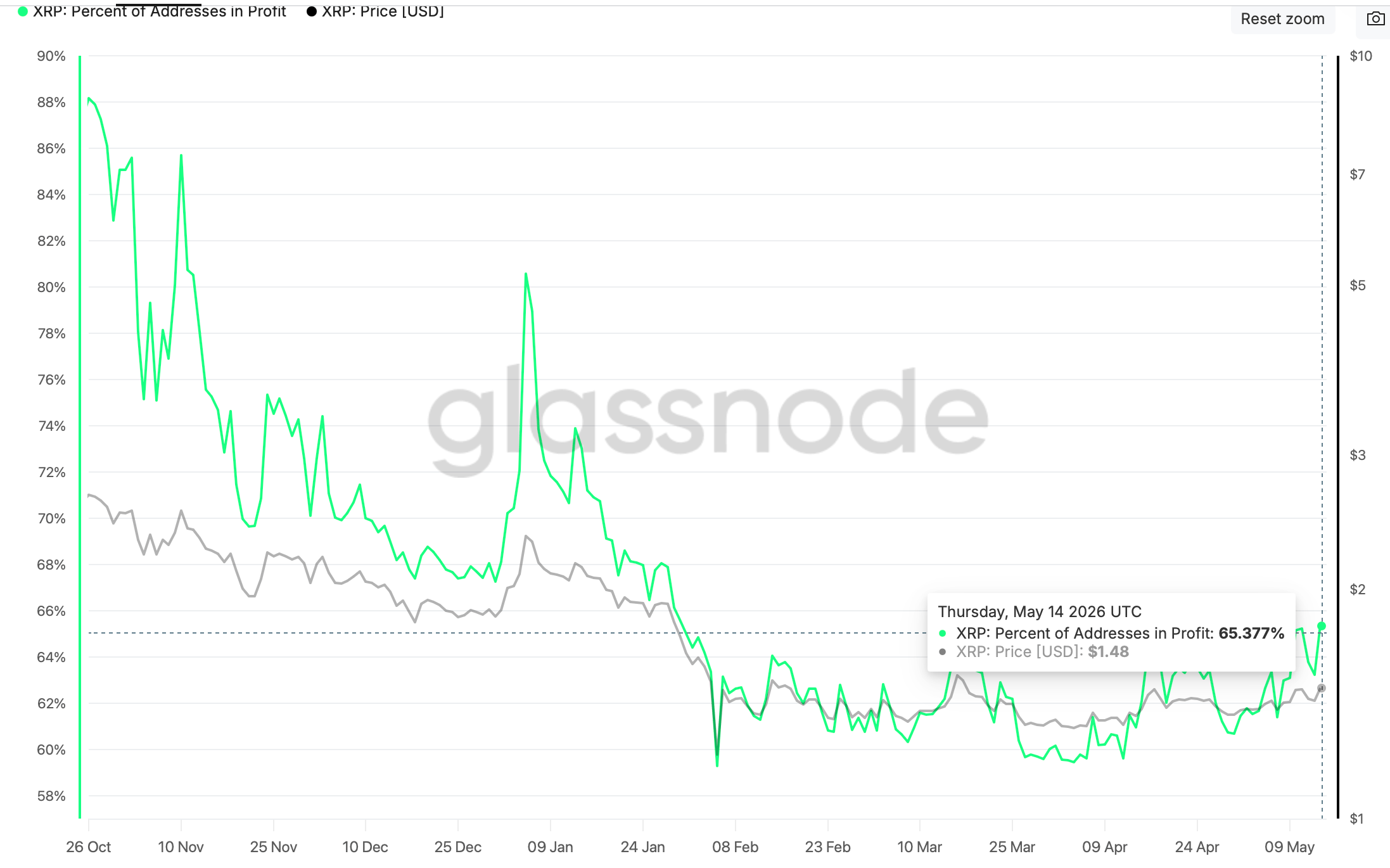
- The percentage of XRP addresses in profit rebounded to 65% on Thursday, reflecting a notable uptick in market risk appetite.
- XRP retail and institutional investors increase risk exposure as capital flows in through derivatives and spot ETFs.


Ripple (XRP) is grinding lower and testing support at $1.43 at the time of writing on Friday. It is pressured by strong bearish waves from the supply range at $1.50, which has capped its upside since Monday.
Despite the United States (US) Senate Banking Committee advancing the Digital Asset Market Clarity Act of 2025, commonly known as the Clarity Act, on Thursday, marking a major milestone for digital assets regulation in the country, sentiment remained largely constrained due to a lack of conviction in the broader crypto market’s recovery outlook.
XRP addresses in profit tick up amid capital inflows
The percentage of XRP addresses with unrealized profit rebounded to around 65% on Thursday, up from 63% the previous day. This increase coincided with XRP testing the $1.50 resistance and underscores a growing risk-on sentiment among market participants.
Still, traders should remain cautiously optimistic in case investors realize profits, which could weigh on the price amid a weakening technical environment.
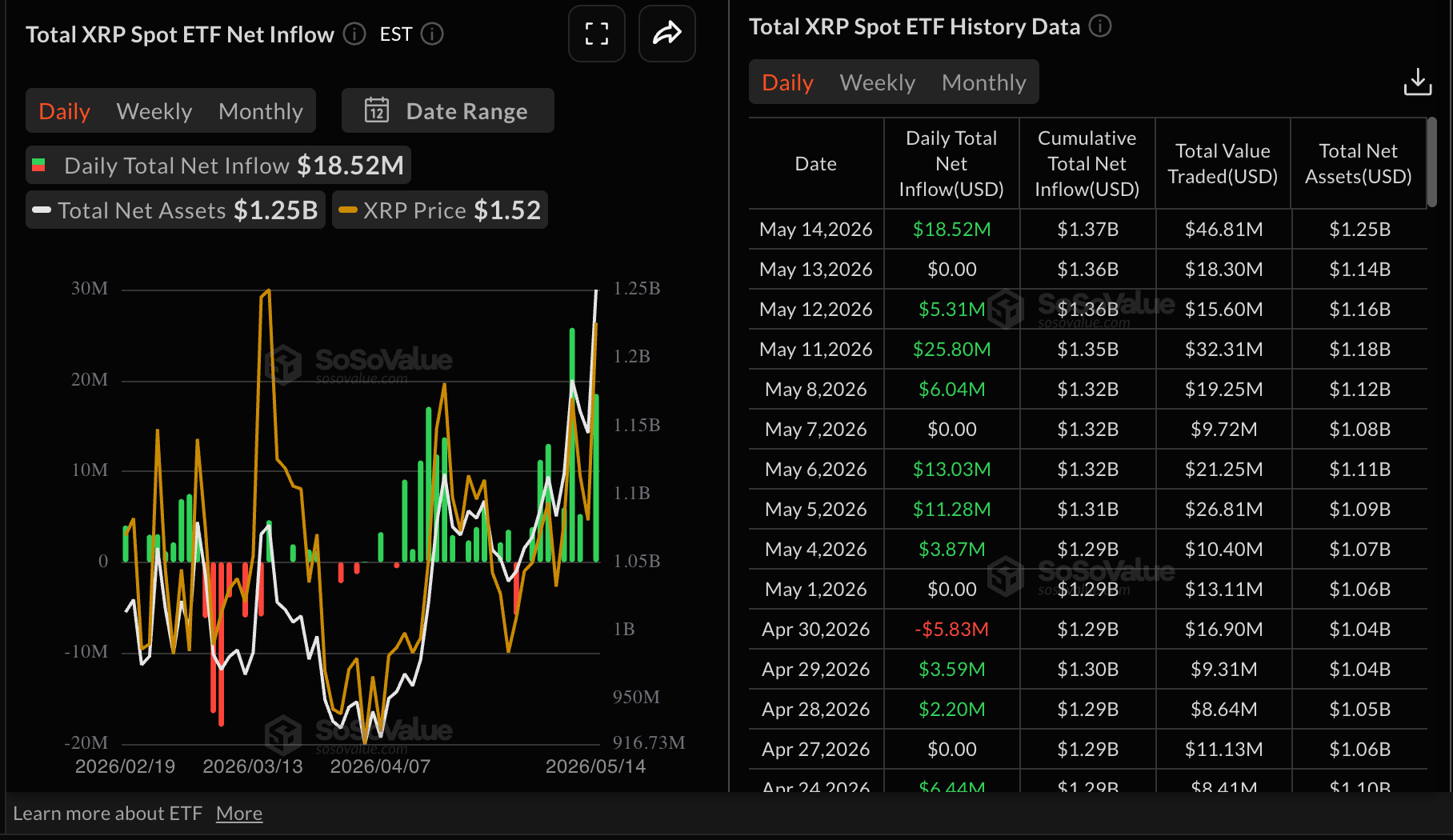
Institutional flows into XRP spot Exchange-Traded Funds (ETFs) rebounded sharply on Thursday, with nearly $19 million in fresh inflows following a brief pause the previous day. Demand for these ETFs has held steady, with cumulative inflows rising to $1.37 billion from $1.36 billion, while net assets under management increased to an average of $1.25 billion, up from $1.14 billion.
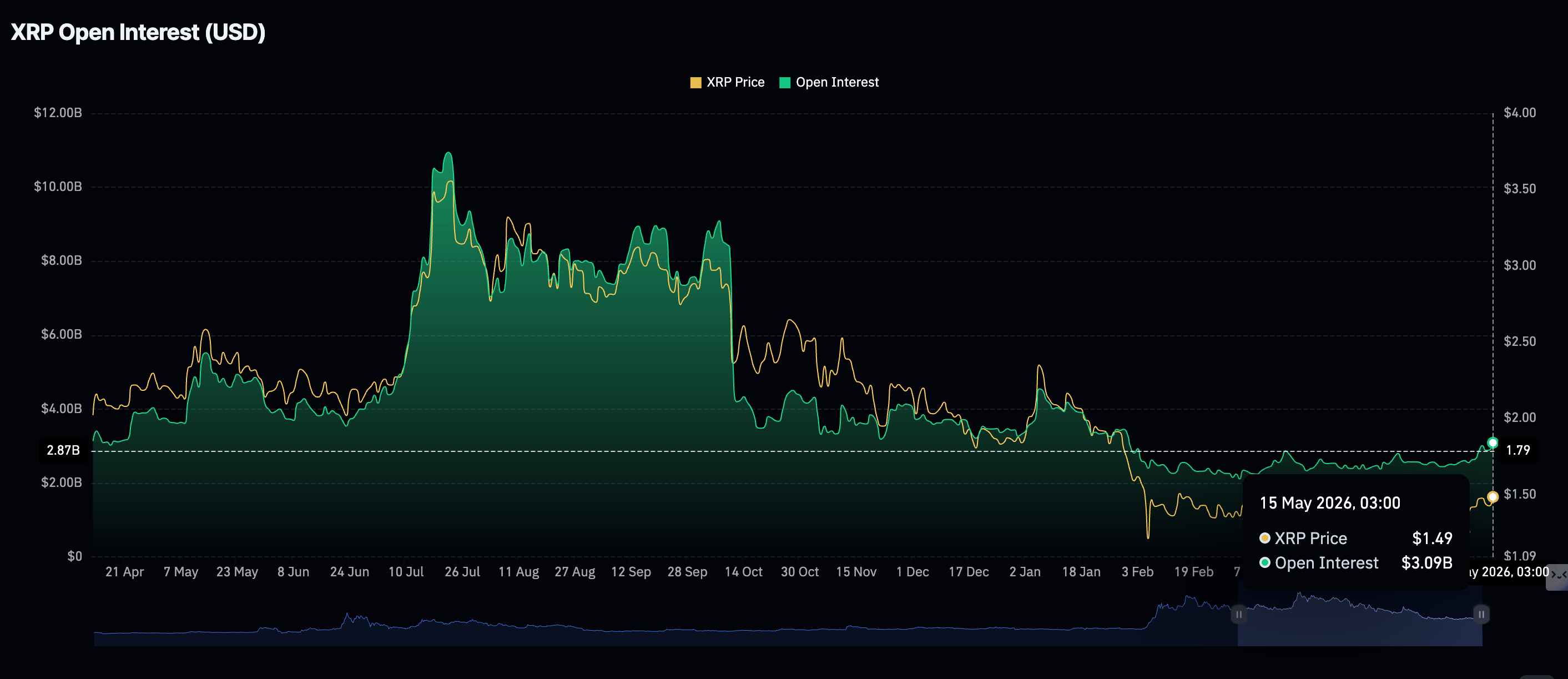
Retail participation in XRP derivatives continues to strengthen, as evidenced by a rise in futures Open Interest (OI) to an average of $3.09 billion on Thursday, up from $2.90 billion the previous day. This uptick in OI mirrors the broader improvement in risk appetite and highlights traders’ strong conviction in XRP’s potential to extend its upward trajectory.
Technical outlook: XRP wobbles as sellers tighten grip
XRP trades at $1.43, holding a neutral to mildly constructive bias as price trades above the 50-day Exponential Moving Average (EMA) at $1.42 while remaining capped beneath the 100-day EMA at $1.49 and the 200-day EMA at $1.70. This configuration suggests an ongoing consolidation within a broader corrective phase.
Momentum is mixed, as the Relative Strength Index (RSI) at 52 on the daily chart and a slightly positive Moving Average Convergence Divergence (MACD) histogram hint at limited directional conviction rather than a sustained impulsive move.
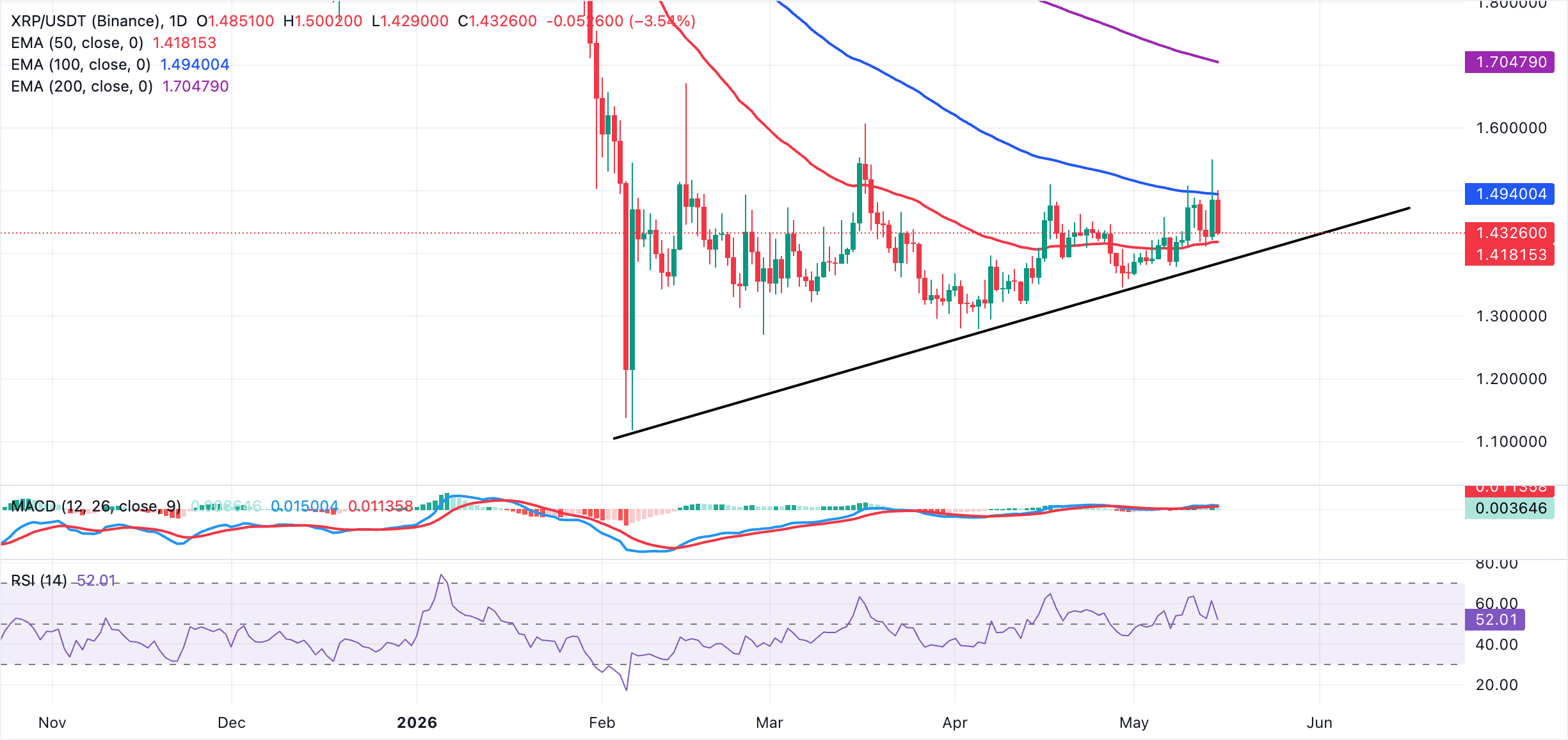
On the downside, immediate support lies at the 50-day EMA around $1.42, with the rising trendline zone near $1.39 serving as a more important floor. A daily close below that area would likely expose deeper losses. On the topside, initial resistance is seen at the 100-day EMA at $1.49, and only a sustained break above this level would open the door toward the more distant 200-day EMA near $1.70, where the broader bearish pressure would be more decisively challenged.
(The technical analysis of this story was written with the help of an AI tool.)
Crypto ETF FAQs
An Exchange-Traded Fund (ETF) is an investment vehicle or an index that tracks the price of an underlying asset. ETFs can not only track a single asset, but a group of assets and sectors. For example, a Bitcoin ETF tracks Bitcoin’s price. ETF is a tool used by investors to gain exposure to a certain asset.
Yes. The first Bitcoin futures ETF in the US was approved by the US Securities & Exchange Commission in October 2021. A total of seven Bitcoin futures ETFs have been approved, with more than 20 still waiting for the regulator’s permission. The SEC says that the cryptocurrency industry is new and subject to manipulation, which is why it has been delaying crypto-related futures ETFs for the last few years.
Yes. The SEC approved in January 2024 the listing and trading of several Bitcoin spot Exchange-Traded Funds, opening the door to institutional capital and mainstream investors to trade the main crypto currency. The decision was hailed by the industry as a game changer.
The main advantage of crypto ETFs is the possibility of gaining exposure to a cryptocurrency without ownership, reducing the risk and cost of holding the asset. Other pros are a lower learning curve and higher security for investors since ETFs take charge of securing the underlying asset holdings. As for the main drawbacks, the main one is that as an investor you can’t have direct ownership of the asset, or, as they say in crypto, “not your keys, not your coins.” Other disadvantages are higher costs associated with holding crypto since ETFs charge fees for active management. Finally, even though investing in ETFs reduces the risk of holding an asset, price swings in the underlying cryptocurrency are likely to be reflected in the investment vehicle too.
Author
John Isige
FXStreet
John Isige is a seasoned cryptocurrency journalist and markets analyst committed to delivering high-quality, actionable insights tailored to traders, investors, and crypto enthusiasts. He enjoys deep dives into emerging Web3 tren