Memory crisis: How AI is disrupting console gaming

Memory prices have experienced an unprecedented surge in recent years, creating mounting pressure across the consumer electronics industry and particularly within the gaming hardware sector. For companies such as Nintendo, rising memory costs could become a major challenge for both hardware profitability and consumer demand.
Memory prices skyrocket by 80–90% in Q1 2026 over previous quarter
According to Counterpoint’s Memory Price Tracker, memory prices soared between 80% and 90% in Q1 2026 compared to Q4 2025, marking one of the sharpest increases ever. DRAM, NAND Flash and HBM all reached record highs as supply shortages intensified across the market.
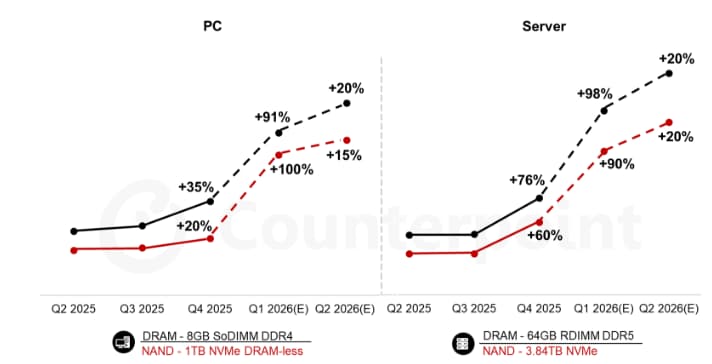
The primary driver behind this rally is the explosive expansion of artificial intelligence infrastructure.
As Steven Woo, Forbes Councils Member, explained, in the early phase of the AI boom, semiconductor companies focused mainly on developing faster GPUs and scaling training capacity. However, as AI models became larger and more complex, the bottleneck gradually shifted away from pure computing power toward memory capacity and data transfer efficiency.
According to him, the industry is now increasingly constrained by how quickly data can be accessed and moved between processing engines rather than by compute performance alone. As AI systems continue to expand in size and context length, memory has become one of the most critical components determining overall AI scalability and performance.
This shift has triggered an aggressive global buildout of AI infrastructure. Major technology firms are racing to secure advanced memory supplies for AI servers and data centers, putting enormous strain on the semiconductor supply chain. As a result, shortages have emerged across several key memory categories, especially HBM and server-grade DRAM.
The impact is now spreading beyond the AI sector and into consumer electronics industries such as gaming consoles, PCs and smartphones. General-purpose server DRAM has been one of the main contributors to the recent spike, but NAND Flash prices have also risen sharply, increasing storage costs for hardware manufacturers.
TrendForce’s March 2026 research suggests that the pressure is unlikely to ease anytime soon.
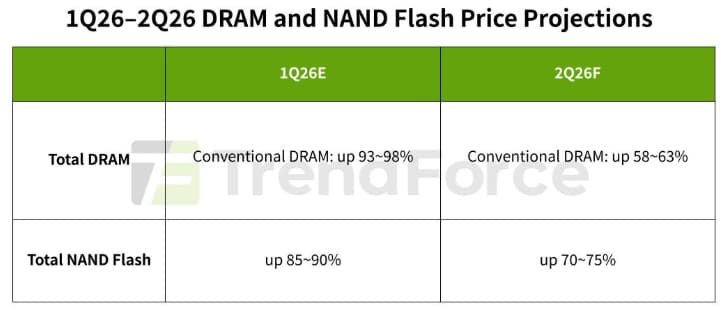
Conventional DRAM contract prices are expected to rise another 58% to 63% quarter-on-quarter in Q2 2026, while NAND Flash contract prices could increase by an additional 70% to 75% QoQ. For gaming hardware manufacturers such as Nintendo, these trends could create several operational and financial risks.
Why rising memory costs are a threat to gaming manufacturers?
Modern gaming consoles rely heavily on DRAM and NAND Flash memory for performance, storage capacity and game loading speeds. Rising component costs therefore directly increase manufacturing expenses per unit. Nintendo has projected that these rising hardware expenses, coupled with the impact of tariffs, will inflate their costs by approximately 100 billion yen ($638 million) during this fiscal year.
If memory inflation persists throughout 2026, console makers may face lower hardware margins unless they pass part of the increase onto consumers through higher retail prices, which is what Nintendo declared this week ready to do.
Specifically, the Switch 2 is seeing significant price hikes: the U.S. model will rise by $50 to $499.99 effective September 1, while the Japanese model will jump by 10,000 yen to 59,980 yen on May 25. Nintendo has confirmed that similar price adjustments are also slated for the Canadian and European markets.
This situation becomes particularly sensitive for the gaming industry because consumer demand remains highly price elastic.
Senior Research Analyst at Counterpoint, Jeongku Choi, warned that device manufacturers are facing a “double whammy”: rising component costs combined with weakening consumer purchasing power. Higher inflation and slower economic growth in several regions are already reducing discretionary spending, particularly for expensive consumer electronics.
Nintendo traditionally targets a broader family-oriented audience compared to premium-focused competitors, meaning affordability remains a core part of its business model. Sustained memory inflation could therefore limit Nintendo’s flexibility on pricing strategy, especially if it aims to maintain strong mass-market demand for its gaming ecosystem.
Higher memory costs could also influence product specifications and launch strategies. Manufacturers may attempt to offset rising expenses by reducing storage capacity, limiting hardware upgrades or prioritizing higher-margin premium versions of consoles and accessories. Choi noted that OEMs may increasingly focus on premium models in order to justify higher prices by offering additional value to consumers.
Another potential consequence concerns software and digital gaming ecosystems. As storage costs rise, manufacturers could further accelerate the transition toward digital distribution and subscription services, which generally provide higher margins and recurring revenue streams. Companies with strong first-party gaming ecosystems may therefore be better positioned to absorb hardware margin pressure over time.
At the same time, the broader semiconductor shortage could lead to tighter console inventories if manufacturers struggle to secure enough memory supply. This would not only impact production volumes but could also create launch delays, limited stock availability and additional volatility in gaming hardware pricing throughout 2026.
Stay up to date with what's moving and shaking on the world's markets and never miss another important headline again! Check ActivTrades daily news and analyses here.
Author

Carolane de Palmas
ActivTrades
Carolane graduated with a Masters in Corporate Finance & Financial Markets and got the AMF Certification (Financial Markets Regulator in France). Afterward, she became an independent trader, investing mostly in European and American stocks/indices.