Ethereum Foundation unveils 'Strawmap' plan for Layer 1 upgrades through 2029
- Ethereum Foundation released Strawmap, outlining proposed Layer 1 upgrades and a structured timeline extending through 2029.
- The roadmap highlights five north stars, including faster finality, higher throughput, post-quantum security, scalable Layer 2, and built-in privacy.
- Vitalik Buterin proposed gradual reductions in slot time and faster finality to improve the user experience while maintaining network security.


The Ethereum Foundation (EF) has introduced Strawmap, outlining proposed Layer 1 upgrades through 2029, with goals focused on speed, scalability, security, privacy, and improved user experience.
Ethereum Foundation releases Strawmap, highlighting new protocol goals
The Ethereum Foundation’s Protocol team has introduced a new planning document called Strawmap, outlining a long-term vision for Ethereum’s Layer 1 development. The announcement was shared by Ethereum (ETH) researcher Justin Drake in an X post on Wednesday.
Strawmap combines the words “strawman” and “roadmap.” The document is designed to help researchers, developers, and governance participants understand how upcoming upgrades fit together. It presents Ethereum’s future upgrades in one visual format to encourage coordination across the ecosystem.
Strawmap outlines a projected timeline that runs through the end of the decade. It proposes seven network forks by 2029, following a rough six-month release cycle.
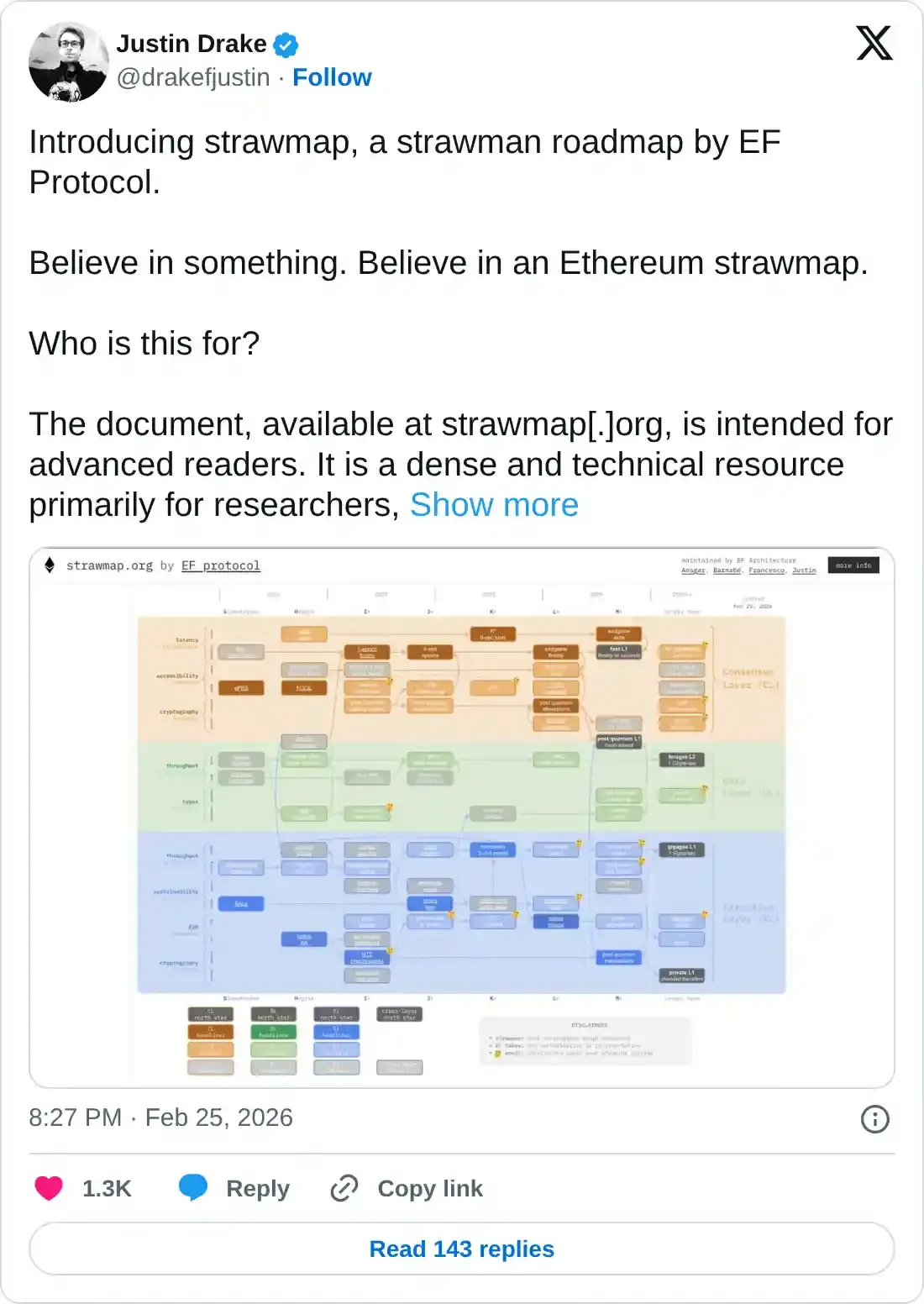
The layout features three color-coded horizontal layers representing the Consensus Layer, Data Layer, and Execution Layer. Within these, upgrades are grouped by themes, with arrows showing dependencies and underlined links to EIPs. Headliners are prominent, ambitious items, typically one per layer per fork to keep development cadence high.
At the core of the roadmap are five long-term priorities, described as “north stars.” These include building a faster Layer 1 to improve user experience with shorter slot times and near-instant finality. Another goal is a “gigagas” Layer 1 capable of processing around 1 gigagas per second, or roughly 10,000 transactions per second, powered by zkEVM technology and real-time proving.
The roadmap also envisions a “teragas” Layer 2 that could handle up to 1 gigabyte per second, or about 10 million transactions per second, using data availability sampling. In addition, it targets a post-quantum Layer 1 secured by hash-based cryptography, as well as a private Layer 1 that enables native privacy features such as shielded ETH transfers.
Ethereum co-founder Vitalik Buterin responded to the proposal with a detailed explanation of how the “fast L1” goal could be achieved.
Buterin suggested gradually reducing slot times, which determine how often new blocks are produced.
He proposed using a square-root-of-two reduction method, moving step by step from 12 seconds to 8, then to 6, 4, 3, and possibly 2 seconds. He emphasized that the later reductions would depend on further research and testing.
“I expect that we’ll reduce slot time in an incremental fashion,” Buterin wrote, adding that changes would only happen when developers are confident the network can handle them safely.
He also discussed improving Ethereum’s peer-to-peer network by using tools such as erasure coding to reduce block propagation delays.
In addition to faster block times, Ethereum developers are exploring a new finality system called Minimmit, a one-round Byzantine Fault Tolerant mechanism.
Strawmap was first developed during an Ethereum Foundation workshop in January 2026 to serve as a discussion framework rather than a fixed roadmap.
ETH is trading at $2,060 at the time of publication on Friday, down 0.1% over the past 24 hours.
Author
Michael Ebiekutan
FXStreet
With a deep passion for web3 technology, he's collaborated with industry-leading brands like Mara, ITAK, and FXStreet in delivering groundbreaking reports on web3's transformative potential across diverse sectors. In addition to