Debasement trades lift Bitcoin amid long-term holder distributions

Bitcoin (BTC/USD) remains close to three-month highs after a strong rebound brought digital assets back into focus. The cryptocurrency has gained more than 20% over the past week and approached $80,000, supported by changing conditions in the US bond market, renewed investor demand and a return of the debasement trade. Bitcoin opened above $77,500 on Monday, 24 August, after reaching around $79,500 on Friday.
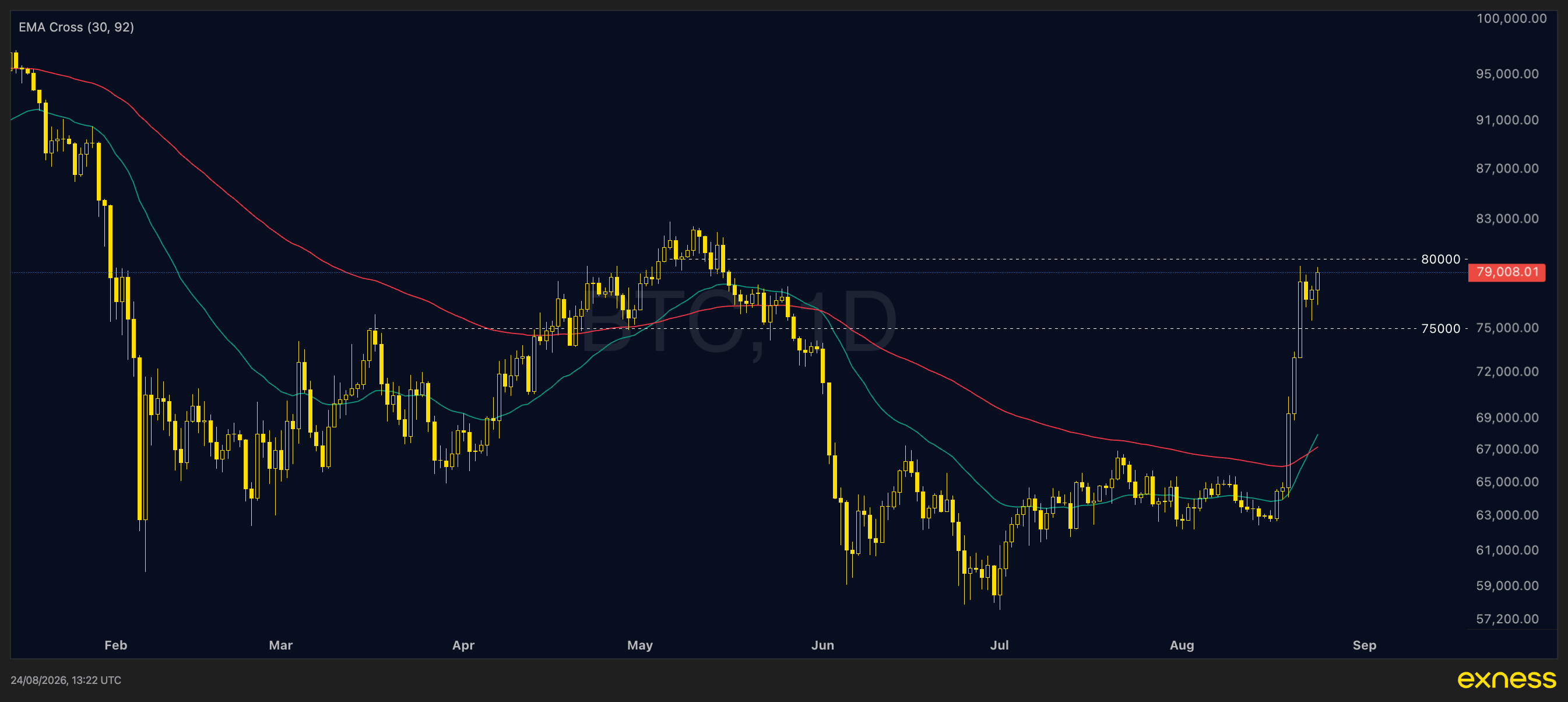
US Treasury policy has played an important role in the latest move. The Treasury Department recently announced that it will at least double the maximum size of liquidity-support buybacks for longer-dated government securities from September, increasing the cap to at least $4 billion per operation from $2 billion. The announcement initially pressured longer-term Treasury yields lower and weakened the dollar, creating a more supportive environment for bitcoin and other alternative assets. However, the effect proved relatively short-lived as yields recovered, with concerns around government borrowing, inflation, and the US fiscal outlook continuing to influence the bond market.
The development has also strengthened interest in debasement trades. Concerns about government debt and the longer-term purchasing power of traditional currencies can increase demand for assets perceived as scarce or less directly tied to sovereign balance sheets. Bitcoin has benefited from this narrative alongside other alternative assets, while the initial decline in US yields provided another tailwind. Short covering also contributed to the speed of the rally, suggesting that positioning has amplified the underlying improvement in sentiment.
Investor demand has provided additional support. US spot bitcoin ETFs recorded strong net inflows over the latest week, indicating that investors have increased their exposure during the rebound. This demand could become particularly important after such a rapid advance, as sustained ETF inflows may help provide a stronger foundation for the rally once the impact of short covering and the initial reaction to the Treasury announcement begin to fade.
At the same time, activity among existing bitcoin holders presents a more cautious signal. Long-term holders reduced their positions by around 15,800 BTC over the same period, not taking into account the Coldcard-related movements, suggesting some investors are using the latest rise to realise profits accumulated at lower prices. With bitcoin approaching the psychologically area of $80,000, additional distribution could increase selling pressure and make further gains more dependent on fresh demand entering the market.
The broader macroeconomic environment remains mixed. US Treasury yields have somewhat recovered on Monday, but longer-term borrowing costs remain elevated and the dollar has regained some ground. This leaves bitcoin facing a less straightforward backdrop than during the
Author

Christopher Tahir
Exness
CMT Level II | Certified Financial Planner (2012) Bachelor’s degree in Accounting Initiated the Indonesian translation of the Bitcoin Whitepaper (2018)