Can Bitcoin hold $75K as geopolitical risks return and Oil prices rise?
- BTC eases back from 78k, a 10-week high to 75k.
- Doubts grow over the outlook for peace in the Middle East.
- Oil jumps 6% as the Strait remains closed.
- But risk assets show signs of resilience and fatigue with headlines.
- BTC ETFs post a third week of net inflows.
- BTC technical analysis.

After rising to a 10-week high of $78K last week, Bitcoin pulled back over the weekend, finding support around the $75K level, where it trades at the start of the new week.
Bitcoin and broader risk assets had rallied last week on optimism surrounding a potential lasting US–Iran peace deal. However, doubts are now emerging over the durability of any truce following weekend developments. Reports that the US attacked an Iranian-flagged vessel, alongside Iran’s decision to close the Strait of Hormuz again after briefly reopening it on Friday, have renewed concerns over renewed hostilities in the region.
While US negotiators are expected to arrive in Pakistan for talks, Iranian state media has suggested that officials may not attend, adding further uncertainty.
What next for BTC as Oil and treasury yields rise, risk assets fall?
The shift in sentiment is being reflected across financial markets. Oil prices have jumped around 6%, lifting inflation expectations and pushing Treasury yields higher — a combination that typically weighs on risk assets such as Bitcoin.
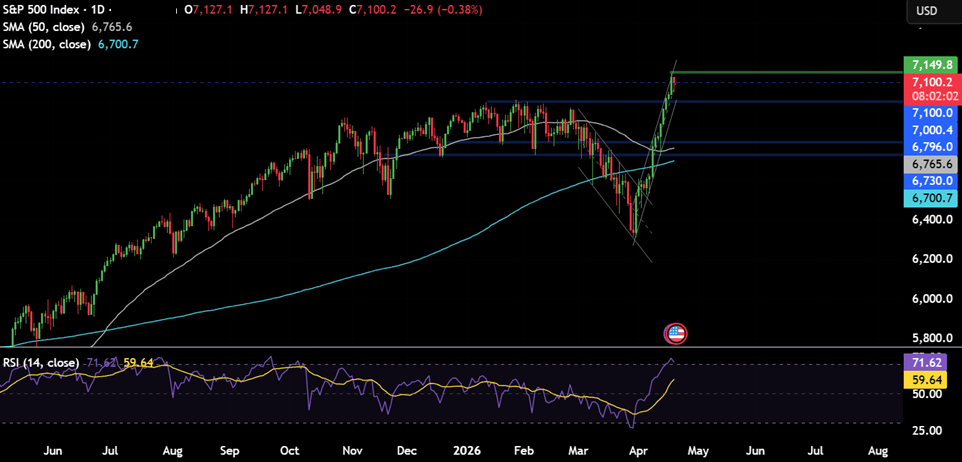
US equity futures are pointing lower after stocks reached record highs last week, although futures have recovered from earlier lows, suggesting the market is becoming increasingly resilient to toing and froing headlines.
This reinforces a key point that crypto is currently trading as a macro-sensitive asset. Bitcoin’s direction is closely tied to geopolitical developments. If tensions escalate further, higher oil prices could drive yields higher and tighten financial conditions — an environment in which Bitcoin typically struggles.
Conversely, credible progress towards peace could see oil prices fall, inflation concerns ease, and risk appetite recover. The fact that BTC has steadied and oil remains below $100 suggests that, whilst progress is rocky, the situation is still moving in the right direction and will eventually end the conflict.
Institutional demand remains supportive
Despite the macro uncertainty, institutional demand continues to provide a supportive backdrop. Spot BTC ETFs recorded $996.4 million in net inflows last week — the strongest weekly inflow since mid-January — extending a three-week streak of positive flows.
Over the past three weeks, cumulative inflows have reached approximately $1.8 billion, reflecting steady institutional accumulation. At the same time, traditional finance participation is expanding. Morgan Stanley recently launched its MSBT Bitcoin ETF, while Goldman Sachs has also introduced new crypto-related products.
These developments highlight growing acceptance of Bitcoin within traditional financial markets and provide a structural source of demand.
However, it is worth noting that the average ETF investor cost basis is estimated to be above current price levels (around $81K), which could act as a resistance zone as investors look to exit at breakeven.
Bitcoin technical analysis
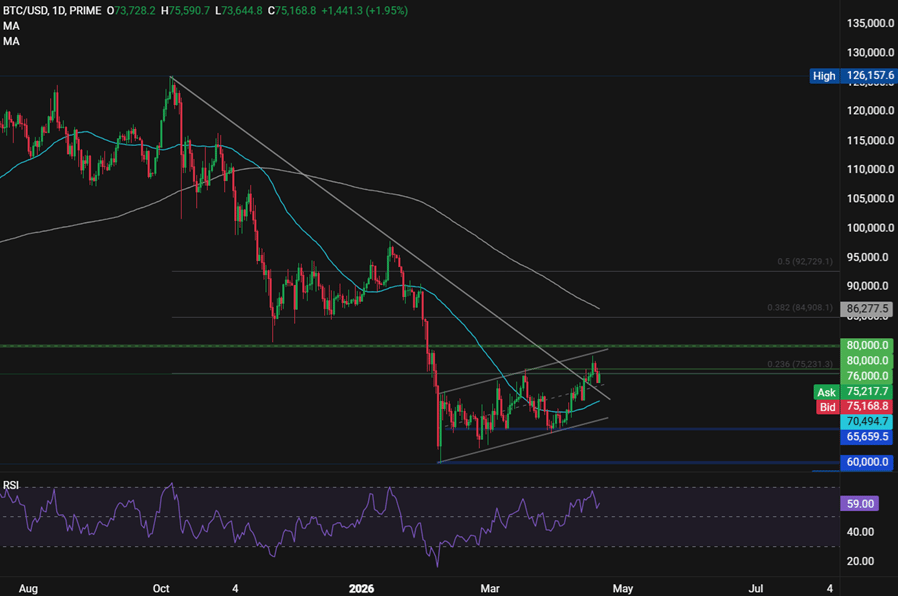
Bitcoin continues to trade within a rising channel that has been in place since early February.
The price recently broke above a multi-month descending trendline from the $126K peak but failed to sustain momentum above $78K, the upper and of the rising channel — and has since pulled back to consolidate around $75K, below the 23.6% Fibonacci retracement of the move from $126K to $60K.
Buyers, supported by the RSI above 50, will look to break above $78K to open the door to $80K (psychological level and November low), followed by $85K (38.2% retracement level and near the 200-day moving average).
On the downside, initial support is seen around $72K (trendline support), followed by $70K (50-day SMA) and 67k (the lower band of the rising channel). A break below $65K would signal a lower low and increase the risk of a deeper move towards $60K.
Start trading with PrimeXBT
Author

PrimeXBT Research Team
PrimeXBT
PrimeXBT is a leading Crypto and CFD broker that offers an all-in-one trading platform to buy, sell and store Cryptocurrencies and trade over 100 popular markets, including Crypto Futures, Copy Trading and CFDs on Crypto, Forex, I