Bitcoin's identity crisis: Hedge, tech proxy, or liquidity trade?

The Gold vs. Bitcoin debate has turned into one of the defining macro arguments of 2026, and for once, it is not abstract. Gold is still trading near $4,500 per ounce in May — up from a territory that felt unreachable not long ago. Bitcoin had its moment above $120,000 in late 2025, then handed most of it back and has been stuck in the $76,000–$80,000 range ever since. Watching that play out in real time is what finally pushed investors to do something they had been putting off for years: treat these two assets as separate things.
Why Gold has outperformed
The current Bitcoin vs. gold setup reflects the type of stress driving global markets. Geopolitical tension around Iran, central banks quietly stacking reserves, and a creeping unease about where the dollar goes from here—that combination has kept gold bid all year. Goldman Sachs and J.P. Morgan have both held constructive views on the metal through all of it, though neither is writing the same price target, and how this plays out still depends heavily on what the Fed does next.
The scale difference also matters. The gold market cap vs. Bitcoin gap tells the story plainly: roughly $22 trillion against $1.5 trillion. That is not a rounding error. Central banks are not sitting on bitcoin reserves because bitcoin does not fit the institutional infrastructure they have spent decades building around gold: custody frameworks, legal precedent, treaty obligations, and decades of precedent baked into sovereign balance sheets. Bitcoin is still, for most governments, a private-market instrument. That may change. It has not yet.
The bitcoin vs gold store of value question does not have a clean answer, and anyone who tells you it does is selling something. Bitcoin has historically shown up when liquidity is loose and risk appetite is running hot. Gold does its job when the world feels genuinely dangerous and people want out of everything else. The problem is that markets in 2026 have been both things at once, which is exactly why this debate keeps going in circles. The current environment has favored the latter.
Bitcoin is trading more like a liquidity asset
In 2026, Versus Trade BTC/XAU increasingly reflects two separate market functions rather than two versions of the same hedge.
Bitcoin's relationship with equities strengthened noticeably after the approval of spot ETFs in 2024. During several periods in early 2026, BTC traded more closely in line with risk assets than with traditional defensive instruments. Institutional flows became a much larger driver of price action than they were in earlier crypto cycles.
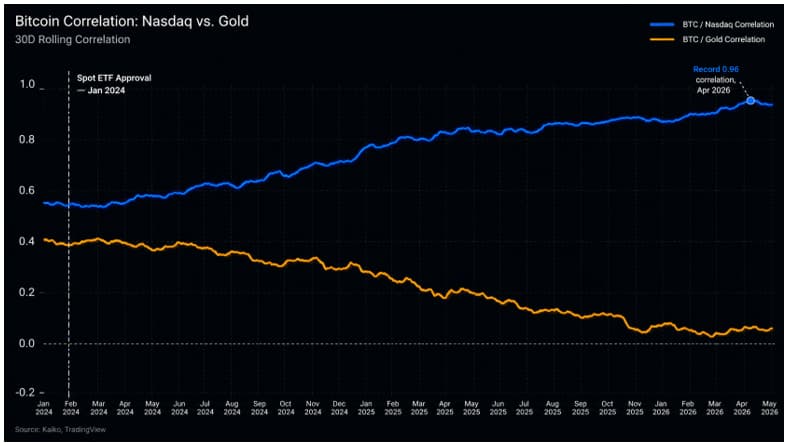
The latest gold vs. Bitcoin comparison also highlights how ETF demand reshaped market structure. U.S. spot bitcoin ETFs attracted billions of dollars in net inflows during the first months of 2026, while BlackRock's IBIT remained the dominant vehicle for institutional exposure. Even during corrections, large allocators continued adding exposure instead of exiting positions aggressively.
The conversation around crypto vs. gold hedge has changed alongside that shift. Gold is still viewed primarily as protection against geopolitical instability and long-term monetary uncertainty. Bitcoin now trades more as a liquidity-sensitive macro asset tied to institutional positioning, ETF demand, and broader risk appetite.
What traders are watching now
The modern gold vs. Bitcoin chart tells a more nuanced story than the old "digital gold" narrative. Gold reacts more cleanly when markets prioritize safety and stability. Bitcoin tends to respond faster once liquidity expectations improve and institutional inflows accelerate.
For many traders, ETF flow data has become one of the most closely watched indicators for BTC. That does not mean inflation or Federal Reserve policy stopped mattering. It simply means market structure has changed since large institutional products entered the space.
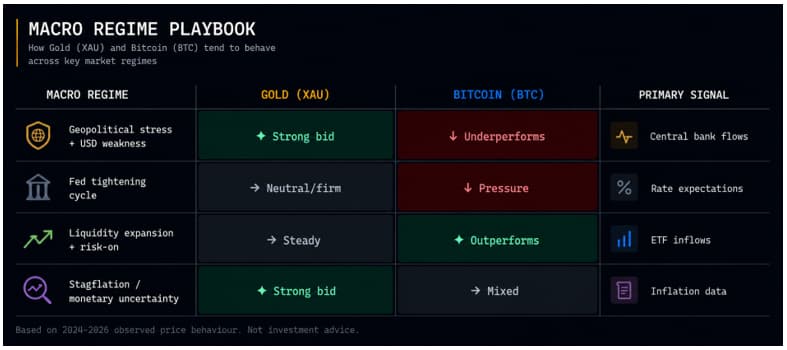
Reading the gold price vs. Bitcoin relationship now requires identifying the dominant macro regime. For traders trying to trade Bitcoin vs. gold, the ideology debate is mostly noise. What actually matters is where liquidity is going. When conditions tighten and geopolitics gets messy enough that people just want to stop losing money, gold absorbs that flow quietly. It does not spike; it does not tweet about itself; it just goes up. Bitcoin does the opposite thing in the opposite environment — when liquidity loosens and risk appetite returns, it moves faster and harder than gold ever would, because the float is thin and the crowd that trades it has never been known for patience.
The Bitcoin vs. gold performance 2025–2026 cycle will probably get remembered as a rotation, not a verdict. Two assets doing different jobs in different conditions, neither one permanently winning. The structural Bitcoin argument — that institutional adoption eventually lets BTC eat into gold's role — has not been disproven, just delayed. Ark Invest put a number on it in a 2026 report: substantial market cap expansion by the end of the decade if the digital gold thesis keeps getting institutional traction. Could happen. The people who are absolutely certain it will are also, not coincidentally, the ones most long the asset. Worth keeping that in mind.
That possibility remains speculative, but it helps explain why institutional interest has not disappeared during the correction.
The current Bitcoin vs. gold chart shows that neither asset behaves the same way across every macro environment. Gold continues to function more effectively during periods dominated by geopolitical risk and defensive positioning. Bitcoin becomes more attractive when liquidity expands and investors move back toward higher-beta assets. Understanding that distinction matters more now than it did during previous cycles.
Author

Amir Razak
Versus Trade
Malaysian-born market analyst Amir Razak cuts through the noise every week, breaking down Versus Pairs and explaining what is really driving one asset ahead of another.