Bitcoin holds firm a year after crypto crash
- Bitcoin above $83,000 one year after the $19 billion liquidation event.
- CPI and the $85,000 level remain key near-term catalysts.
- Higher yields and elevated oil prices remain key headwinds.
- Corporate Bitcoin adoption grows; Strategy sees Bitcoin above $100,000.

One year on, crypto has recovered but not healed
It has been a year since the October 10, 2025 crypto crash that saw a record $19 billion in leveraged positions wiped out in a single day. While the market has recovered significantly from its post-crash lows, it has yet to fully heal. The bellwether cryptocurrency remains roughly one-third below its October 2025 record high near $126,000 and is down nearly 5% year-to-date, while leverage has declined and traders are taking less risk.
More importantly, some of the conditions that fuelled the 2025 crash remain intact, particularly the widespread use of perpetual futures. Yet unlike previous rallies, leverage is not driving the current advance. Despite Bitcoin gaining roughly 35% from its August lows near $63,500, futures positioning has remained subdued, while open interest continues to sit below its pre-crash peak of roughly $45 billion. This suggests the recovery has been driven more by spot demand, ETF flows and short covering than by aggressive leveraged speculation. Thus, while the recent move above $80,000 has helped restore confidence, risk appetite has yet to fully recover.
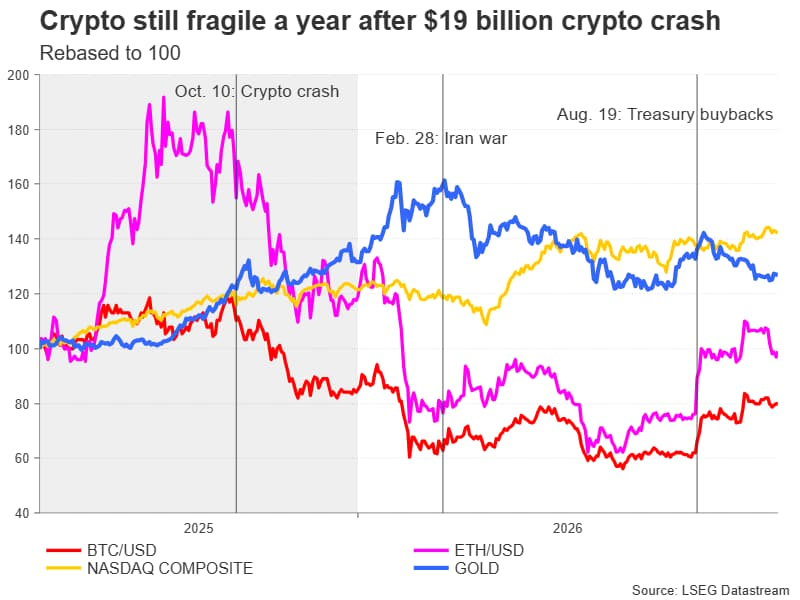
Bond market turmoil weighs on Bitcoin recovery
Bitcoin is trading above $83,000 as investors await Wednesday's US inflation report, with the recovery from August lows largely stalling within the $80,000-$87,000 range. Treasury yields have climbed to multi-year highs while oil prices remain elevated amid ongoing geopolitical uncertainty, reinforcing inflation concerns and weighing on risk assets. Against this backdrop, CPI is the next key catalyst. A hotter-than-expected reading could reinforce expectations that interest rates remain elevated for longer, supporting the US dollar and Treasury yields while pressuring cryptocurrencies. Conversely, a softer print could improve risk appetite and give Bitcoin room to retest the $85,000 resistance area.
Treasury yields remain an important part of the story. Higher yields have tightened financial conditions and increased the attractiveness of government bonds relative to non-yielding assets such as Bitcoin and gold. As a result, Bitcoin's ability to sustain a move above $85,000 may depend not only on crypto-specific flows but also on whether inflation cools sufficiently to ease pressure on bond markets.
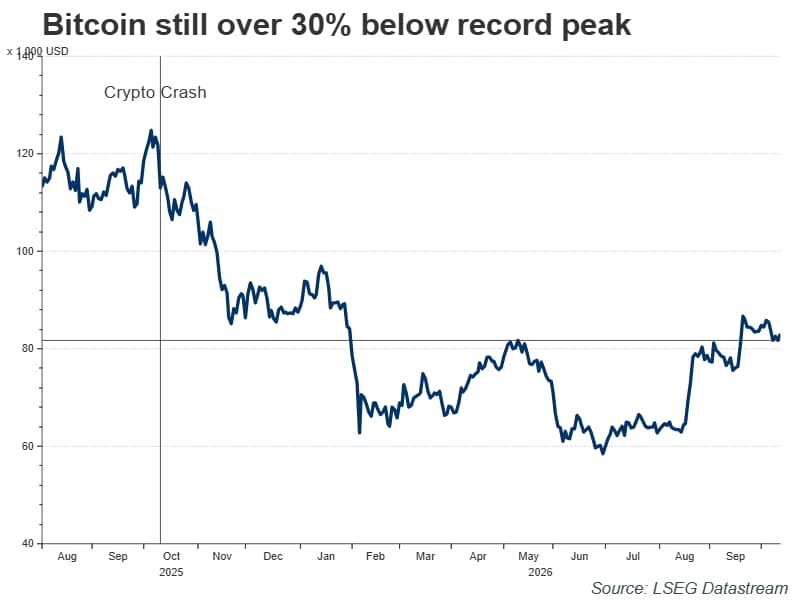
Corporate adoption continues to grow
Despite the more challenging macro backdrop, corporate adoption continues to expand. Bitcoin whale holdings have reached their highest level since late 2025, while banks, asset managers and trading firms continue to increase their involvement in digital assets as the industry becomes increasingly integrated with traditional finance. One year after the crash, the focus has shifted from speculative excess towards tokenization, settlement infrastructure and blockchain-based financial services, providing a longer-term structural tailwind for the sector.
Bitcoin's next move: $90k ceiling or $100k milestone?
Meanwhile, Strategy, the largest corporate holder of Bitcoin, remains one of the market's most closely watched participants. The company recently resumed Bitcoin purchases, reinforcing its long-term accumulation strategy even as the broader market remains rangebound. Executive Chairman Michael Saylor reiterated this week that Bitcoin should eventually move back above $100,000, citing improving regulation, growing bank adoption and increasing demand for scarce assets in an AI-driven economy.
His optimism contrasts with the more cautious view from QCP Capital, which expects Bitcoin to remain broadly rangebound between $80,000 and $90,000 during the fourth quarter. The contrast highlights the market's current dilemma: while the longer-term case remains constructive, investors are still searching for a catalyst capable of driving a sustained breakout. For now, inflation trends, ETF flows and institutional demand remain key factors determining whether Bitcoin can bridge the gap between today's consolidation range and the prospect of a return to six-figure prices.
ETF flows remain a key market gauge
Institutional participation remains one of the most important forces shaping Bitcoin's direction, though October has started on a softer footing. ETF flows have slowed considerably after strong inflows of $3.52 billion in August and $2.65 billion in September, with October seeing roughly $884 million in net outflows so far, leaving the month in negative territory.
The key question is whether Bitcoin can continue to hold above $80,000 within the consolidation range established after its summer rally. Continued ETF outflows could increase the risk of a deeper correction, particularly if key support levels give way. However, Bitcoin's ability to absorb these withdrawals while remaining above $80,000 suggests underlying demand remains intact, leaving ETF flows as a key gauge of institutional sentiment heading into year-end.
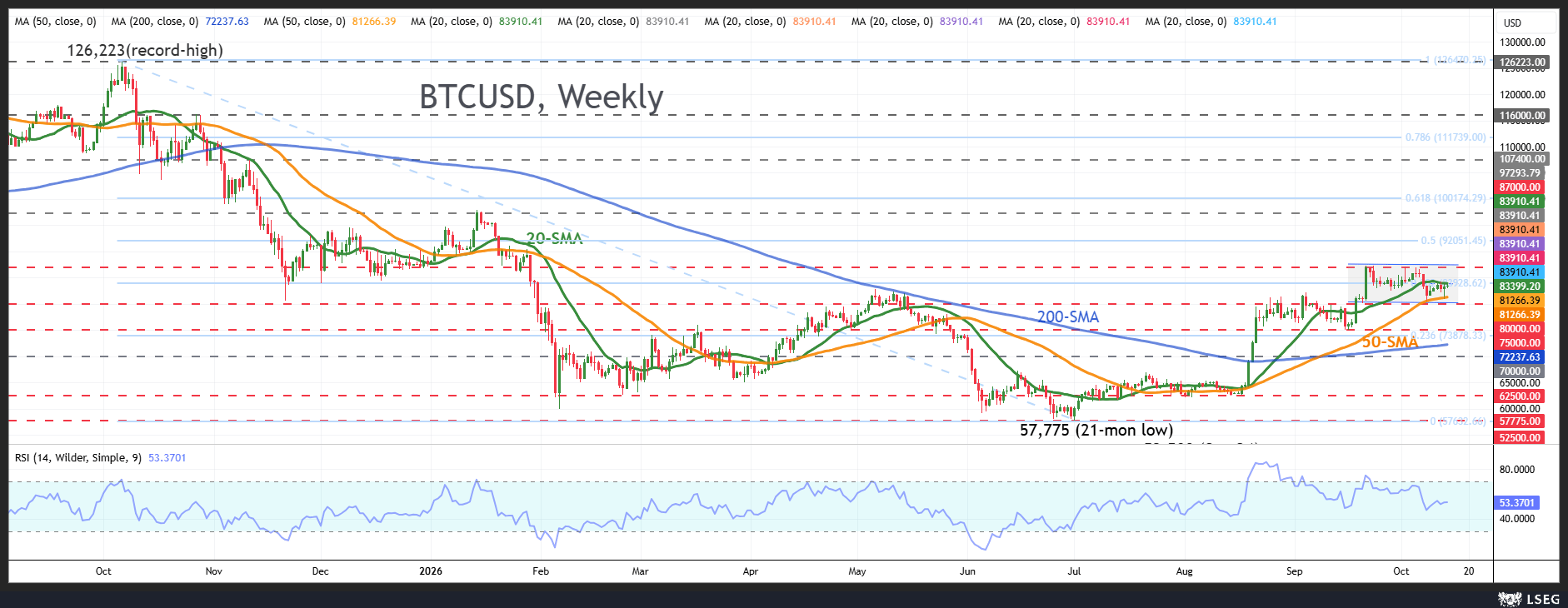
Bitcoin consolidates above key weekly support
Bitcoin continues to consolidate above the psychologically important $80,000 region, although price remains trapped between the 20- and 50-week moving averages, currently near $83,800. Weekly momentum remains constructive, with buyers continuing to defend pullbacks, though upside progress remains limited as traders await fresh macro catalysts. A sustained move above $85,000 could trigger short covering and expose the $87,000 resistance level ahead of the broader $90,000 area. On the downside, a break below the $80,000-$82,000 support zone would weaken the constructive outlook and raise the risk of a deeper correction towards the mid-$70,000s.
Author

Nicole joined Trading Point as a Market Analyst in January 2025. She holds a BA in English Literature from Kingston University, London, and an MA in Applied Linguistics (Research Methodology) from the University of Southampton with distinction.