Bitcoin holds above $30k as investors await historically strong July, eye options expiry

Could Bitcoin be headed higher?
On Monday, the largest cryptocurrency by market capitalization recently was trading near $30,165, down 0.9% over the past 24 hours and a comedown from its loftier heights last Friday when BTC traveled to a one-year high over $31,300. The momentum from multiple spot bitcoin filings by BlackRock and other financial services giants that sent the asset higher dissolved as investors addressed the realities that any SEC approval was months off, maybe longer, and that macroeconomic indicators remained uncertain.
Yet in a Sunday report, Markus Thielen, head of research for crypto service provider Matrixport, wrote that July has been a historically strong month, including 24%, 20% and 27% returns in the past three years.
“Therefore, the probability that Bitcoin will be 10-20% higher during the next 30 days is high,” Thielen wrote. “Bitcoin could be at $33,000 to $36,000 by August.”
Thielen noted that bitcoin had followed a pattern this year of rising about $10,000 before falling $5,000 first after the tumult caused by the U.S. banking crisis in March when BTC sank to $20,000 after reaching as high as $25,000 and then following this month’s SEC lawsuits against crypto exchanges Binance and Coinbase when it dropped to $25,000 from $30,000. “Now we appear on the way to $35,000 as the expectations for the Bitcoin ETFs approval will bring more U.S. institutions and U.S. retail into this space.”
Earlier this year, Matrixport predicted that bitcoin would reach $45,000 by years-end. Thielen added that BTC’s strongest rallies have occurred during U.S. trading hours, “a sign that U.S. institutions are buying Bitcoin while other regions are less active. “Claiming that ‘Crypto is dead in the U.S.’ appears to be a misconception,” he wrote.
Meanwhile, Bitcoin’s price as the market approaches Friday’s expiry of Bitcoin options contracts could fuel an additional price increase, or send it spiraling in the immediate aftermath. “If bitcoin builds momentum above $30,000 as expiry approaches, dealers will buy the cryptocurrency in the spot and futures markets,” CoinDesk Co-Managing Editor of Markets Omkar Godbole wrote. “That, in turn, could lead to an exaggerated price rally, often called a gamma squeeze, or sling-shot effect. On the flip side, dealers will be forced to sell on a potential decline below $30,000.”
Ether, the second largest crypto in market value, was recently changing hands at $1,854, off roughly 2.2% from Sunday, the same time. In an interview with CoinDesk TV’s “First Mover” program, Katie Talati, head of research for crypto asset management firm Arca, said that a developer proposal to change Ethereum’s maximum validator balance from 32 ETH to over 2,000 “shouldn’t have an effect on the price of ETH necessarily,” calling the proposal “a long shot.”
Other major cryptos were largely in the red with ADA and SOL, the tokens of smart contracts platforms Cardano and Solana, recently both down more than 4%, although Bitcoin Cash was a rare bright spot, rising nearly 16% to reach a fresh one-year high. BCH, which forked from the original bitcoin blockchain, extended its rally to more than 100% in the week after being one of the four cryptocurrencies listed on institutional-backed crypto exchange EDX Markets.
U.S. equity markets started the week on a sour note with the tech-focused Nasdaq Composite and S&P 500 closing down 1.1% and 0.4%, respectively. The yield on 10-year U.S. Treasurys and safe haven asset gold ticked upward.
Arca’s Talati was cautiously optimistic about investors’ enthusiasm following the spot bitcoin ETF filings over the past 10 days. “The bigger problem is that most people don’t realize that ETF approval is going to be a while away, if it happens,” she said. “The SEC has taken a very strong anti-crypto stance.”
But she added: “There could be some more pressure on regulators to approve this vehicle, just because it is being sponsored by BlackRock. We’re also seeing other asset managers for the traditional world filing their own ETFs, which is promising down the road in terms of having access to the asset class.”
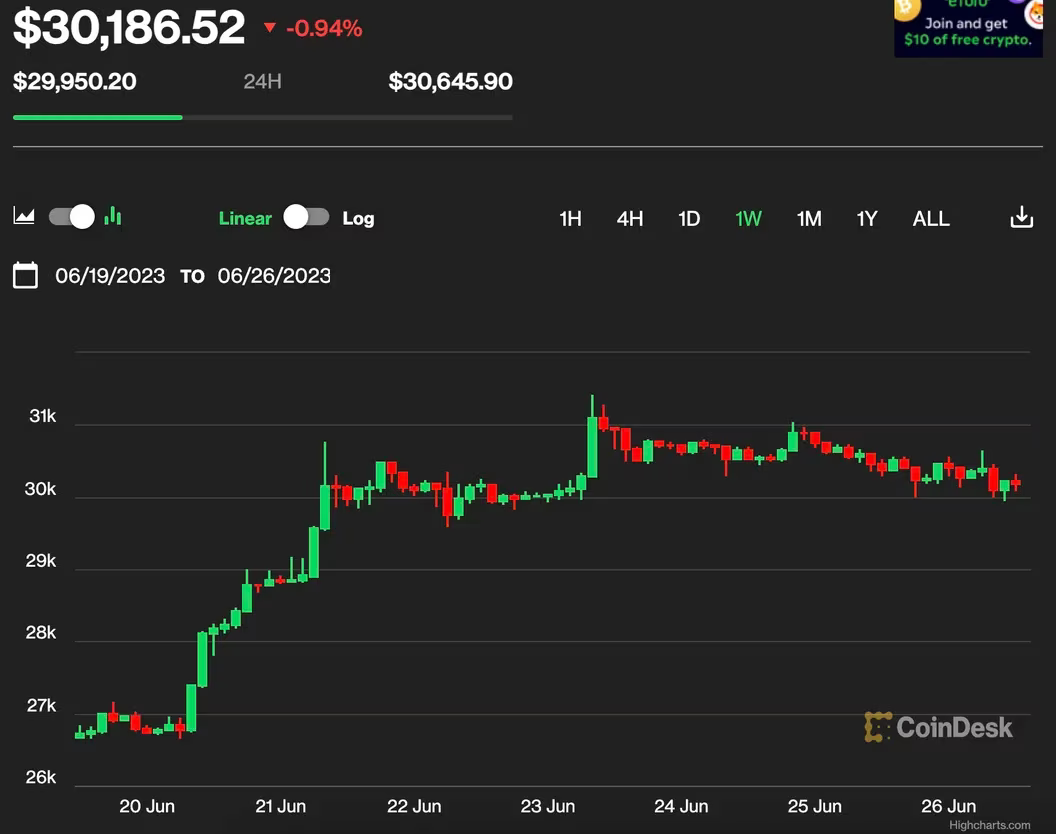
Bitcoin weekly chart (CoinDesk Indices)
Author

CoinDesk Analysis Team
CoinDesk
CoinDesk is the media platform for the next generation of investors exploring how cryptocurrencies and digital assets are contributing to the evolution of the global financial system.