Bitcoin funding rates turn positive: Is BTC rally to $85K next?


Key takeaways
- Bitcoin derivatives show limited conviction among pro traders, but ETF flows and Strategy could play a role in the next higher rally.
- Reduced odds of a peace plan between the US and Iran and high oil prices, could impede Bitcoin’s price discovery.
Bitcoin (BTC) flirted with the $82,000 level on Monday, sparking a brief surge in demand for bullish leverage. Bitcoin has held near $80,000 for over a week, prompting many traders to bet on further upside. However, derivative metrics show that professional players remain skeptical, leaving many to wonder whether $85,000 is actually within reach.
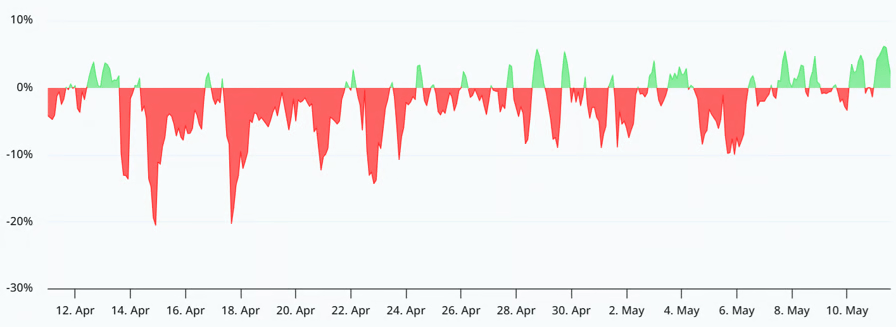
Bitcoin perpetual futures annualized funding rate. Source: Laevitas
The annualized funding rate for Bitcoin perpetual futures briefly jumped to 6% on Monday, touching neutral-to-bullish territory for the first time in over a month. Still, the indicator has mostly stayed negative, signaling more demand for bearish leverage. This lack of confidence among bulls doesn't necessarily block further gains, but it does highlight a cautious mood among traders.
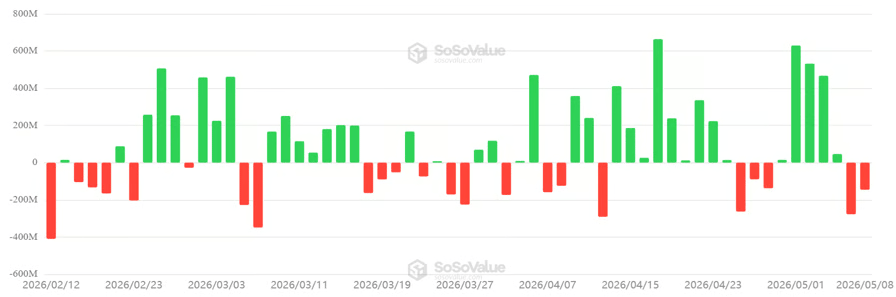
US-listed Bitcoin spot ETFs daily net flows, USD. Source: SoSoValue
Outflows from US-listed spot Bitcoin ETFs on Thursday and Friday likely fueled this bearish sentiment. Since ETF flows are a go-to proxy for institutional interest, seeing a reversal right as Bitcoin failed to break $82,000 on several attempts is triggering real concern across the market.
Bitcoin miners pivot to AI, BTC price remains stable
The artificial intelligence sector continues to capture investors' attention, especially after several Bitcoin mining firms pivoted to high-performance computing. Iren (IREN US) announced a massive $34 billion deal with Nvidia on Friday. Additionally, Core Scientific (CORZ US) recently announced plans to expand its campus in Muskogee, Oklahoma.
Bitcoin’s hashrate dropped to its lowest point in eight weeks on April 26, but the indicator showed plenty of resilience throughout May.
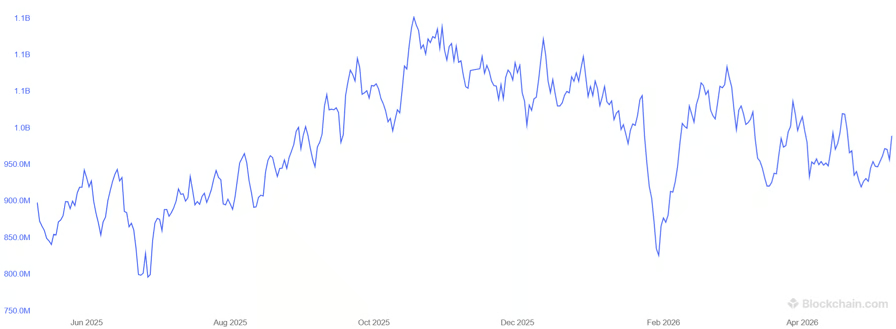
Bitcoin seven-day average hashrate, exahashes per second. Source: Blockchain.com
The estimated processing power supporting the Bitcoin network climbed 5% in just two weeks, reaching 970 exahashes per second. While this is still far from the peak of 1,150 exahashes per second, the fear that miners would abandon the network for AI proved irrational.
Even so, bullish momentum hasn't quite returned for traders, as Bitcoin remains 35% below its all-time high.
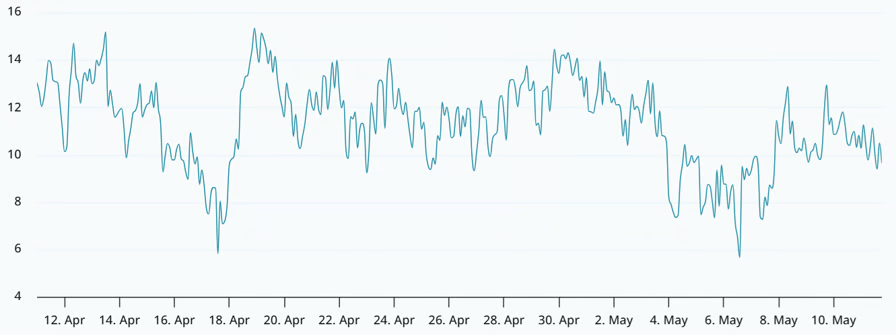
Bitcoin 30-day options delta skew (put-call) at Deribit. Source: Laevitas
The Bitcoin options delta skew (put-call) sat at 10% on Monday, unchanged from the previous week. Put (sell) options are trading at a premium, hinting that whales and market makers aren't comfortable holding downside risk right now. Whether the main issue is the economy or geopolitics, professional traders clearly fear a correction.
Outside of crypto, Brent crude oil prices jumped above $105 on Monday as the Strait of Hormuz remains partially closed due to the war in Iran. US President Donald Trump called Iran’s latest demands “totally unacceptable,” while Israeli Prime Minister Benjamin Netanyahu argued the conflict won't end until Iran's enriched uranium stockpiles are “taken out.”
On the corporate BTC treasury side, Strategy (MSTR US) announced it acquired $43 million in Bitcoin after a one-week break. The buy was funded by selling company shares. So, while the derivatives market still feels a bit bearish, the path to $85,000 is still wide open. Any fresh inflows into Bitcoin spot ETFs this week could easily be the catalyst the market needs.
Author
Cointelegraph Team
Cointelegraph
We are privileged enough to work with the best and brightest in Bitcoin.