XRP steadies on ETF inflows as Standard Chartered adds RLUSD custody
- XRP holds firmly above $1.40, reinforced by the 50-day EMA.
- Standard Chartered launches custody services for RLUSD stablecoin on the XRP Ledger, expanding the bank’s crypto services.
- XRP spot ETFs log 13 consecutive weeks of inflows despite weakening technical structure.

Ripple (XRP) is coming under intense selling pressure, trading around $1.40 on Monday. The remittance token appears to lack the required tailwind to sustain its recovery, while broader crypto market headwinds weigh on price action.
A daily close above $1.40 could encourage buyers to take on more risk. However, it is too early to rule out another sharp decline below the same level, which could further weaken XRP’s technical outlook.
Standard Chartered adds RLUSD custody support
Standard Chartered Bank has reportedly launched institutional custody for RippleUSD (RLUSD), Ripple’s $2.4 billion stablecoin on the XRP Ledger (XRPL). A report published by The Block confirmed that RLUSD was live and accessible through Standard Chartered’s Dubai International Financial Center (DIFC) branch. The product, which expands the bank’s crypto-related services, is regulated by the Dubai Financial Services Authority.
Ripple, LMAX Group and Standard Chartered are also collaborating to enable the stablecoin to be used as eligible collateral for specific services LMAX offers. This development would allow RLUSD assets to be mirrored to LMAX Group for collateral purposes without moving the underlying asset to the trading platform. However, the RLUSD collateral product remains under review pending final documentation, testing, regulatory and internal approvals.
Standard Chartered’s Global Head of Digital Assets, Waqar Chaudry, said that integrating RLUSD would enable eligible institutional clients “to participate in digital asset markets without compromising on how their assets are safeguarded or how risk is managed. The ecosystem must therefore make it easier for clients to hold assets securely, access liquidity and deploy collateral efficiently within trusted frameworks.”
Technical analysis: XRP consolidates as support holds
XRP trades above $1.40, maintaining a constructive near-term bias as price holds above a dense layer of moving-average support. The pair sits above the 50-day Exponential Moving Average (EMA) at $1.40, while the 200-day EMA at $1.38 and the 100-day EMA at $1.34 sit further below and reinforce the broader bullish structure.
The SuperTrend indicator at $1.30 underpins the medium-term uptrend, though a soft Relative Strength Index (RSI) around 45 and a negative Moving Average Convergence Divergence (MACD) line suggest upside momentum is subdued despite the supportive backdrop.
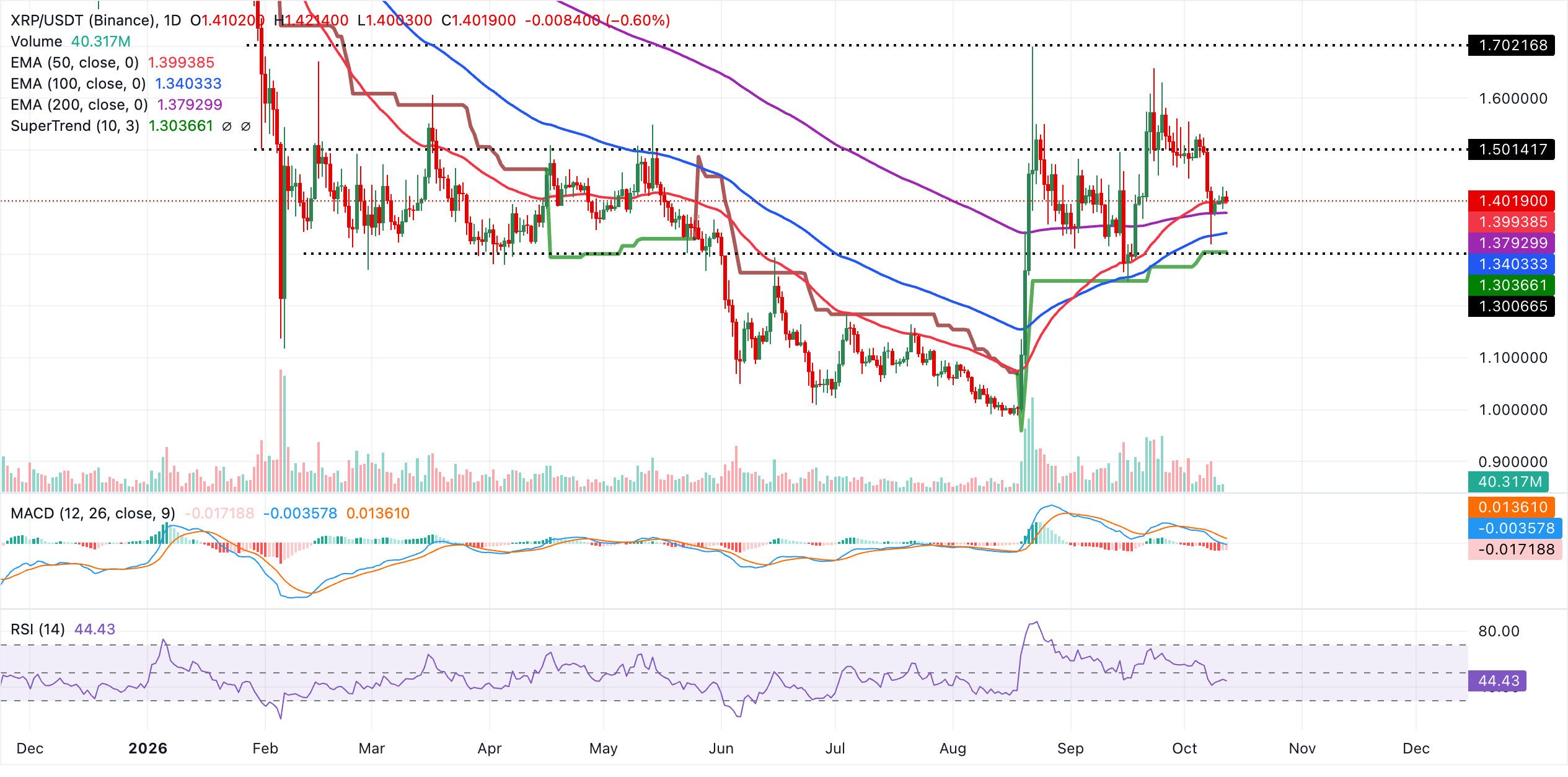
Initial support lies at the 50-day EMA near $1.40, with the 200-day EMA at $1.38 acting as the next cushion if sellers press lower. A deeper pullback would expose the 100-day EMA at $1.34 ahead of the SuperTrend line around $1.30, where buyers would be expected to defend the broader bullish trend.
(The technical analysis of this story was written with the help of an AI tool. Know more.)
Ripple FAQs
Ripple is a payments company that specializes in cross-border remittance. The company does this by leveraging blockchain technology. RippleNet is a network used for payments transfer created by Ripple Labs Inc. and is open to financial institutions worldwide. The company also leverages the XRP token.
XRP is the native token of the decentralized blockchain XRPLedger. The token is used by Ripple Labs to facilitate transactions on the XRPLedger, helping financial institutions transfer value in a borderless manner. XRP therefore facilitates trustless and instant payments on the XRPLedger chain, helping financial firms save on the cost of transacting worldwide.
XRPLedger is based on a distributed ledger technology and the blockchain using XRP to power transactions. The ledger is different from other blockchains as it has a built-in inflammatory protocol that helps fight spam and distributed denial-of-service (DDOS) attacks. The XRPL is maintained by a peer-to-peer network known as the global XRP Ledger community.
XRP uses the interledger standard. This is a blockchain protocol that aids payments across different networks. For instance, XRP’s blockchain can connect the ledgers of two or more banks. This effectively removes intermediaries and the need for centralization in the system. XRP acts as the native token of the XRPLedger blockchain engineered by Jed McCaleb, Arthur Britto and David Schwartz.
Author

John Isige
FXStreet
John Isige is a seasoned cryptocurrency journalist and markets analyst committed to delivering high-quality, actionable insights tailored to traders, investors, and crypto enthusiasts. He enjoys deep dives into emerging Web3 tren