Yen caught between the Fed and BoJ
As of 15 October 2026, USD/JPY is caught between two key forces: the risk of intervention by the Japanese authorities and expectations for US Federal Reserve interest rates.
The main fundamental factor is the direct threat of intervention by Japanese authorities in the foreign exchange market. Japan’s Finance Minister said that Tokyo and Washington have maintained a united stance since their joint intervention in July and are ready to act again without hesitation if necessary. This statement came as USD/JPY fell following the release of US inflation data before beginning to recover. The market views the 160.00 level as a red line, so approaching it automatically triggers profit-taking and yen strengthening.
Despite US CPI rising to 3.7% in September, above forecasts, the market does not expect an immediate rate hike at the October meeting. The probability of such a move is estimated at around 40% or less, as Fed officials have made it clear that there is no need to rush.
The BoJ is opposed to another rate hike at its October meeting. At the same time, markets are pricing in a high probability of a December rate hike, at around 88–90%.
Japan’s hawkish rhetoric is keeping USD/JPY from rising above 159.00, while low expectations of an October Fed rate hike are preventing the yen from strengthening much further. Today’s focus is on US PPI data, which could give the pair a boost.
Technical analysis
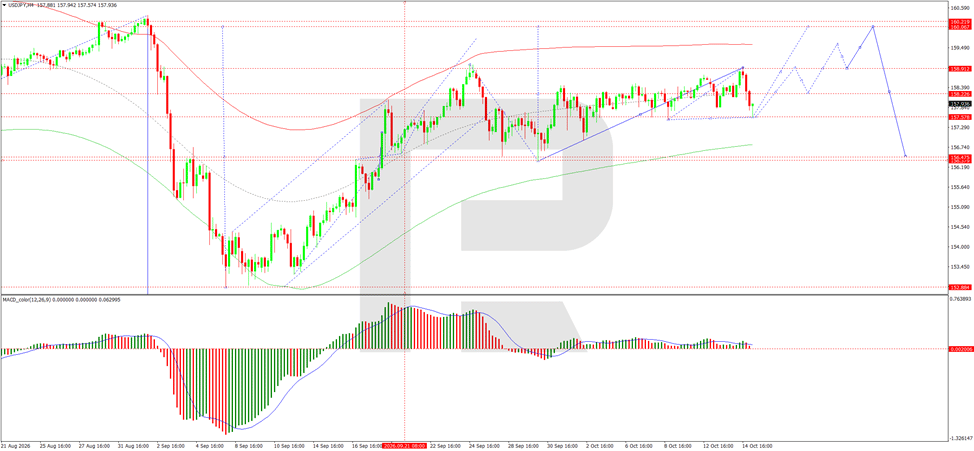
On the H4 chart, USD/JPY reached resistance at 158.91 following the formation of an upward wave structure, after which a corrective decline began. The price returned to the key level of 157.57, which previously acted as the centre of consolidation and is now considered the main support. The current structure continues to provide the conditions for a resumption of the upward move, provided this level holds.
Today, the correction around 157.57 is expected to be completed, followed by a new upward wave towards resistance at 158.28. A close above this level would open the way for a retest of 158.91 and a further move towards 160.06. The MACD indicator is in positive territory, but the shrinking histogram suggests weakening upward momentum, with confirmation of a turn still needed.
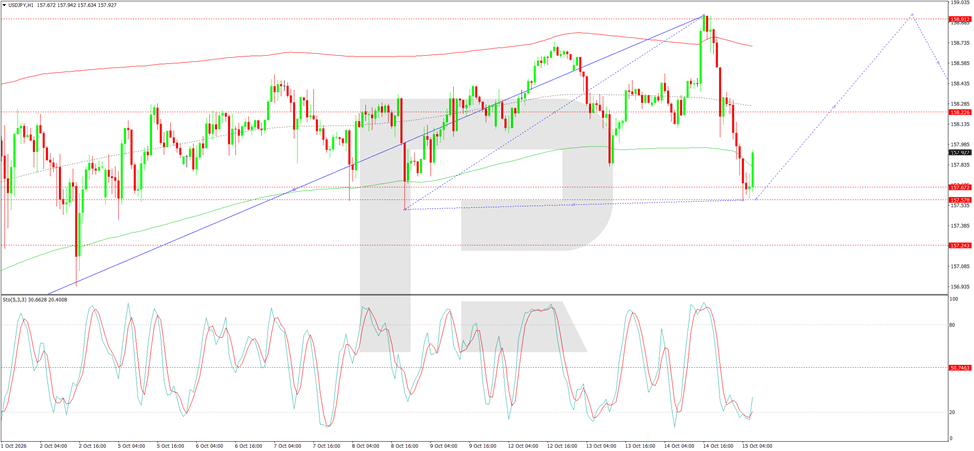
The H1 chart shows a downward correction after the pair reached resistance at 158.91. The price has tested support at 157.57 and is showing early signs of recovery. The main scenario envisages the formation of a local upward wave, with an initial target of 158.28.
The Stochastic oscillator has moved out of oversold territory, with its signal lines turning upwards, supporting the likelihood of short-term gains. At the same time, consolidation below 157.57 would invalidate the main scenario and create the conditions for a further decline towards support at 157.24 and then 156.47. Until key support is broken, the priority remains a resumption of the upward move towards 158.91, with scope for 160.06 during the next upward impulse.
Conclusion
USD/JPY remains caught between two dominant forces: the threat of Japanese intervention, which caps gains near the 160.00 red line, and Fed rate expectations, which limit the yen’s upside. Despite stronger-than-expected US CPI, markets see a probability of around 40% or less of an October Fed hike, while the BoJ is opposed to another rate hike in October and markets expect one in December. Japan’s hawkish intervention rhetoric is keeping the pair below 159.00, while US PPI data due today could provide the next catalyst. Technically, the pair is testing key support at 157.57, with the main scenario envisaging the completion of the correction followed by a renewed move towards 158.28, 158.91 and potentially 160.06. A break below 157.57 would invalidate the main upward scenario and open the way for a decline towards 157.24 and 156.47.
Author

RoboForex Analysis Department
RoboForex
RoboForex Analysis Department provides timely market insights, expert technical analysis, and actionable forecasts across forex, commodities, indices, and equities.

















