XAU/USD — Iran tensions sustain bullish order flow bias on safe-haven demand

Gold's premium pricing continues to find institutional backing amid deep-rooted geopolitical uncertainty, as U.S. President Donald Trump extended the ceasefire window with Iran — contingent on Tehran presenting a "unified proposal." Rather than signaling a true shift in sentiment, this development reflects a liquidity-driven headline environment where smart money continues to position defensively. Trump's own characterization of Iran's government as "seriously fractured" suggests the premium on uncertainty is far from priced out.
Critically, the U.S. naval blockade on Iranian ports remains fully operational — a structural constraint that continues to suppress risk appetite globally. Tehran has framed the blockade as "an act of war and a ceasefire violation," with Foreign Minister Abbas Araghchi signaling Iran's intent to resist. This deadlock prevents any meaningful shift in institutional order flow away from safe-haven assets.
The Strait of Hormuz — a key liquidity corridor for global energy supply — remains effectively closed since the onset of the conflict. With energy disruptions unresolved and the macro narrative still fragile, institutions continue to defend higher price levels in XAUUSD, treating each dip as a potential area of interest (AOI) for accumulation.
Until a credible resolution framework emerges, XAUUSD remains highly reactive to Middle East headline risk. Any fresh escalation could serve as the catalyst for a buy-side liquidity sweep above recent highs, extending the bullish leg in the precious metal.
Technical outlook — Four-hour chart
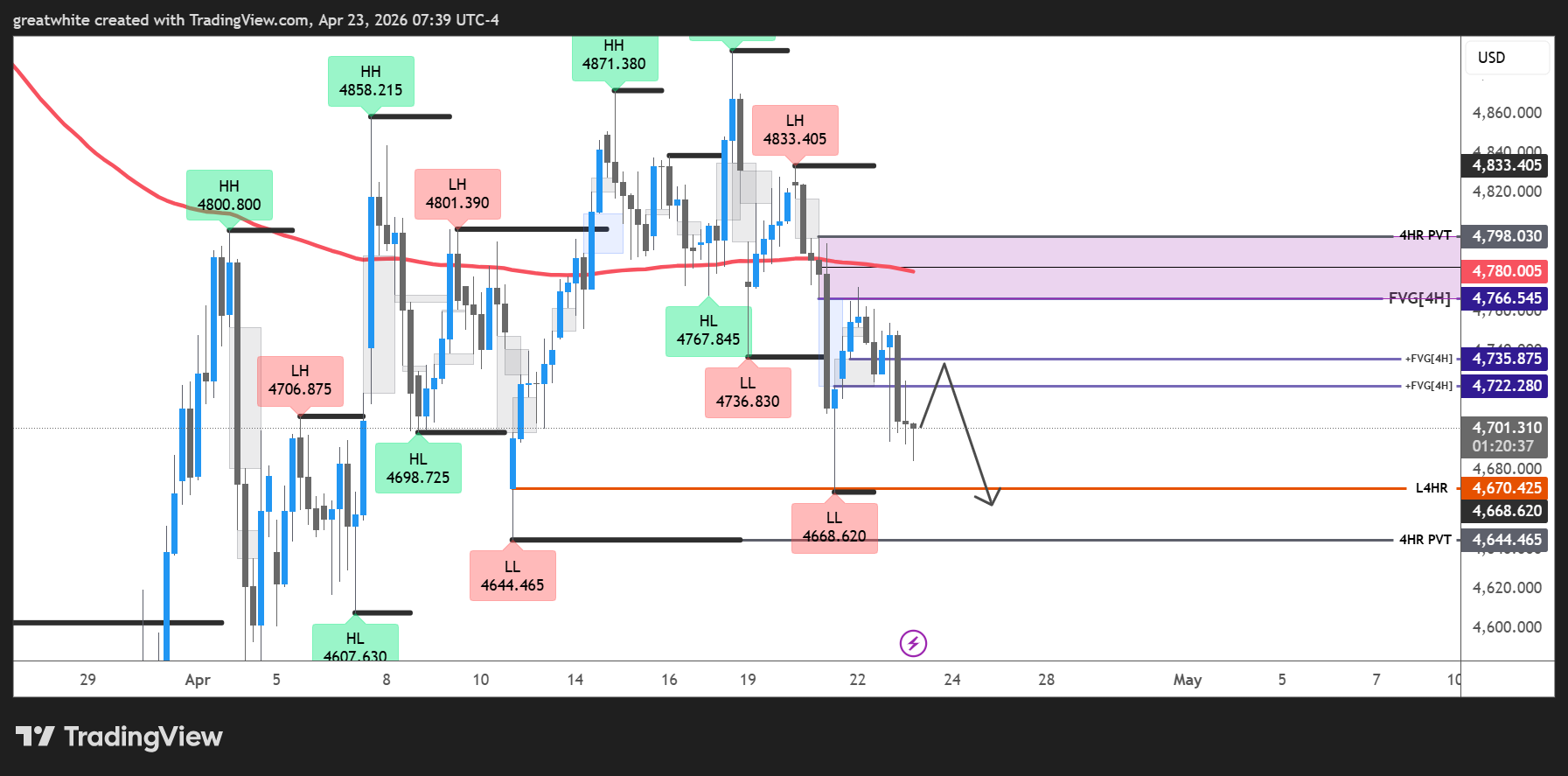
Price action on the 4H chart has printed a decisive Market Structure Shift (MSS) to the downside, confirmed by a clean break and close below $4,736 — establishing a Lower Low (LL) that formally invalidates the prior bullish leg and transfers structural narrative to the bears.
Following the MSS, price staged a corrective retracement into the confluence of a Bearish Order Block (OB) and an embedded Fair Value Gap (FVG) within that range, where sell-side delivery was met with clear rejection. This rejection subsequently drove a violation of the Bullish FVG between $4,722 — $4,735, inverting it into an Inverted Fair Value Gap (IFVG) — now anticipated to function as a resistance ceiling on any bullish retracement attempt.
Provided price respects the IFVG as resistance, the path of least resistance targets $4,668, with an extended draw toward $4,644 as a deeper liquidity objective.
Bullish invalidation: A decisive 4H close above $4,800 negates the bearish thesis and signals potential re-accumulation.
Author

Martin Nwankwo
TradingPRO
Technical Market analyst with over a decade of forex experience, an ICT chartered student.