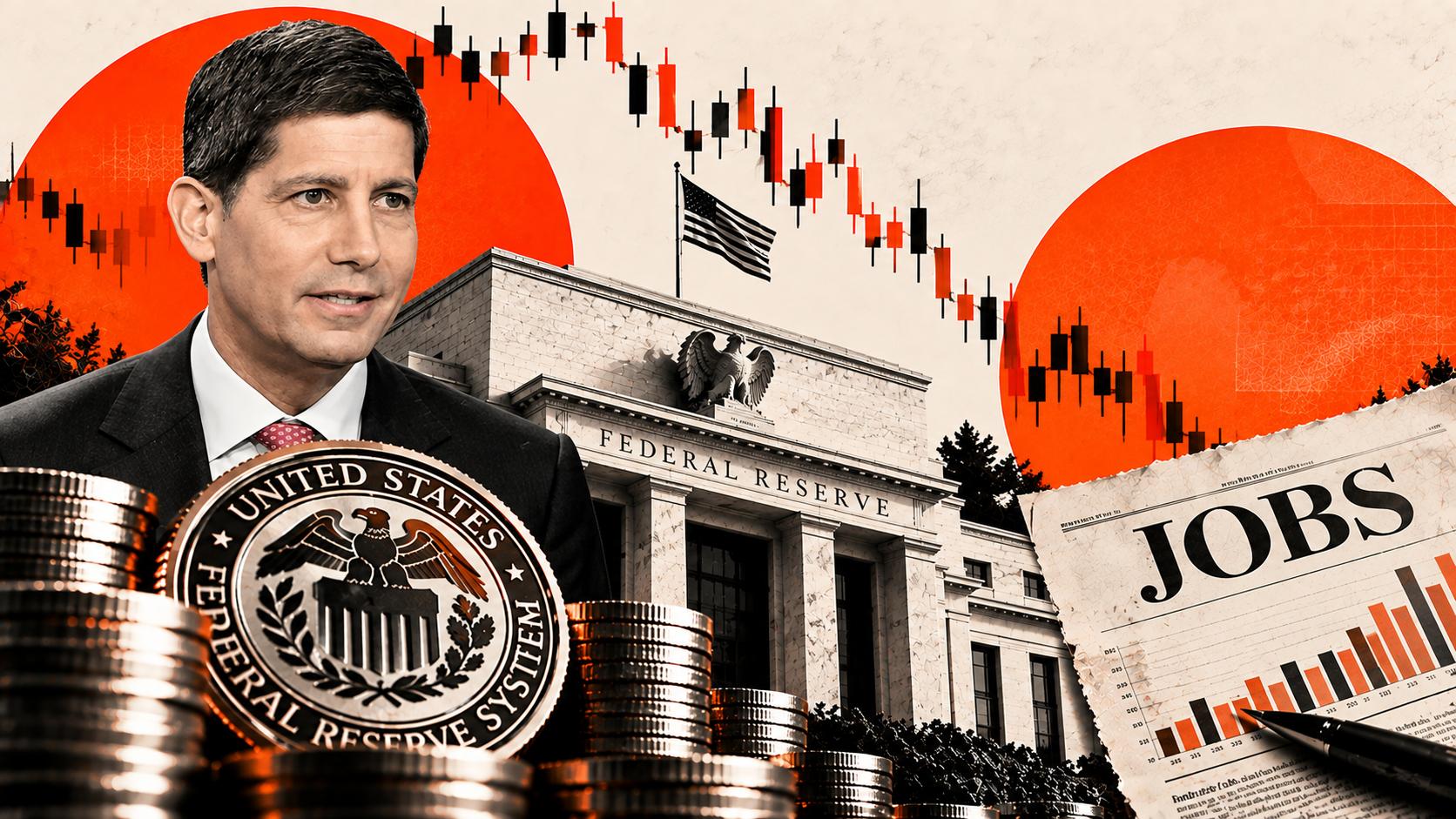
Will PCE inflation data fuel bets of early Fed rate hike?
- Warsh’s hawkish debut sparks sharp repricing in Fed funds futures.
- Inflation is front and centre as September hike now seen likely.
- Will PCE report due Thursday, 12:30 GMT, support the hawkish bets?
Markets brace for first Fed hike in 3 years
New Fed chief Kevin Warsh didn’t waste any time in stamping his authority when he chaired his first ever FOMC meeting on June 16 and 17. Not only did he ditch the much-loved-by-the-markets forward guidance, he also set up task forces to oversee a host of other reforms such as evaluating the size of the balance sheet and the inflation framework.
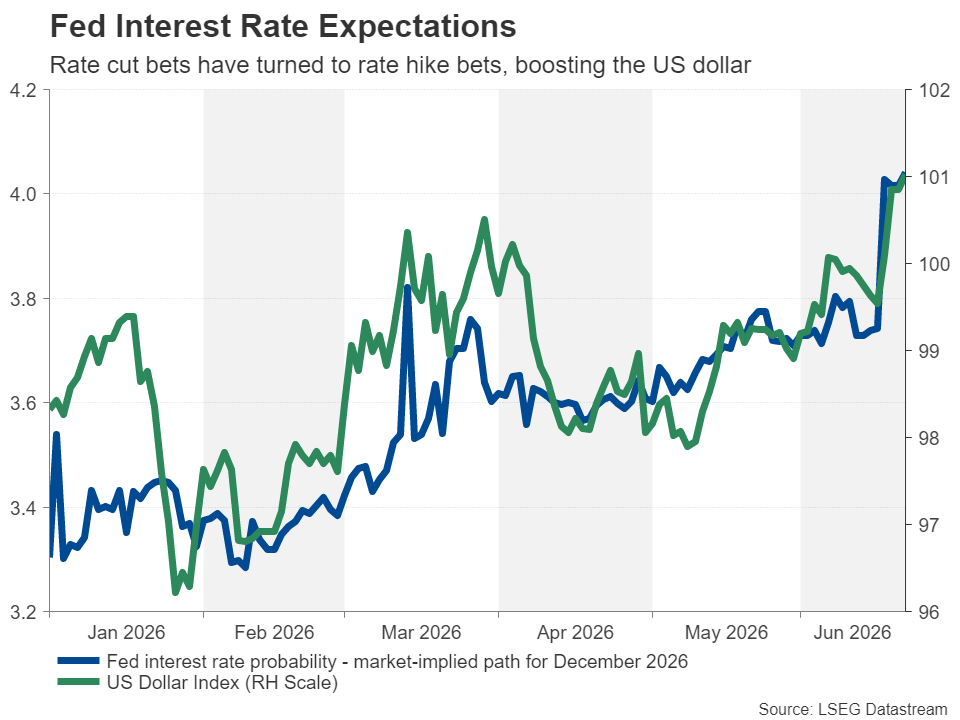
But those are problems for another day. In the immediate term, investors are still reeling from the Fed’s far bigger hawkish shift than anyone anticipated. Although FOMC members were split almost 50/50 whether rates should move higher or stay where they are (but only because Warsh refused to add his own projections), the median dot plot for 2026 has changed from a 25-bps cut to a 25-bps increase.
Inflation is creeping higher
The significant de-escalation in the Middle East has done little to ease inflation worries. Even though hopes of a permanent resolution of the conflict are high after the US and Iran agreed to a 60-day negotiating period and there appears to be a gradual normalization of energy flows through the Strait of Hormuz, the impact of three months of elevated oil prices is still being filtered through prices.
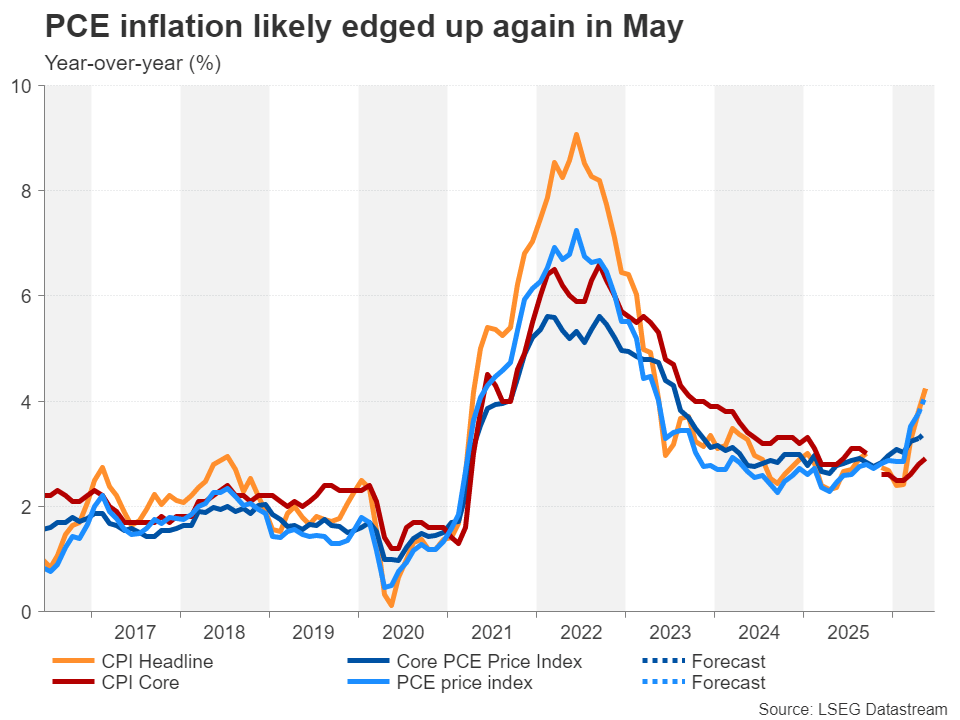
The Fed upped its projection of core PCE in 2026 from 2.7% to 3.3% and doesn’t see it falling to its 2% target by 2028 at the earliest. The last time either CPI or PCE inflation readings were at or below 2% was in early 2021. That’s not a good record for any central bank that has an explicit price objective.
Hence, the Fed would have probably felt the need to recommit to its inflation mandate whoever was at the helm to bolster its credibility. Bond markets certainly liked Warsh’s no-nonsense appearance at the FOMC press conference, as the 30-year Treasury yield finished the week 7 bps lower on greater confidence in the Fed’s ability to fight inflation.
All eyes on core PCE
Thursday’s PCE price indices for May are set to add more pressure on the Fed to tame inflation as quickly as possible. The core PCE price index – the Fed’s preferred inflation metric – is expected to have ticked up slightly in May from 3.3% to 3.4% y/y, while headline PCE is forecast to have jumped from 3.8% to 4.1% y/y amid the surge in gasoline prices.
However, the squeeze on disposable incomes from higher energy costs isn’t projected to have hugely hurt households, as personal consumption is expected to have risen by 0.6% m/m, with personal income also forecast to have grown a decent 0.4% m/m.
Dollar at multi-week highs
The Fed’s hawkish pivot combined with still solid economic indicators have lifted the US dollar to near four-week highs against a basket of currencies, even as geopolitical risks have subsided.
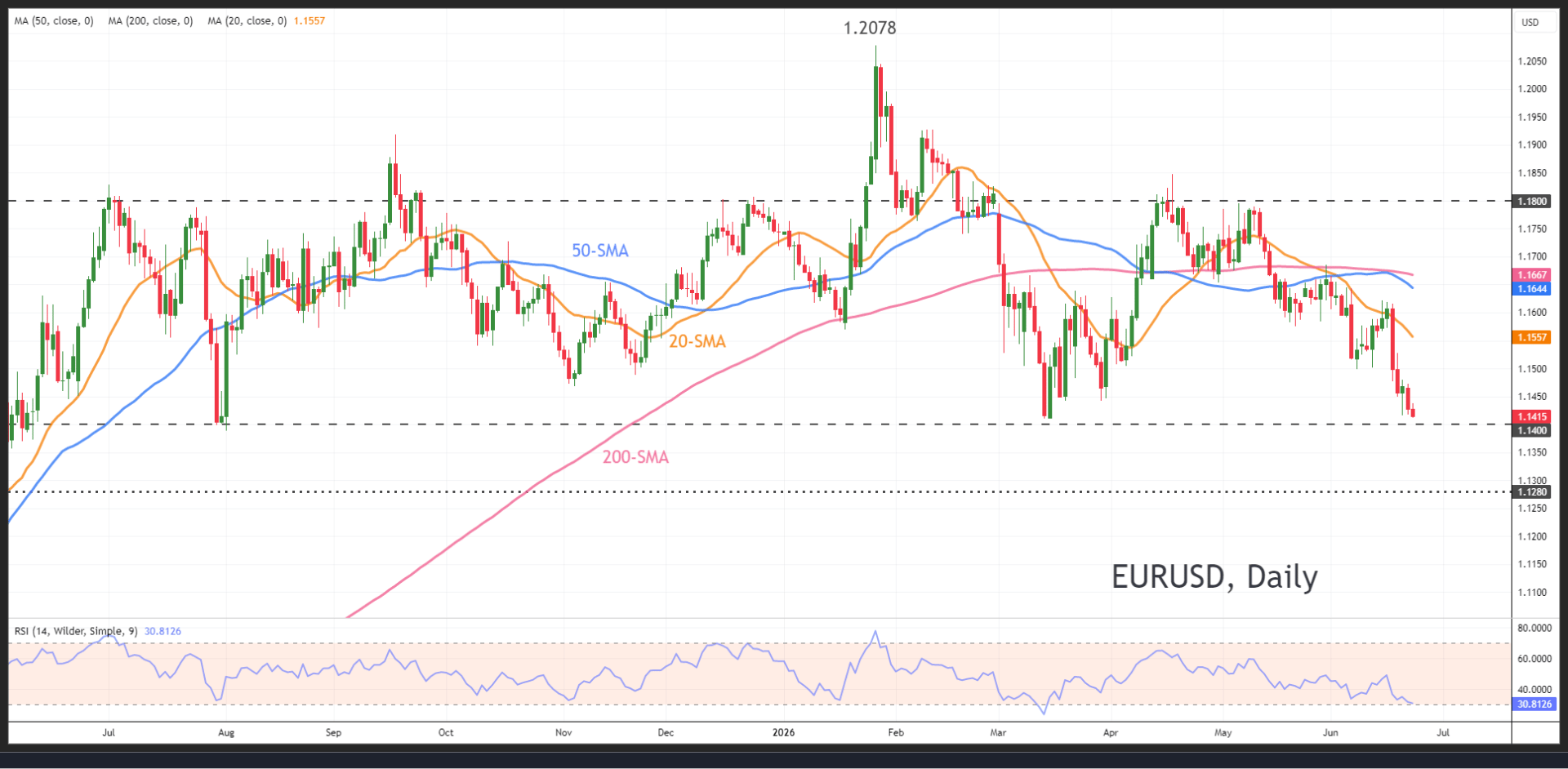
The euro is currently flirting with the $1.1400 level, with a breach looking imminent if the PCE data is strong. After that, the $1.1280 area could be the euro bears’ next target.
But if core PCE rises by less than expected, the euro could rebound towards its 20-day moving average (MA) at $1.1557, with a stronger rebound potentially extending towards the 200-day MA at $1.1667.
Has Warsh really shown his true colours yet?
It’s worth pointing out that sticky inflation and a resilient economy would have likely taken a rate cut off the table even without the US-Iran war. But there’s also a possibility traders are getting a bit ahead of themselves with all the rate hike speculation.
Not only has Warsh kept his cards close to his chest by not revealing his own views on the economy and rate path, a further speedy reversal in oil prices could encourage the Fed to be patient on inflation. This raises the possibility of the Fed not living up to the hawkish expectations, limiting any tightening to just 25-50 basis points and keeping the dollar’s revival short-lived.
Author

Mr Boyadjian graduated from the London School of Economics in 1999 with a BSc in Business Mathematics and Statistics.