What Gold did when the shooting resumed

In Friday's Gold Trading Alert, I wrote: "The breakdown below the rising support line and then below $4,500 will likely be the final two nails in gold's temporary coffin."
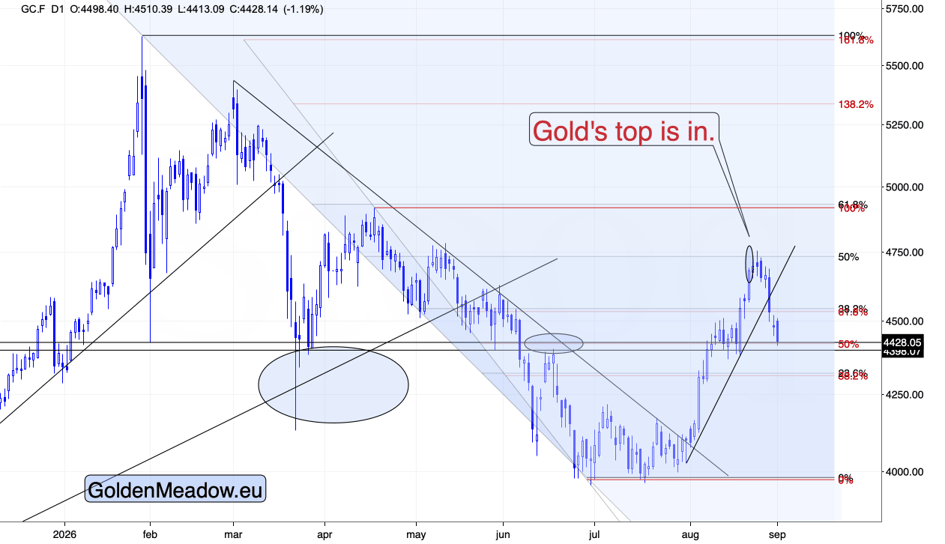
Friday's close hammered in the first, and yesterday I noted that the day's close would decide the second.
It decided. Gold closed Monday at $4,481.50, below $4,500, and it trades near $4,426 as I write this, down again. Both nails are in, and the word temporary still means what it meant: gold remains in a long-term bull market, and the following months are still likely to repeat what we saw in late 2012 and 2013 before that bull market resumes.
Silver answered in one session
Yesterday, I wrote: "The immediate-term outperformance in silver is rarely true strength – it's usually the sign that the market wants to move lower, not higher."
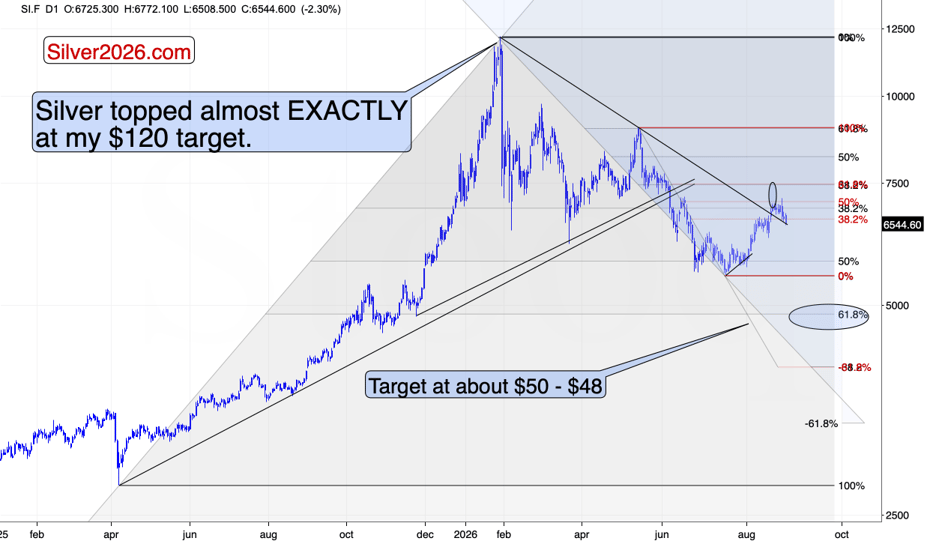
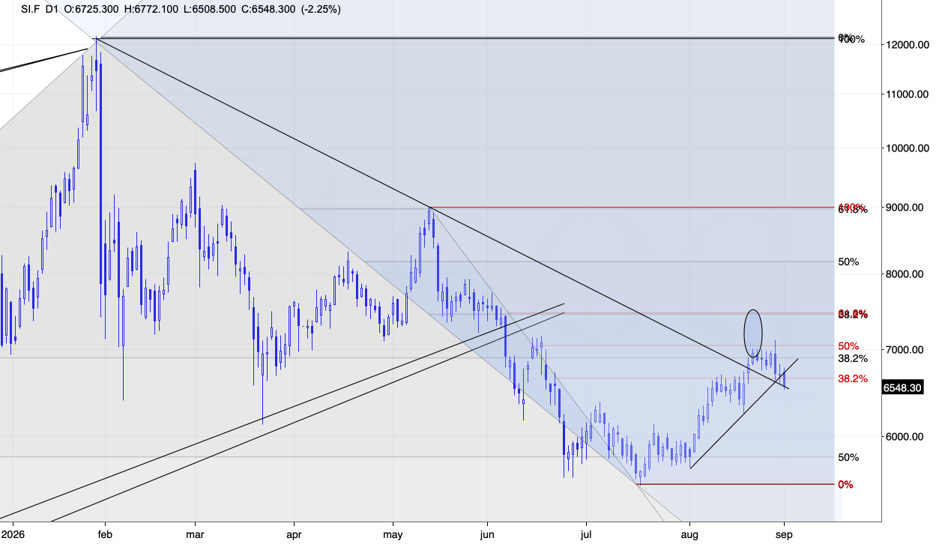
This morning, silver is falling at roughly twice gold's pace. The outperformance resolved the way it usually does, within a single session, and silver's breakout invalidation is now the thing to watch on a closing basis.
For now, silver still remains above (precisely: at) its declining resistance line. Once silver breaks back below it, we’re likely to see a powerful slide.
Additionally, please note the following:
- Silver already broke below its rising support line, which is a bearish indication
- On Friday, silver topped exactly at the intersection of two support/resistance lines. This technique proved to be very useful once again.
Here’s why the support is most likely to fail:
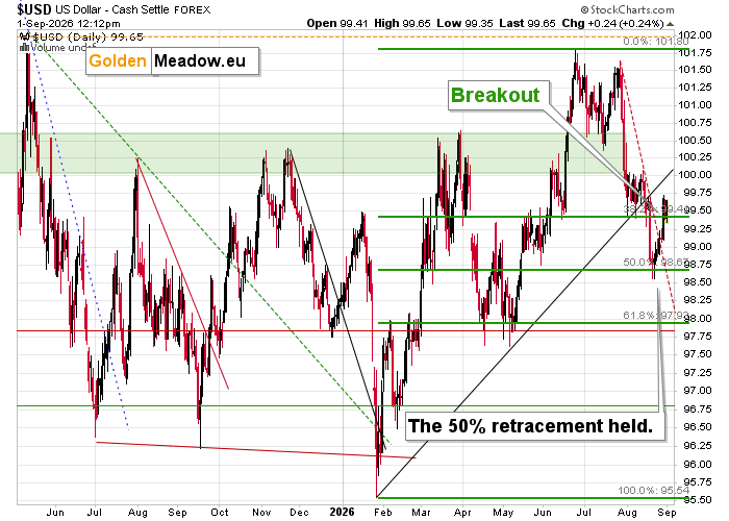
Yesterday was the third day in a row when the USD Index closed above its declining resistance line. This means that the breakout was confirmed. The USD Index is also moving higher today. All this means that the decline that we saw in August is – in all likelihood – over.
The opposite is therefore most likely the case for the precious metals sector. This makes sense also from the fundamental point of view.
The war restarted, and Gold went down
This is the part of today's session that tells you the most.
The US and Iran exchanged strikes for the first time in roughly a month. American forces targeted Iranian rocket launchers on Larak Island after detecting preparations to deploy mines in the strait, Tehran responded with missile and drone attacks on US facilities in Jordan and the UAE, Iranian media reported a tanker struck two mines and a bulk carrier was seized near Bandar Abbas, and President Trump extended military threats to Kharg Island, Iran's key oil export hub. Brent moved back above $90.
And gold is down more than a percent.
A month ago, headlines like these produced hundred-dollar rallies in gold within hours. Today the shooting resumed, oil spiked, and the metal that is supposed to feed on exactly this fell instead. When a market stops responding to its best-case news, the news is not the story. The channel is: oil up means inflation up, inflation up means the Fed stays hawkish, and a hawkish Fed with a confirmed dollar breakout outweighs any war premium. The safe-haven bid did not weaken. It left.
Where this leaves us
Both nails are in, silver delivered on its warning overnight, the miners decline as well. The dollar sits on a confirmed breakout while oil re-arms the channel.
A war restarted this morning, and gold went down. That is the entire story of this market in one sentence.
Want free follow-ups to the above article and details not available to 99%+ investors? Sign up to our free newsletter today!
Author

Przemyslaw Radomski, CFA
Gold Price Forecast
Przemyslaw Radomski, CFA (PR) is a precious metals investor and analyst who takes advantage of the emotionality on the markets, and invites you to do the same. His company, Sunshine Profits, publishes analytical software that any

















