What could bring Gold back above $5,000?
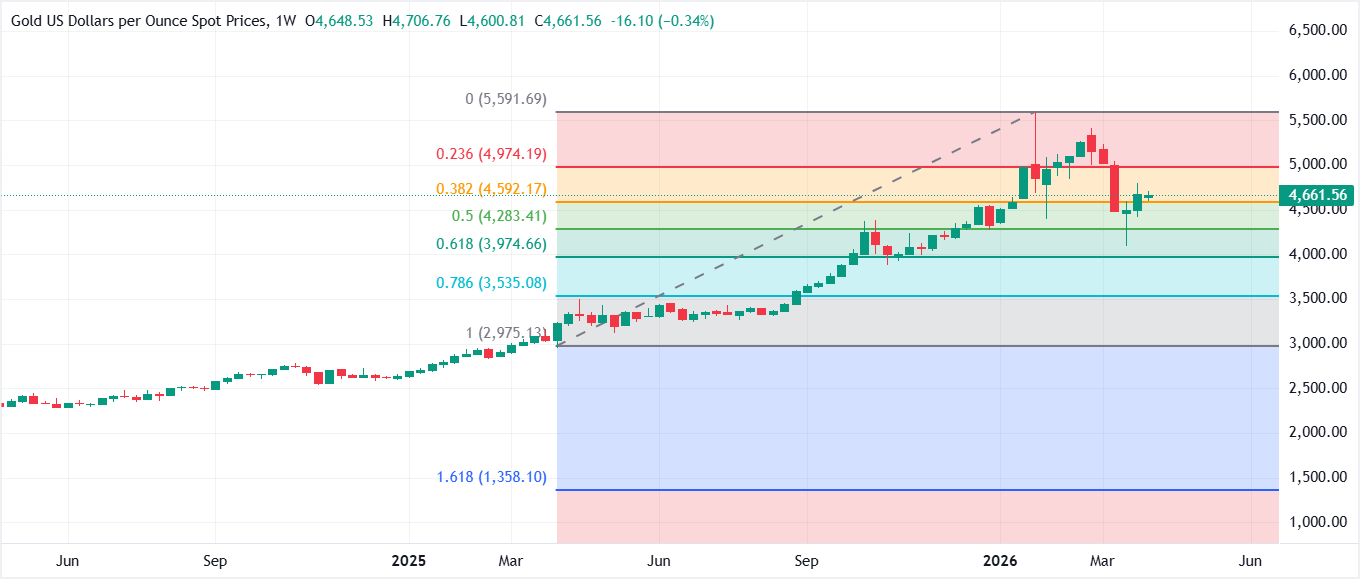
Gold shine has dissipated ever since hitting $5,600 per troy ounce, and market players are wondering whether and when it will come back. The precious metal stabilized far below its all-time peak, and at this point, shows no intentions of revisiting records, despite the world being on the verge of World War III.
But there are hopes.
What can bring the bullish trend back?
There are two main scenarios that can support the case for a sudden and steady surge in Gold price
The first one is directly linked to yields. As widely discussed, risk-off flows diverged from Gold to the US Dollar, as returns from government bonds have made them more attractive in times of turmoil.
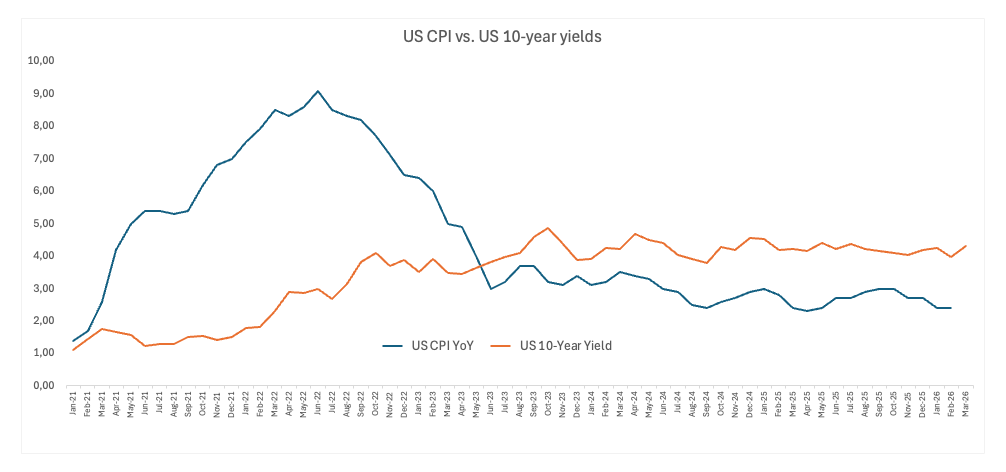
Government bonds could become less attractive in a risk-averse scenario under a particular circumstance: when yields stand below inflation. In that case, safety seekers will return to Gold.
For example, let’s say bond yields are 3% and inflation is at 4%. In that case, the real return for holding bonds would be -1%.
Negative real yields also imply high inflation and hence erode purchasing power. Additionally, negative real yields are a clear sign of economic uncertainty.
Is not a place any major economy would want to be, particularly after barely escaping that particular scenario.
The second scenario is central banks. Central banks from emerging economies tend to accumulate Gold as a reserve, upward pressuring its price and limiting supply.
According to recent data from the People’s Bank of China (PBOC), the country added to its state Gold reserves for a 17th consecutive month in March. The country's Gold holdings rose to 74.38 million fine troy ounces by the end of March, from 74.22 million the previous month.
That China is moving away from the USD is no news. The fact that President Donald Trump arrived at the White House 16 months ago is not a coincidence. China’s decision is purely based on President Trump’s tariffs and the trade war he launched against its major trade rival as soon as he took office. China knew it, and we all knew what was coming.
There is a caveat. There are no stand-alone factors when discussing global economic developments.
The ongoing war in Iran disrupts oil and gas supplies and has become a source of fresh inflationary pressures. At this point, markets are beyond fears: inflation is real.
The latest Federal Reserve Bank of New York Survey of Consumer Expectations shows that households’ inflation expectations increased at the short- and medium-term horizons and remained unchanged at the longer-term horizon in March. Gas price growth expectations surged to the highest level since March 2022.
Additionally, some countries have to get rid of their Gold reserves to cop with higher energy prices. The Turkish Central Bank’s Gold reserves dropped by 69.1 tonnes to 702.5 tonnes in the last week of March, the largest weekly decline in Turkey’s international-standard Gold reserves since 2013. The Turkish Central Bank aims to support the local currency and boost market liquidity. But the lack of central bank demand weighs negatively on Gold price.
In the meantime, where is the United States standing right now?
Meanwhile, government bond yields have been rising since the Iran war began, with the 10-year note yielding 3.99% then and 4.37% now. According to the Consumer Price Index (CPI), inflation rose 2.4% YoY in February. Market players anticipate the figure will jump to 3.3% in March. Indeed, inflation may still be below yields, but the gap is closing.
Source: Reuters
And this is just the tip of the iceberg. Unless the war ends in a matter of days, mounting inflationary pressures will become the norm, as fuel prices ripple through the entire economy. The Federal Reserve will have no choice but to hike rates and force a reduction in consumer spending, while households face eroding purchasing power.
Finally, distrust in the US economy is likely to revive Gold demand and send the precious metal beyond its current record highs. US inflation data will definitely be the trigger for renewed Gold demand.
Author

Valeria Bednarik
FXStreet
Valeria Bednarik was born and lives in Buenos Aires, Argentina. Her passion for math and numbers pushed her into studying economics in her younger years.














