USD/JPY Weekly Forecast: A trend expiring as it falls
- Minimal range leaves the USD/JPY within points of week's open.
- USD/JPY avoids the general US dollar market decline.
- Technical momentum is lower but market lacks conviction.
- FXStreet Forecast Poll sees rebound in coming week.

The Thursday rally that brought the USD/JPY to 104.58, its highest in eight sessions, wilted under the same conditions that have kept the pair pinned around 104.00 for the better part of a month.
There are many competing and conflicting influences in the currency markets and none provides clear direction.
In the US Initial Jobless Claims at 853,000, the highest in eleven weeks, underlined the economic risks of the COVID-19 wave. The hope for a Congressional stimulus package, which would benefit the economy, opposed the notion of a yen safety trade and both were differentiated from the dollar's weakness in most other pairs supposedly as a result of a general improvement in risk outlook that actual global economic conditions strenuously deny.
In Japan the most up-to-date information, the Eco Watchers Surveys, Outlook and Current for November from the Cabinet Office, saw sharp declines from their pandemic highs in October.
The Eurozone remains mired in pandemic closures, made obvious by the ECB's addition of €500 billion to its Pandemic Emergency Purchase Program (PEPP) and its extension by nine months. Neither of which stopped the EUR/USD from reaching a 29-month high against the dollar this week.
The recent strength of the AUD/USD and the Canadian dollar has been founded on the commodity appetites of China's stimulus based recovery.
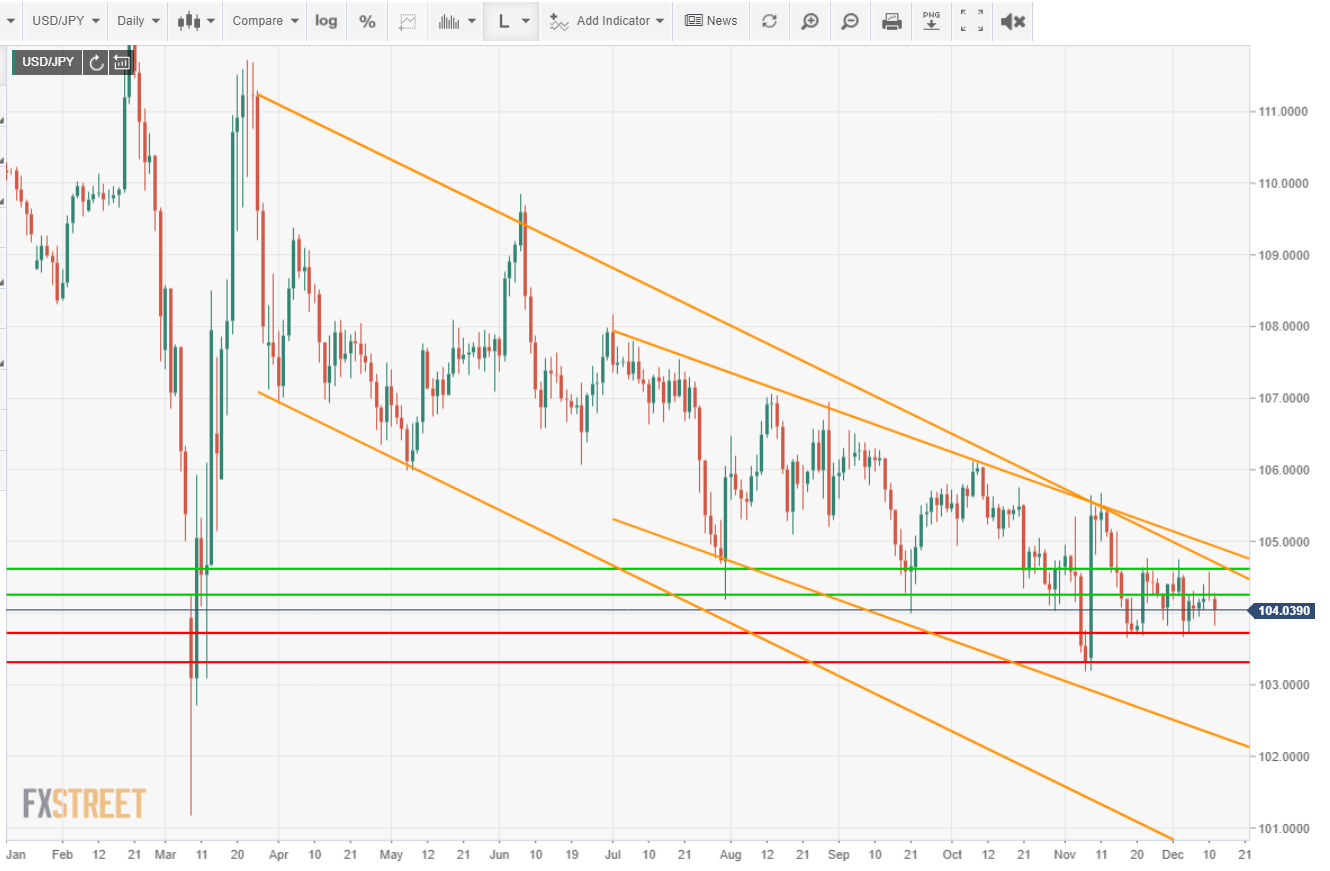
The narrowing range in the USD/JPY, starting to finish this week, was less than 10 points, and even the high and low registered just 75 points, evinces the markets' indecision. The USD/JPY has continued lower since the first week of November on momentum rather than from any conviction. The USD/JPY is weak because its recent history has been weak not because there is logic to the cause.
USD/JPY outlook
The momentum that has carried the USD/JPY down since the two-figure rally on November 9 is a continuation of the market movement that has steadily removed the dollar's panic premium of late March.
There is no dollar advantage yet to be eliminated but there is no replacement for the trend so it continues aided, perhaps by the minor yield advantage Japan's deflationary prices give to domestic interest rates. It is reinforced by the market's regular adherence to the descending channel which dates to July 1 and provides structure.
A lower USD/JPY is also enabled by the more prevalent resistance lines above the market which have a tendency to thwart any weak rally, forcing price action down. Support at 103.70 and 103.30 remains strong, neither was tested this week.
Japan statistics December 7-December 11
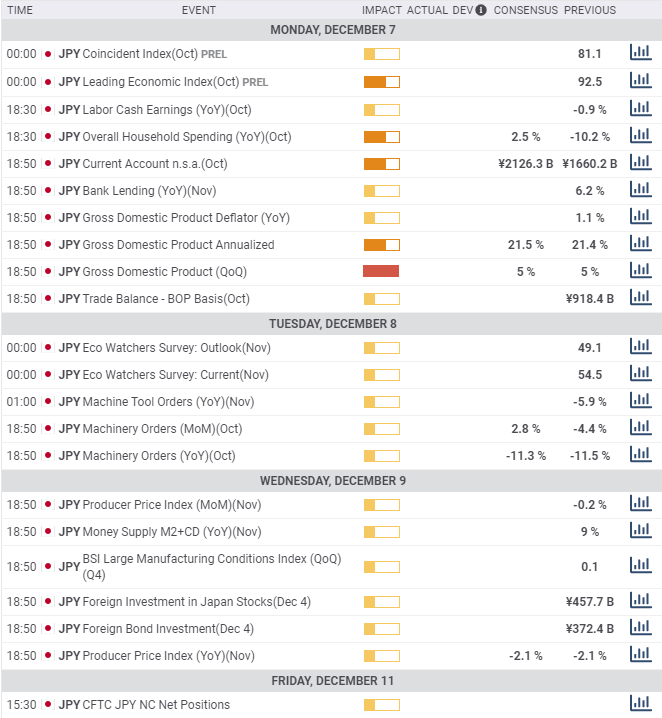
The most recent data from the Eco Watchers Survey show a marked deterioration of short-term economic trends in November.
Monday
The Coincident Index for October was 89.7 following 84.8 in September. The Leading Economic Index rose to 93.8 from 93.3 in September. Labor Cash Earnings dropped -0.8% on the year in October, from -1.3% prior. Overall Household Spending rose 1.9% annually in October, less than the 2.5% anticipated. Spending fell 10.2% in September. Japanese GDP in the third quarter was revised to a 22.9% annualized rate from 21.4%, 21.5% had been predicted. The quarterly gain was 5.3%, up from 5%.
Tuesday
The Eco Watchers Survey for November fell to 36.5 in Outlook from 49.1 and 45.6 in Current from 54.5; both October readings had been the pandemic highs. Machinery Orders jumped 17.1% in October, far more than the 2.8% forecast and the prior 4.4% drop. Machinery Orders on the year were up 2.8% following the 11.5% drop in September.
Wednesday
US statistics December 7-December 11
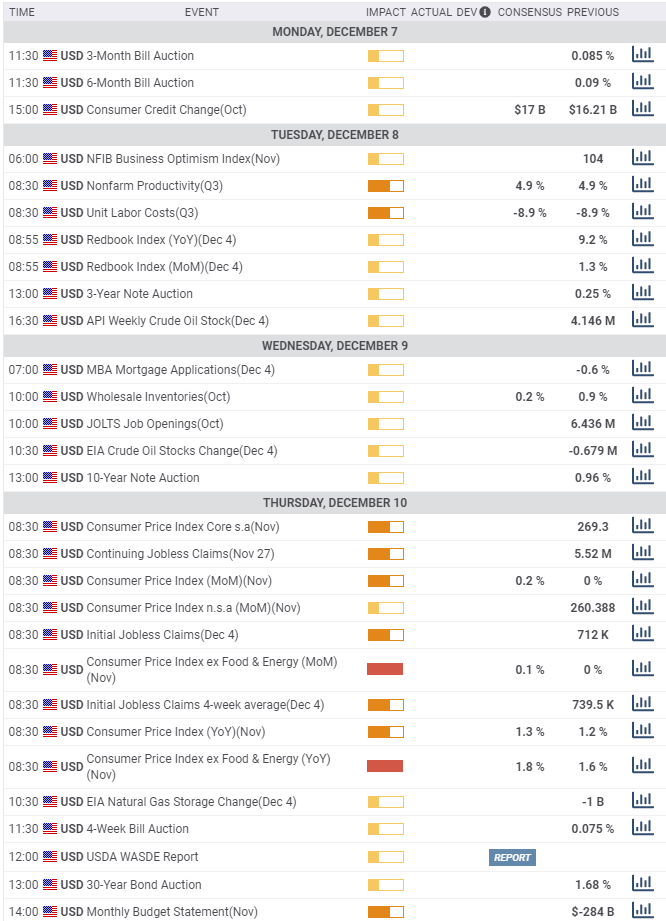
Initial Claims and Michigan Consumer Sentiment held the greatest economic interest. Consumer Confidence was better than forecast but claims were much worse. November CPI confirmed that inflation continues to recover from its second-quarter lows.
Tuesday
National Federation of Independent Business Optimism Index for November was 101.4, down from 104 in October. In February the index was 104.5, the April low was 90.9.
Wednesday
The Job Openings and Labor Turnover Survey (JOLTS) from the US Bureau of Labor Statistics which tracks jobs vacancies, was 6.652 million in October, better than the 6.3 million estimate and September's 6.494 million. The high since February's 7.004 million has been 6.697 in July. The low has been 4.996 million in April.
Thursday
The Consumer Price Index for November was 0.2% on the month and 1.2% the year after October's 0.0% and 1.2% scores. The forecasts were 0.2% and 1.1%. The core CPI rates were 0.2% (MoM) and 1.6% (YoY) following 0.0% and 1.6% in October. Estimates were 0.1% and 1.6%.
Initial Jobless Claims jumped to 853,000 in the week of December 4 on a 725,000 prediction and a revised 716,000 prior. Continuing Claims were 5.757 million in the November 27 week on a 5.527 million prior and a 5.335 million projection.
Friday
The preliminary Michigan Consumer Sentiment Index for December came in at 81.4, considerably better than the 76.5 forecast and November's 76.9 reading.
The Producer Price Index (PPI) rose 0.1% as forecast in November, down from 0.3% prior. On the year it rose 0.8% as expected, up from 0.5% in November. The core index gained 0.1% (MoM) and 1.4% (YoY) after 0.1% and 1.1% in October.
Japan statistics December 14-December 18
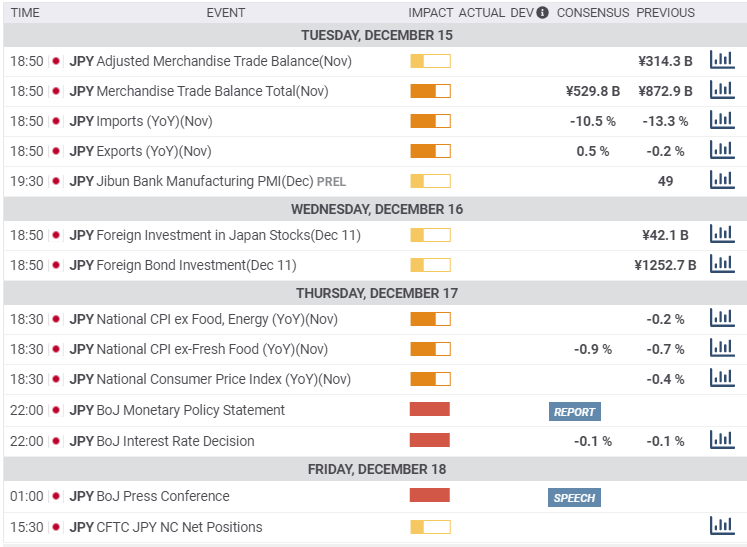
The Bank of Japan rate decision has prominence though no change in rates or policy is anticipated. November's imports and exports are timely for Japanese statistics and could impact the yen. November exports are forecast to rise 0.5% reversing October's -0.2%. Exports have fallen for 23 straight months. The last increase was 0.1% in November 2018.
Monday
The Tankan Large Manufacturing Outlook for Q4 is expected to be -11 after -17 prior. The Large Manufacturing Index is expected to improve to -15 from -27. The Non-Manufacturing Outlook is anticipated to rise to -7 in the fourth quarter from -11 and the Non-Manufacturing Index to reach -6 from -12. The Tankan All Industry Capex is projected to slip 0.1% in the fourth quarter after 1.4% in the third. Industrial Production on the month rose 3.8% in September, on the year it fell 3.2%. The Tertiary Industry Index rose 1.8% in September.
Wednesday
Imports are forecast to shrink 10.5% in November (YoY) after the 13.3% decline in October. Exports are projected to rise 0.5% annually in November following the 0.2% decline prior.
Friday
National CPI fell 0.4% in November (YoY). Core CPI dropped 0.2% in October. National CPI ex-Fresh Food is forecast to decline 0.9% (YoY) in November after -0.7% in October. The Bank of Japan is projected to leave its overnight call rate unchanged at -0.1%. No policy changes are anticipated in its statement or Governor Haruhiko Kuroda's news conference.
US statistics December 14-December 18
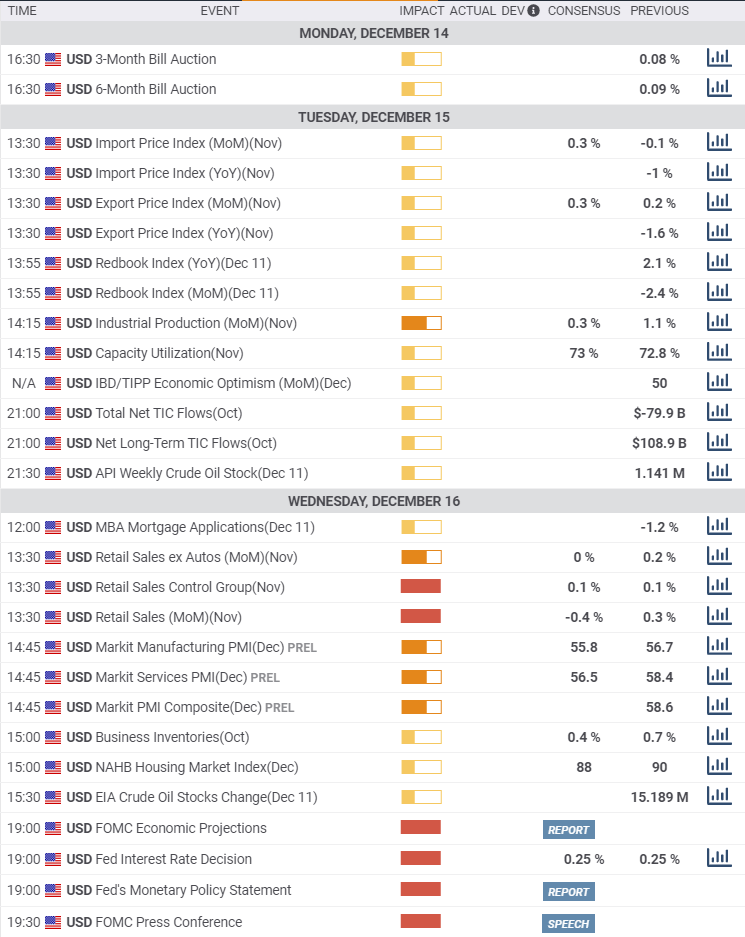
The Federal Reserve rate and economic projections and Chairman Jerome Powell's new conference are the main interests this week. No change is foreseen in the fed funds rate or the monthly $120 billion bond program, though the minutes from the November meeting noted that “many participants judged that the Committee might want to enhance its guidance for asset purchases fairly soon.” Any 'guidance' that hints at reduction will support the dollar as US Treasury rates are being restrained solely by the force of the purchase program.
The last set of Projection Materials in September added a fourth year, 2023, to the estimates. Economic growth was forecast to be -3.7% this year and 4% in 2021. The fed funds rate was unchanged at 0.1% through the end of 2023. Any change in these predictions or unemployment 7.6% this year, 5.5% next or Core PCE inflation, 1.5% in 2020 and 1.7%% in 2021 will, if improved as is likely, aid the dollar.
Retail Sales for November will be watched to see if the miss in October, 0.3% on a 0.5% forecast and 0.1% on a 0.5% prediction for the Control Group, is predictive for the holiday season in December. Given the increasing number of ordered closures in several states and the weak payroll numbers the risk is to the downside, for markets and the dollar. Initial Jobless Claims are important, as every week, for the state of the labor market.
Tuesday
Industrial Production in November is forecast to rise 0.5% after jumping 1.1% in October and dropping 0.4% in September. Production fell 17.1% in March and April, from May to October it has gained 12.5%. Capacity Utilization is projected to reach 73% in November from 72.8%. It was 76.9% in February and the low was 64.2% in April.
Wednesday
Retail Sales are forecast to decrease 0.1% in November following the October 0.3% gain. Control Group Sales are expected to rise 0.2% after the 0.1% addition in October. Sales ex Autos rose 0.2% in October.
The final Federal Reserve Open Market Committee (FOMC) meeting of the year will rule on the fed funds, the bond purchase program and issue new economic and rate projections. Chairman Jerome Powell will read a brief statement and answer press questions half-an-hour after the FOMC statement.
Thursday
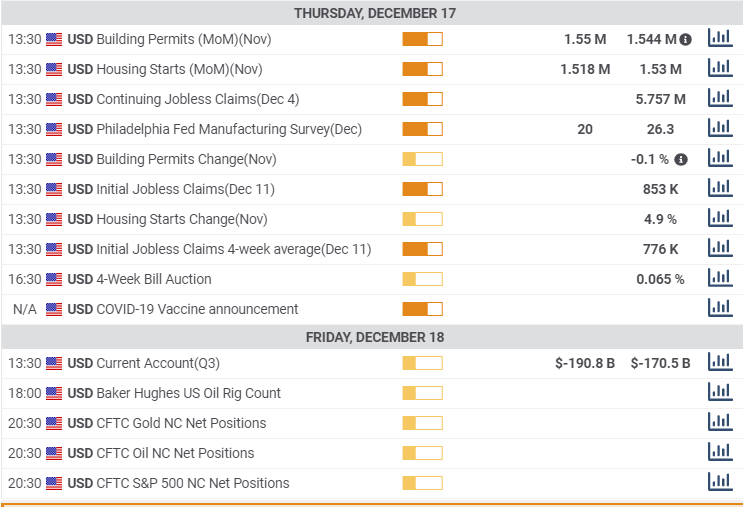
Initial Jobless Claims for the week of December 11 are expected to drop to 800,000 from 853,000. Continuing Claims were 5.757 million in the November 27 week.
Building Permits and Housing Starts for November are expected to be 1.555 million and 1.528 million annualized respectively and about par with October. The housing market has been one of the US economy's bright spots with sales, construction and prices near all-time highs.
USD/JPY technical outlook
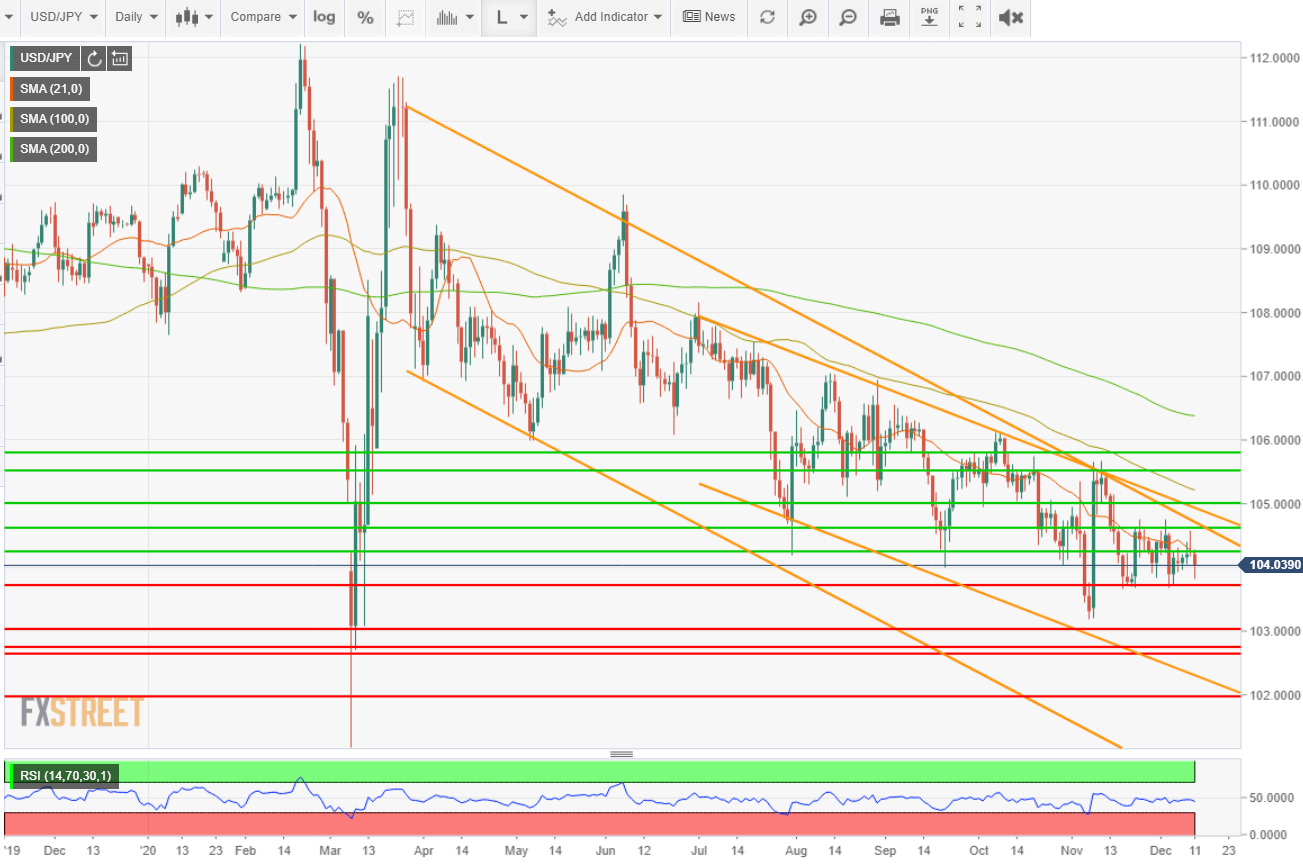
The stasis of the last two weeks has a downward drift but as discussed above it is due largely to the absence of conviction not to its presence. The more numerous and better-traded resistance lines and the descending channel help to keep bias down though without exerting much pressure. Support at 103.70 and 103.30 is robust.
The Relative Strength Index at 44.68 is nearly neutral and exhibits no strong tendencies. The 21-day moving average at 104.22 backs initial resistance at 104.25. The 100-day line at 105.22 and the 200-day at 106.38 await a change in circumstances.
Resistance: 104.25; 104.60; 105.00; 105.50; 105.75
Support: 103.70; 103.30; 103.00; 102.75; 102.00
USD/JPY Forecast Poll
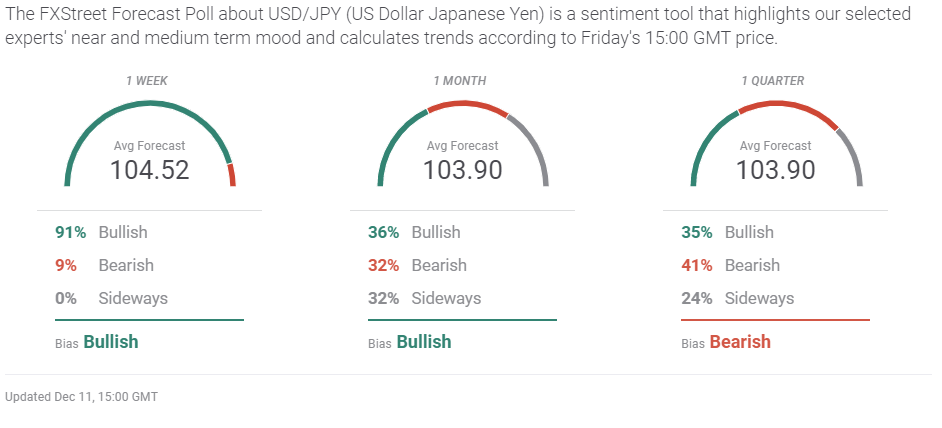
Last week's uniformly bearish FXStreet Forecast Poll out to one quarter has reversed to a positive view of USD/JPY to one month. The failure to breach 103.70 or the more important line at 103.30 has brought out a predicted rebound even though the longer views are still negative.
Author

Joseph Trevisani
FXStreet
Joseph Trevisani began his thirty-year career in the financial markets at Credit Suisse in New York and Singapore where he worked for 12 years as an interbank currency trader and trading desk manager.

















