USD/JPY Price Forecast: Japan’s election fuels BoJ uncertainty and favors bullish traders
- USD/JPY spikes to a three-month top and draws support from a combination of factors.
- Political development raises uncertainty over BoJ’s rate-hike plan and weighs on the JPY.
- Bets for smaller Fed rate cuts continue to underpin the USD and further boost the pair.

The USD/JPY pair opens with a modest bullish gap and climbs to the 154.00 neighborhood, or its highest level since July 30 as Japan's political uncertainty adds to a layer of uncertainty over the Bank of Japan's (BoJ) rate-hike plans. In fact, Japan’s longtime ruling party lost its majority for the first time in 15 years at Sunday's national election. The outcome fueled speculations that the coalition government lost its parliamentary majority in Sunday's election for the first time since 2009. This comes on top of weak economic conditions and a fall in Tokyo’s core inflation rate below the central bank's 2% target, tempering hopes for any further rate hikes in 2024 and undermining the JPY.
Apart from this, a generally positive tone around the equity markets turns out to be another factor that further contributes to driving flows away from the safe-haven JPY. This, along with sustained US Dollar (USD) buying, provides a goodish lift to the USD/JPY pair at the start of a new week. The incoming US macro data has been suggesting that the economy remains on strong footing and supports prospects for smaller interest rate cuts by the Federal Reserve (Fed). Adding to this, deficit-spending concerns after the US election continue to push the US Treasury bond yields higher, which lifts the USD to a three-month top and might further exert pressure on the lower-yielding JPY.
Bullish traders, however, seem reluctant to place fresh bets around the USD/JPY pair and prefer to move to the sidelines ahead of this week's key central bank event risk – the BoJ policy decision on Thursday. Investors this week will confront the release of important US macro data – the Advance Q3 GDP print, the Personal Consumption Expenditures (PCE) Price Index and the closely-watched Nonfarm Payrolls (NFP) report. This, in turn, will play a key role in influencing the next leg of a directional move for the currency pair. Nevertheless, the aforementioned fundamental backdrop suggests that the path of least resistance for spot prices is to the upside.
Technical Outlook
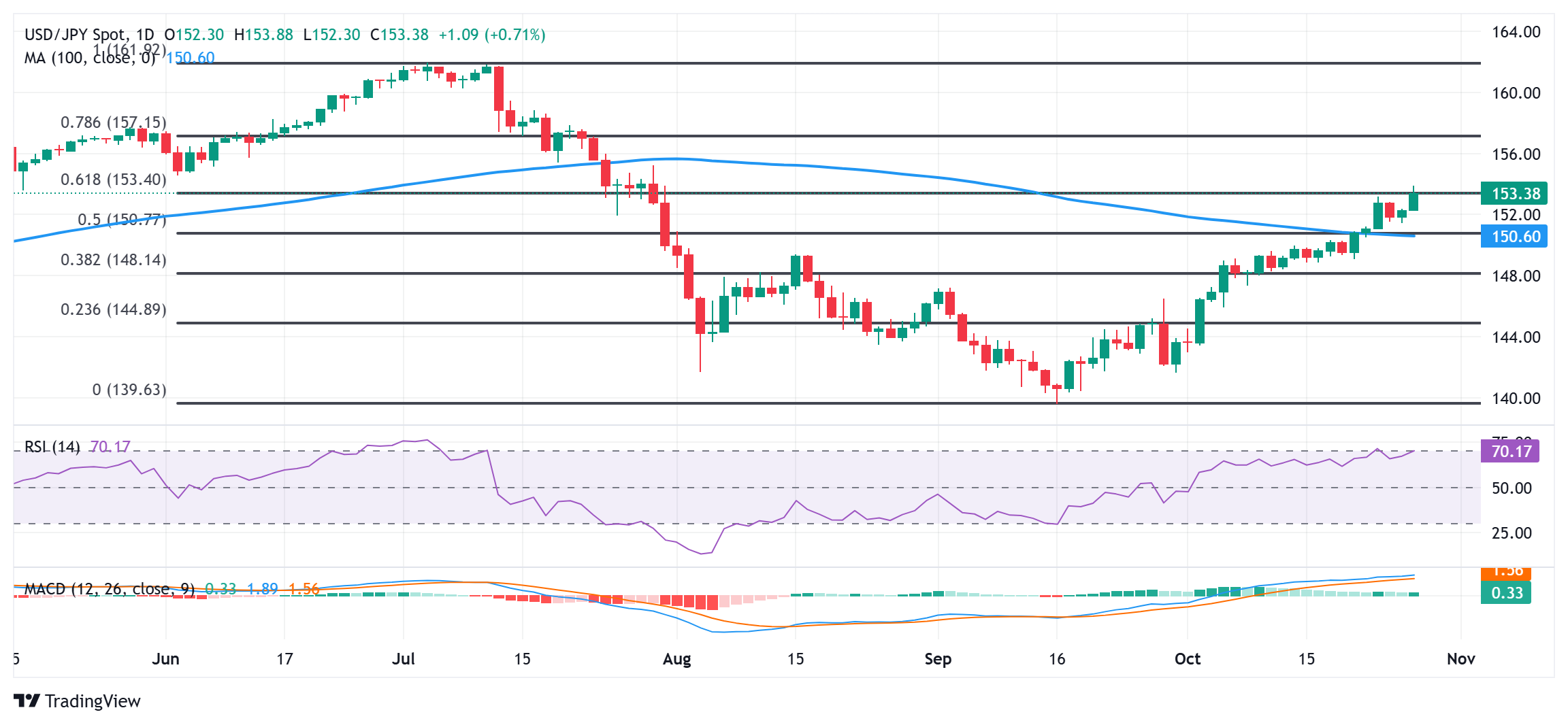
From a technical perspective, last week's breakout through the 150.65 confluence – comprising the 100-day Simple Moving Average (SMA) and the 50% Fibonacci retracement level of the July-September downfall – was seen as a fresh trigger for bulls. A subsequent strength and acceptance above the 153.00 mark further validate the positive outlook for the USD/JPY pair. That said, the Relative Strength Index (RSI) on the daily chart is on the verge of breaking into the overbought zone, making it prudent to wait for some near-term consolidation or a modest pullback before the next leg up.
Nevertheless, spot prices seem poised to prolong the recent well-established uptrend and any corrective slide is more likely to be short-lived, though bulls might wait for some follow-through strength beyond the 61.8% Fibo. level before placing fresh bets. The USD/JPY pair might then surpass the 154.00 mark and climb to the 154.35-154.40 supply zone en route to the 155.00 psychological mark and the late-July swing high, around the 155.20 region.
On the flip side, weakness below the 153.00 round figure is likely to attract some dip-buyers and remain limited near the Asian session low, around the 152.65 region. Some follow-through selling, however, could drag the USD/JPY pair to the 152.00 mark en route to the 151.45 support and the 151.00 mark. The downward trajectory could extend further towards challenging the 150.65 confluence resistance breakpoint, which should now act as a key pivotal point and a strong base for spot prices.
USD/JPY daily chart
Author

Haresh Menghani
FXStreet
Haresh Menghani is a detail-oriented professional with 10+ years of extensive experience in analysing the global financial markets.














