The BoJ is priced for a 70% chance of a December hike to 1.50%

A Bank of Japan hike in December is unlikely to lift the Yen by itself, because the Federal Reserve is expected to raise rates by as much nine days earlier. The Yen needs faster hikes after December, and traders expect only one more by October 2027.
The Bank of Japan (BoJ) has raised its interest rate three times in twelve months, and the US Dollar still buys more Yen than it did before the first. Traders who bet on where that rate goes next put the chance of a fourth increase at 70%. It would take the rate from 1.25% to 1.50% at the December 17-18 meeting. Going by the last three, the hike is the part of that meeting least likely to move the Yen.
The reason is on the other side of the exchange rate, where the Federal Reserve (Fed) decides on December 9 and is expected to raise its own rate by the same quarter-point. In that case, the distance between the two rates would end December where it began. What has moved the Yen this year is any sign that the distance is about to shrink. For that, traders would need to hear how quickly the hikes after December are coming.
The Fed gets there nine days earlier
Money moves toward the currency that pays more interest, and the Dollar pays far more than the Yen. The BoJ's rate is 1.25%, and the Fed's is 3.75%-4.00%, a gap of about 2.6 points when measured from the middle of the Fed's range. Investors who borrow Yen to hold Dollars have collected a gap of at least that size all year, and their selling is the weight a BoJ hike is meant to lift.
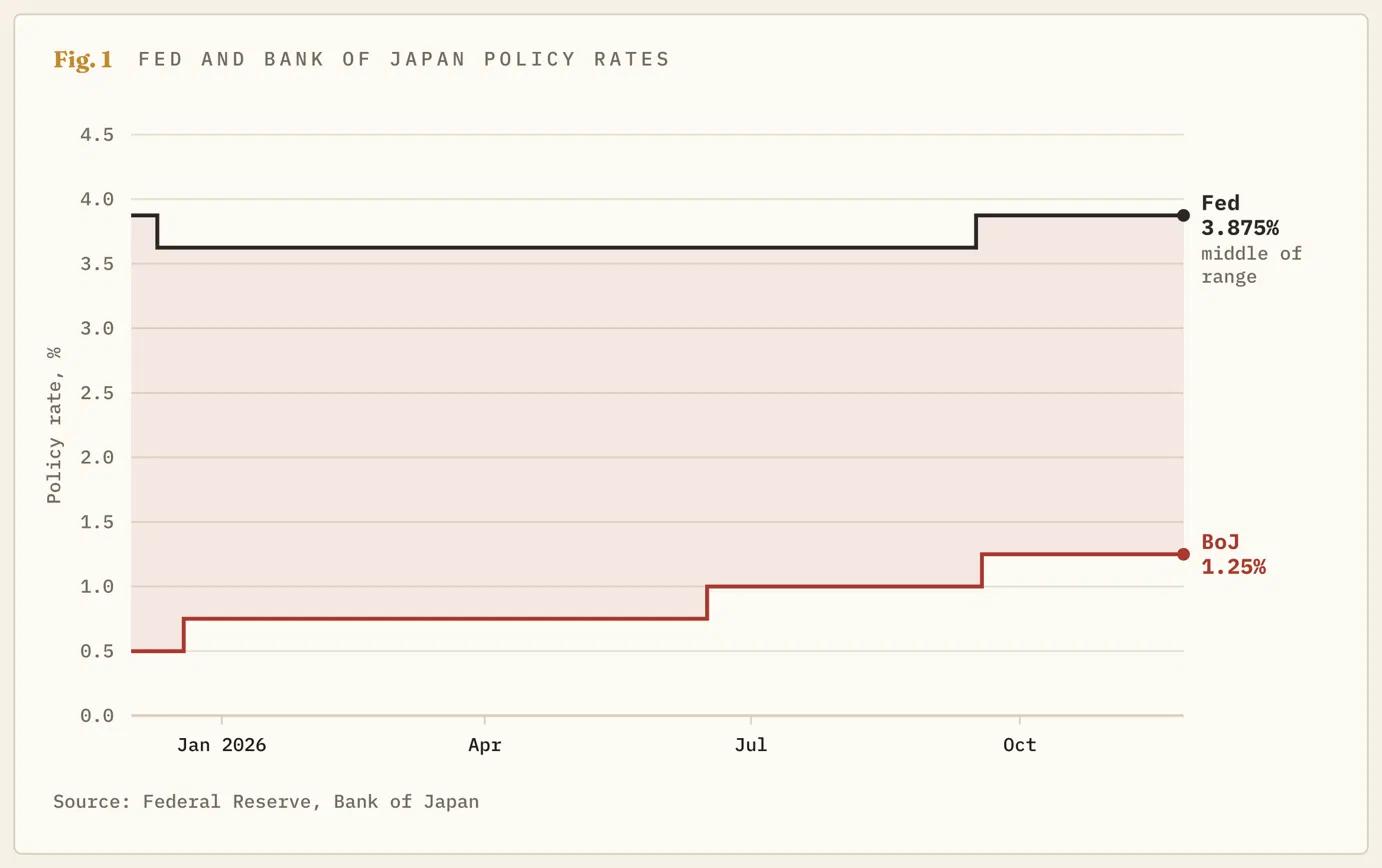
On that measure, December would likely change nothing. The Fed decides first, and traders put the chance of a quarter-point rise to 4.00%-4.25% above 90%. A matching quarter-point from the BoJ on December 18 would leave the gap at 2.6 points going into the two meetings and 2.6 points coming out of them.
From there, the risk leans toward a wider gap, because one Fed official is asking for more. Fed Governor Christopher Waller has argued that a half-point rise is probably needed in December unless the Fed signals another increase for January. Either version would leave the Fed moving faster than a BoJ whose quickest pace so far is one hike every three months. The Yen would then be judged against that difference in speed.
Three hikes, no bounce
The last three hikes show how little the hikes themselves have been worth to the Yen. The Yen fell after the rise to 0.75% in December 2025, because traders had hoped for a firmer message about what would come next. June's rise to 1.00% left the Yen roughly where it was. September's rise to 1.25% was followed by another fall, after two of the nine board members voted against it and BoJ Governor Kazuo Ueda made no commitment on pace.
Set against those three, the Yen's best stretch of the autumn came with no hike at all. In early September it gained roughly 4.5% against the Dollar in less than a week. Governor Ueda had said the board would discuss a rate rise at every meeting, and Governor Waller had said he was inclined to hold US rates steady if inflation kept cooling. Japan's Ministry of Finance (MoF), which buys Yen when it wants to stop a fall, later reported no purchases for that period.
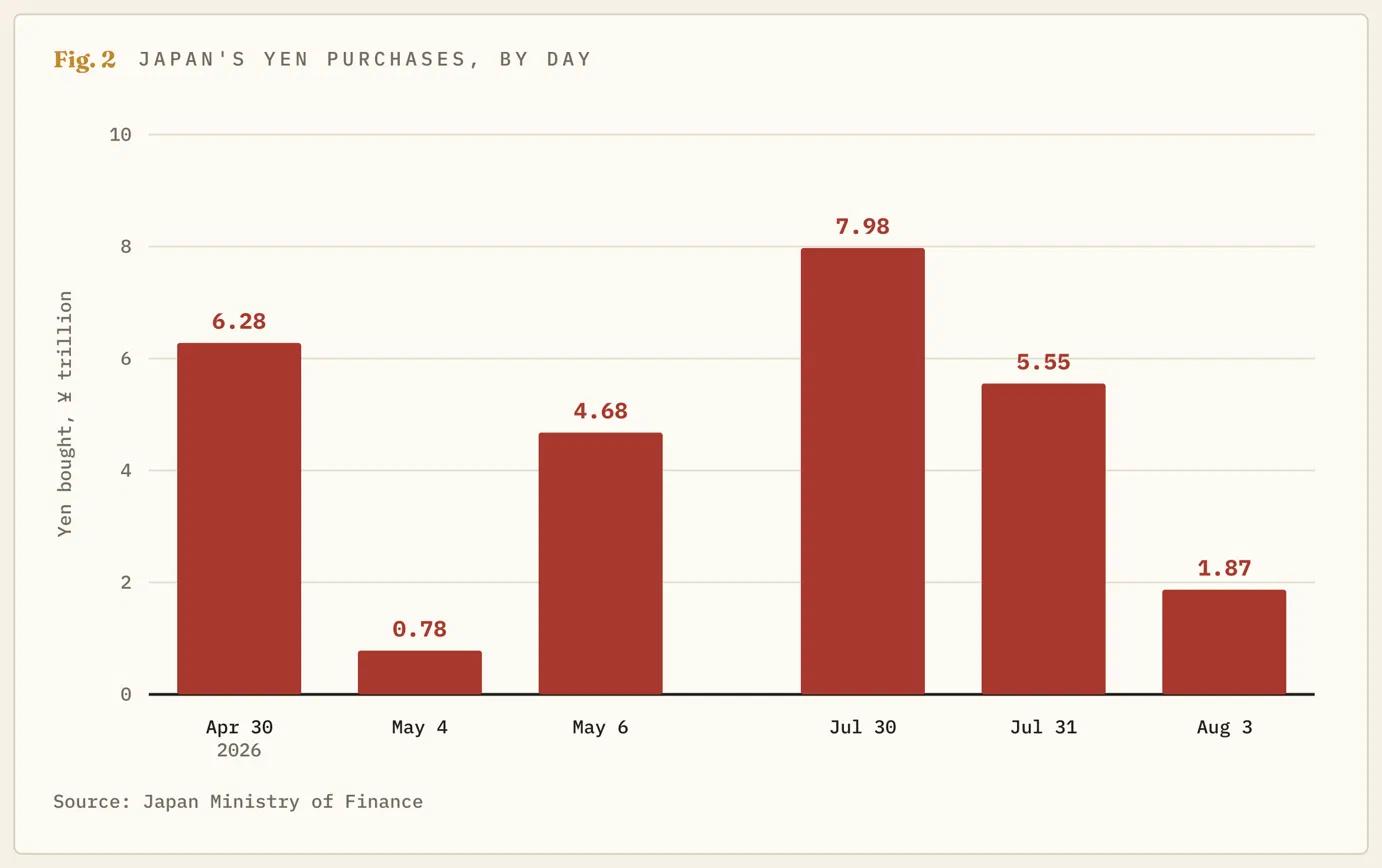
In that week, nothing had changed about the actual gap between the two rates, only what traders expected it to become. The MoF's own buying makes the same point from the other side. It has spent ¥27.1 trillion on six trading days this year, and the Yen is back near 160.00 per Dollar, the level traders treat as the ministry's line. Traders have learned to move the Yen along the expected gap path, and a hike they already expect adds nothing to that path.
One more hike in the ten months after
The pricing behind December's 70% also shows where traders expect the rate to be after each later meeting, and that part bears on the gap. It has the BoJ's rate at 1.56% after the March meeting and at 1.75% by October 2027. That works out to December's hike and one more in the ten months after it, a slower pace than the one the BoJ has kept since June.
Since November 19, that expected path has moved down. On that date, the same pricing put December near 85% and the October 2027 rate close to 1.85%. The November 20 inflation report is the likeliest reason for the change. It showed prices excluding fresh food and energy rising 2.2% in October, down from 2.4%, days after Japan reported that its economy shrank in the third quarter.
Against that, officials have kept talking the path up. BoJ board member Tamura said on Thursday that the rate should reach a neutral level, which he puts at around 2%, as soon as possible. Traders still expect less from the BoJ than they did a week before he said it.
For the Yen, the longer-lasting problem is that the board doesn't agree on where the hikes stop. BoJ staff put the neutral rate, which neither speeds the economy up nor slows it down, at 1.1%-2.5%, and from the current 1.25% that range could hold five more quarter-point hikes or none. The terms of board members Tamura and Takata, the two pressing hardest for faster increases, both end in July 2027. Prime Minister Sanae Takaichi, whose two appointees voted against September's hike, would choose their replacements.
A hold would cost more than a hike earns
None of this makes the December hike unimportant, and the strongest case for it is what would happen without it. At 70%, traders have already paid for most of a hike, so delivering it would likely earn the Yen little. A hold is the outcome they've put at less than one in three, and it would arrive nine days after a Fed rise had widened the gap to about 2.9 points.
In that case, the Yen would likely be sold back to 160.00 and past it, with the MoF as the only buyer in the way. Finance Minister Satsuki Katayama said on November 13 that the Yen's moves were one-sided and rapid. She added that Tokyo would coordinate with the US Treasury, which joined Japan in buying Yen on July 31. A BoJ that passed on December would hand the ministry a wider gap and still ask it to hold the same level anyway.
There's also a case that this hike helps more than the last three did. Governor Ueda told parliament on November 19 that a weak Yen adds to inflation, giving the BoJ its own reason to want the currency higher. The BoJ's October 30 Outlook Report also said inflation, with one-off price moves stripped out, is now broadly in line with the 2% target. A board that hikes on those grounds would find a long pause harder to explain, and that is the best argument for expecting firmer language than September's.
What the 70% doesn't cover
December 18 has three ways to go, and they don't matter equally for the Yen. A hold would be the biggest move of the three and would likely push the Yen down far enough to bring the MoF back in. A hike with wording like September's would likely leave the Yen where it is or a little lower, as the last three did.
The third outcome is a hike that comes with a commitment on pace, and nothing else on the list would likely lift the Yen for more than a few sessions. The signal would be any reason to expect the next move by March, whether in the statement or at Governor Ueda's press conference. Pricing has the rate at 1.56% after the March meeting, while nearly 60% of economists in a Reuters poll expect 1.75% by the end of that month. A sign that the economists are right would narrow the expected gap for the first time since early September.
Until then, the lean stays against the Yen, with the vote count as the second signal. Two votes against, as in September, would tell traders the board's doubters haven't moved, and a third would matter more than the hike itself. That stance breaks if the BoJ commits to a pace in the same month that the Fed raises by a quarter-point and signals a pause, since both would shrink the expected gap. Traders have already paid for 70% of the hike, and what's left for the Yen is the sentence that comes after it.
Author
Joshua Gibson
FXStreet
Joshua joins the FXStreet team as an Economics and Finance double major from Vancouver Island University with twelve years' experience as an independent trader focusing on technical analysis.