UK inflation inches higher on rising fuel bills

UK inflation has risen back above 3%, and higher energy prices suggest that could get to 3.6-3.7% over the winter. For now, though, there’s nothing in the latest data that screams a need to hike interest rates.
Headline inflation edged up to 3.1% on a widely expected 7% month-on-month rise in fuel costs. The weekly data points to another 3-4% rise in petrol/diesel through September, which we expect to help lift headline inflation up to 3.4% in next month’s data.
But this isn’t what matters to the Bank of England – the question is whether the energy shock is broadening out to other parts of the inflation basket. And there is very little sign that this is happening.
Take food inflation, which slipped even lower in August to 1.1% year-on-year. Producer price data suggests this could actually turn negative in the very near term. That feels unlikely given the wider energy shock. But then again, fertiliser costs have retreated, and so far, the sector is displaying signs of strong competition. In time, we expect food inflation to rise as the full effect of the Iran war feeds through, but that doesn't appear to be the case currently.
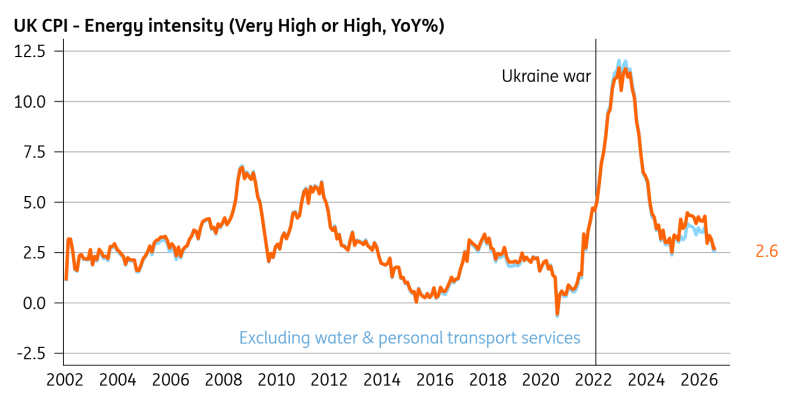
It’s a similar story when we look at goods and services the Office for National Statistics has previously defined as having ‘high’ or ‘very high’ energy intensity. This covers everything from fruit to air fares, to canteens. Even stripping out the distortion from last year’s water and car tax hike, we calculate that the inflation rate for these energy-intensive categories has actually fallen this year. This showed no sign of changing in August.
There's no sign the energy shock is broadening out
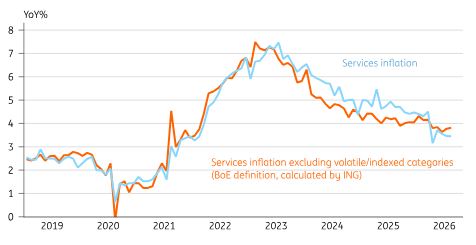
Services inflation is similarly reassuring. The Bank of England’s ‘core services’ metric, which strips out volatile and indexed categories, is tracking a bit higher than the headline services index (which stayed at 3.4% in August). But it remains benign, and given wage growth is similarly contained, we’d expect it to stay that way.
All of this serves as a reminder that the UK economy is far less susceptible to second-round effects than it was during the Ukraine shock four years ago. There’s nothing in today’s data that suggests the Bank of England needs to turn more hawkish. Inflation is currently behaving fairly predictably – which wasn’t the case back in 2022, when the data was consistently coming in above forecasts.
Services inflation is under control
None of this is to say the Bank of England won’t hike rates this year. If it does raise rates in November, it won’t be because of the inflation data today – or any other data for that matter. It’ll be because energy prices have stayed high for a number of weeks, at which point the Bank’s models are telling them there’s a good chance headline inflation exceeds 4%. When that happens, the Bank has previously cited research showing that second-round effects become more likely.
Whether that’s true or not is debatable. The BoE doves will certainly need some convincing, given their scepticism about the scope for second-round effects. But at some point, the inflation forecasts may become hard to argue against.
That isn’t our base case, however. Our base case is that energy prices dip back towards year-end. Our spreadsheet currently points to inflation peaking around 3.7% early next year, assuming the household energy cap increases by circa 25% in January, as the energy companies are currently predicting.
For now, we think the Bank can remain on hold into 2027.
Author

ING Global Economics Team
ING Economic and Financial Analysis
From Trump to trade, FX to Brexit, ING’s global economists have it covered. Go to ING.com/THINK to stay a step ahead.