This is a big week for data, but the Hamas-Israel war will continue to dominate the news and feelings


Outlook: This is a big week for data, but we guess that the Hamas-Israel war will continue to dominate the news and feelings. It can all too easily bleed over into market sentiment and neutralize economic data and things like corporate earnings. It’s the start of the earnings season and so far we have a few big banks doing okay but overnight the shocker of Rite-Aid declaring bankruptcy. Where will we get our vaccinations now?
Push earnings to one side. Front and center is the price of oil, the obvious result of war if it widens out regionally. Reuters notes that it has the most power “of emitting shocks through other markets by reigniting both inflation and economic demand fears simultaneously. For now, oil has reacted directionally as many would suspect, although the extent of its climb remains modest given the political stakes.”
Reuters blames the drop in U of Michigan consumer sentiment (and rising inflation expectations) on the war and the rising price of oil. “But with U.S. Treasury bonds and the dollar also tending to benefit from Middle East anxieties, the picture becomes messy and suggests a more general retreat from risky assets like stocks is still the playbook on any rise in geopolitical heat.”
As for the Fed outlook, this is the last week when Feds can speak ahead of the blackout starting next week. The biggie will be Fed chief Powell at the New York Economic Club on Thursday. Chicago Fed chief Goolsbee gave an interview to the FT in which he says he hasn’t made up his mind about the Nov hike but feels confident the declining trend in inflation is the real deal. Still, more data has to be examined. “That’s what I call the ‘data-dog’ approach. Let’s just keep sniffing.” And we have yet to absorb two external shocks, the price of oil and the autoworkers strike as well as the specter of a US government shutdown next month. ‘Oil price shocks and external shocks have derailed soft landings that were easier than this one, [Goolsbee] said.”
About the Swiss franc: why is the Swiss franc so strong? First, it really is a safe haven and can be counted on not to get involved in the Hamas-Israel war or any other mess in the Middle East. It’s neutral, aside from some discreet arms sales. Second, Switzerland managed to avoid the big jumps in inflation that the rest of the West experienced. See the chart from Trading Economics.
Third, it has a quite nice current account surplus. This is considered an old-fashioned factor these days, but it’s still a measure of a solid economy. Fourth, it has an amazingly stable population that has permitted very little and very tightly constrained entry to migrants. It helps to have serious border control.
Forecast: The dollar remains the primary beneficiary, along with the Swiss franc, of the Hamas-Israel war. It gets credit for a robust and resilient economy, too, albeit with worries about the yield reaching a “too high” 5%, the price of oil that could derail the soft landing narrative, and the potential government shutdown as well as oil rising back over $120 if the war spreads. We can note that oil could rise disproportionately to the news on pure fear alone. More than one analysts has noted that the fear factor has yet to affect market sentiment in full.
Tidbit: Analysts are still obsessing about shelter prices in the latest (Sept) CPI up 7.1% y/y being misleading. Zillow says actual rent growth was only 3.2%. Apartment List has an outright drop by 1.2%. Apart from Wolf Street’s perspicacious noting that medical costs were understated and about to come back, this leads to the deduction that the Fed has already over-tightened.
Homes prices themselves are up only 1% y/y, according to Case Shiller (lags a lot) and the Realtor has an outright drop by 0.9%. he same story holds true for home prices. Because shelter is 35% of the CPI, we might assume that 2.5% of the 3.7% CPI rate should be subtracted. We doubt this is statistically proper, but never mind. Even the St. Louis Fed gets a number under 2.5%.
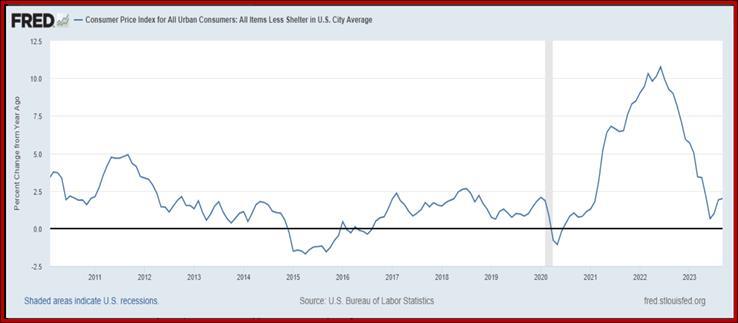
So now the question is when does Main Fed see the number it needs to stop hiking—assuming it still has one more up its sleeve—and start easing? As much discussed in a hundred places, it’s probably not March 2024 but it might not be as far out as Sept. How about June? Gee, haven’t we been here before?
Funny enough, this morning Bloomberg reports “The ECB won’t lower interest rates until September 2024, according to a poll of economists. That suggests policymaker messaging is sinking in. The latest Bloomberg survey is a departure from the previous round, when respondents still saw borrowing costs being lowered in March. Another reduction is foreseen in October.”
Since it’s the job of analysts to project into the future, the implications of the Fed reaching the end of that last mile include a stock market rally and the return of real estate as an investment target. That’s not here yet.
Tidbit: Every news junkie knows by now that is not the time to trust the news about the Hamas-Israeli war, let alone the analysts from both sides. Will threats from all sides keep Iran at bay? Will the Saudis stick to the peace deal with Israel? Just how firm are the Sunni countries, including Egypt, against the Shiites? Sunnis are about 90% of the total Muslim population. So what?
Can Egypt be persuaded (aka bought) to open the border for refugees? When is Israel going to conduct its urban ground-war invasion and how anti-humanitarian is it going to be? The mind recoils in horror. And can we please get rid of the words “colonization” and “occupying”?
One thing is abundantly clear—the Palestinians never bothered to form multi-party governments and just let the terrorists run the show (or sit back and drink tea). The most interesting question we heard on the Sunday TV shows is what will the post-war Palestinian government be? That’s assuming Israel roots out all the Hamas leadership tooth and nail.
One other point: nobody is acknowledging that the Evangelicals’ support of Israel was a Mossad operation to get a big slice of the American body politic. This seems too obvious to mention. But why couldn’t Mossad do something equivalent in Gaza?
This is an excerpt from “The Rockefeller Morning Briefing,” which is far larger (about 10 pages). The Briefing has been published every day for over 25 years and represents experienced analysis and insight. The report offers deep background and is not intended to guide FX trading. Rockefeller produces other reports (in spot and futures) for trading purposes.
To get a two-week trial of the full reports plus traders advice for only $3.95. Click here!
Author
Barbara Rockefeller
Rockefeller Treasury Services, Inc.
Experience Before founding Rockefeller Treasury, Barbara worked at Citibank and other banks as a risk manager, new product developer (Cititrend), FX trader, advisor and loan officer. Miss Rockefeller is engaged to perform FX-relat

















