The reporting season in the US: What’s going on?
The reporting season is in full swing in the United States. So far, with a few exceptions, the "big guys" are reporting well. And the market reacts positively to the reports. But there are several questions which need to be answered.
What’s happening with banks?
Good reports in the banking sector, how should we say it, have a "stink.” Revenues grow, but there is a steady tendency to "escape” depositors. Thus, experts paid attention to Bank of America and Bank of New York Mellon - reduction of deposits by 8% and 16%, respectively.
The reason for this, as we all remember, is the history of Credit Suisse and SVB.
It begs the question - will there be a global banking crisis?
We do not think so. At least not now and not under current conditions. Inflation in the US, though high, is not enough to provoke a massive outflow of capital. And despite the gradual dismantling of the dollar system, confidence in the US currency is still enormous (the key word here is "so far"). By the way, it is essential to understand that we may be dealing with a controlled dismantling, i.e., with the full awareness of the US of this process and focusing primarily on keeping key allies and not attracting "rebel" countries to its side and control.
The second question on the agenda is, "Where is the money?” After all, if deposits are taken out, they must flow somewhere.
Here we should remember the growth of crypto (after all, bitcoin has been adding more than 90% since January) and gold (on the spot price rose by more than 12%). And the US stock market itself has not disappointed so far. S&P categorically refuses to fall.
The market doesn't believe that the Fed may not reverse its monetary policy. This is even though most voting FOMC members (7 out of 11) continue to be hawkish on policy, and inflation is unlikely to turn down permanently.
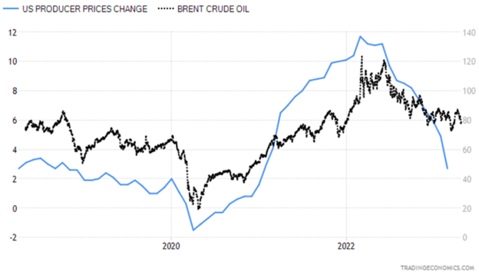
Here, it is interesting to look again at the movement in the PPI index versus the oil price. Only in June 2022 (before the oil price reversed) the Fed had virtually no room for maneuver - the rate was raised rather quickly. Now that space has appeared, that does not mean that the FOMC will also quickly turn 180 degrees. However, for some reason, the market has already decided on this soon reversal for the Fed, which is now reflected in the prices.
The S&P 500 technical analysis
The technical picture continues to be quite interesting.
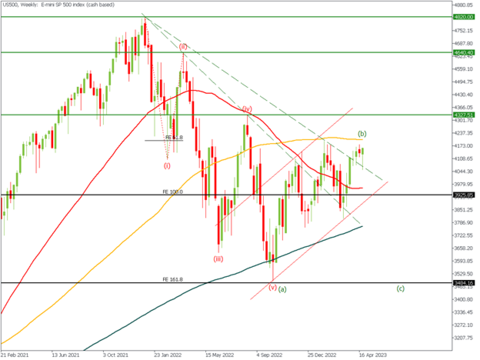
While many in the market continue to expect growth, the S& P500 index has formed five waves of decline and is creating corrective growth waves amid some euphoria. However, the key word here continues to be corrective.
We expect a new downside wave of the index, with the nearest target being 3925.85 points.
A breakdown of this level will take the S&P500 down to 3775 points (MA 200).
What to expect?
Our assumptions
1. Oil price will resume growth and will be closer to $100 by the end of the year
2. US inflation will remain above the 2% target
3. The Fed will be forced to keep rates high. We may be in for a reversal in monetary policy, but the fact that the FOMC will lower the rate by 100 points, as the market thinks, is not to be believed.
4. The US stock market will turn around and start to decline. This is a logical consequence of point 3, a consequence of point 2. The economy is not on the way to recession; the economy is ALREADY in a recession. We remain pessimistic about the US market, and for now, we believe there is still no consolidation above 4100 points on the S&P.
5. As the defragmentation of the global financial system intensifies, it is logical to expect the dollar to weaken. Consequently, we continue to remain moderate optimists on gold. By the way, here we are saying it is worth paying attention to other metals.
This article is sponsored
Author

FBS Team
FBS
FBS team is a group of professional analysts focused on Forex, stock, and commodity markets. Each expert possesses a years-long experience in fundamental and technical analysis.

















