The Fed Warsh inherits: Divided and with its independence in doubt

The Federal Reserve is the central bank of the world’s most powerful economy, and prides itself on its independence. But is it? Or, better said, will it continue to be under Kevin Warsh?
Kevin Warsh is on his way to be the next United States (US) Fed Chair. His path toward it was not as smooth as it should have been, but he has been nominated and passed the Senate Banking Committee according to all the US legal standards. 13 Republican members voted in his favor, while 11 Democrats voted against him. It was the first fully partisan vote on a Fed chair nominee in the committee’s history.
For Warsh to become Chair, there is still one more step pending: the full Republican-controlled Senate needs to vote on his nomination next week, right before Jerome Powell’s term ends on May 15.
At this point, there are no doubts about the result of the final vote. But uncertainty revolves around what he would deliver, either what the position demands or what US President Donald Trump desires.
To be or not to be independent
During the Senate hearing, Warsh pledged not to be a “sock puppet” for President Trump and emphasized the central banks’ independence. In fact, he had to repeat the Fed’s independence idea more than once, given how he ended up nominated to become the Chair.
US President Trump chose Warsh after spending the last year demanding that Powell cut interest rates, to no avail. Trump insulted, threatened to fire, and even supported a criminal investigation against Powell, who bore with Trump’s clashes according to the Fed’s mandate.
Why is the Fed’s independence so critical? Because the central bank is meant to make objective, data-driven decisions aimed at protecting the people, granting stable inflation and low unemployment in the long run.
A politicized Fed not only challenges the institutional independence, building distrust in the government, but it also has long-term consequences that could jeopardize the US economic status. Sure, lower rates boost near-term economic activity, but in the long run, these could translate into double-digit inflation.
Distrust could cause markets to panic, whipping whatever near-term growth lower rates generated. Long-term Treasury yields would likely skyrocket as investors got rid of them, and let’s not even talk about mortgage rates or the massive budget hole.
The future would have been less concerning in a different scenario than the current one, but the US economy is already dealing with mounting price pressures. Trump’s tariffs spurred concerns about inflation, but nothing like launching an Oil war at the other end of the globe that triggered soaring gas and energy prices.
An unusually divided Fed
The Federal Reserve Open Market Committee held the Fed funds rate unchanged in the range of 3.5%-3.75% when it met late April, as expected. The decision, however, was the most divided since 1992, with eight officials voting to hold, three favoring maintaining the target range but not supporting the inclusion of an easing bias in the statement, and one who voted to cut rates.
With Kevin Warsh taking the Chair, a still-wide majority of the twelve voting members seems more keen to hike. And if the war continues, markets will start betting on an imminent hike.
FXStreet’s speech tracker, which gauges the tone of Fed officials’ speeches on a dovish-to-hawkish scale from 0 to 10 using a custom AI model, highlights that most Fed voters currently lean neutral to hawkish:
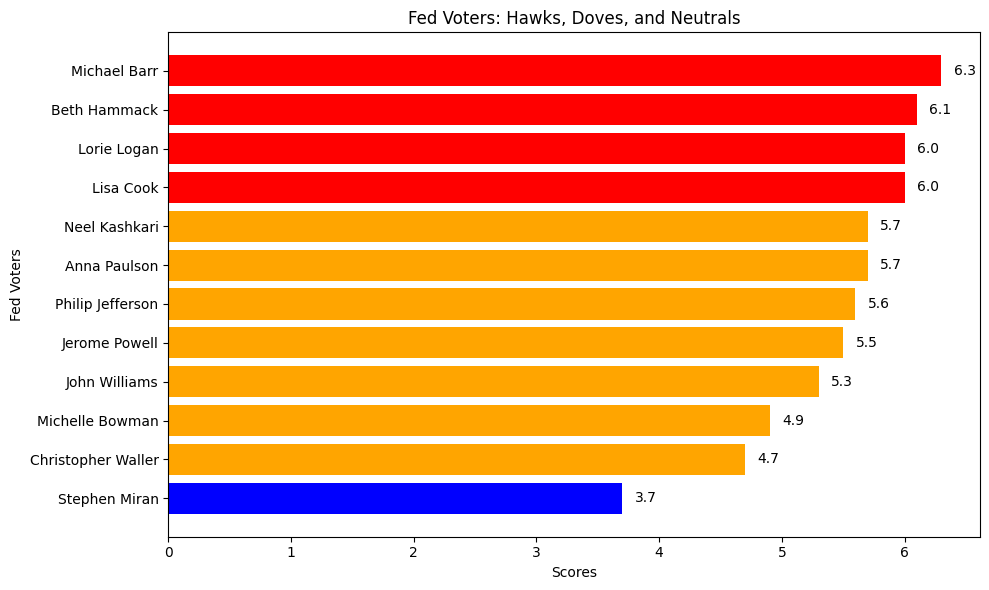
Data favors a rate hike, President Trump favors rate cuts, and Fed members are more divided than ever. Kevin Warsh has not even yet taken the Chair, and he is already between a rock and a hard place.
Author

Valeria Bednarik
FXStreet
Valeria Bednarik was born and lives in Buenos Aires, Argentina. Her passion for math and numbers pushed her into studying economics in her younger years.