The Fed can’t meet without telling us something, can they?

Outlook: The big news is a closed unscheduled Fed meeting this morning. It’s astonishing this news is not blazoned all over the financial press. Perhaps we should not be expecting any announcement.
We get retail sales and the Fed minutes this week. A big question will be whether the Fed is committed to rating hike first, QT after. Former TreasSec Summers is not alone in saying the Fed should call a special meeting right away and announce the end of QE, not so much for the market effect, which would be minor, but for the Announcement Effect. With housing inflation even higher than in 2006 ahead of the crisis, it makes no sense for the Fed to be buying (subsidizing) mortgage-backed.
Whether the Fed hikes by 25 bp or 50 bp at the March meeting, the markets are getting the message (finally) and this is a Big Deal. St. Louis Fed chief Bullard speaks again this morning and had the muscle, apparently, to get the Fed to call for an unscheduled meeting today. Each Fed is allowed to speak his mind without censorship. The Bullard interview was scheduled before the meeting was announced so perhaps he won’t speak this morning, after all. That kind of information can’t be found around 8 am. We are astonished the unscheduled Fed meeting is not the top front-page news everywhere.
Reuters reports the BoE may join the Fed and hike rates in March, too, on inflation exceeding the forecasts, according to the latest survey. “Nearly two-thirds of respondents in the Feb. 7-11 poll, or 25 of 40, expected a 25 basis points increase in Bank Rate to 0.75% at the conclusion of the next MPC meeting on March 17. That would mark the first time the Bank has raised rates at three meetings in a row since 1997.
“A slim majority, 21 of 41, forecast a further increase to 1.00% next quarter. That is well behind financial markets, which are pricing in the bank to make a cumulative 75 basis points of increases at its March and May meetings.”
In the US, we are starting to see the revisions to upcoming inflation numbers that (logically) could or should influence the Fed. There is a fair amount of hemming and hawing, some of it due to the base effect that delivered such a high number this time and will inevitably deliver lower ones going forward. Other factors are the new weightings in the index and most important, the likely lasting effect of shelter costs, and that’s just the rental part.
Morgan Stanley, for example, sees inflation peaking in Feb at 7.9% and core at 6.4%. The PCE version will also peak, but at 6.2% with core at 5.3%. By June, core PCE inflation will be at 4.0% y/y, but taken in the form of 3-months annualized, it will be nicely lower at 2.6%. By year-end, Q4 over Q4 will be 3.2%. Even if the Fed sticks to its story that inflation can run a little hot after running below target for so long, this would not be dramatically too high. (About that process for annualizing monthly data into quarterly–it’s a nightmare for someone who can barely manage a simple Excel spreadsheet. The Cleveland Fed has a tutorial.)
A note about that inversion of the yield curve: an economist told us to chill out about it. The 2/10 yield spread reflects only expectations by market players about a pending recession and by inference, where inflation will have gone. Expectations are not real. And they are also often dead-wrong.
Since nobody has a crystal ball, this is another way of saying what Samuelson said decades ago–the inverted yield curve has predicted 38 of the last three recessions (or something like that). Former Fed chief Greenspan said in 2005 that yield curve is obsolete, and some analysts are now naming the shift toward inversion a “false positive.”
We may be able to set aside yield curves and even some high-frequency data (like retail sales) if Russia invades Ukraine, although talk of the event coming on Wednesday seems unlikely given German Chancellor Scholz is in Kyiv today and Moscow tomorrow. Putin seems to seek something more than worldwide attention, although he waters down his own importance with stupid things like that oversized table he used to speak with Pres Macron.
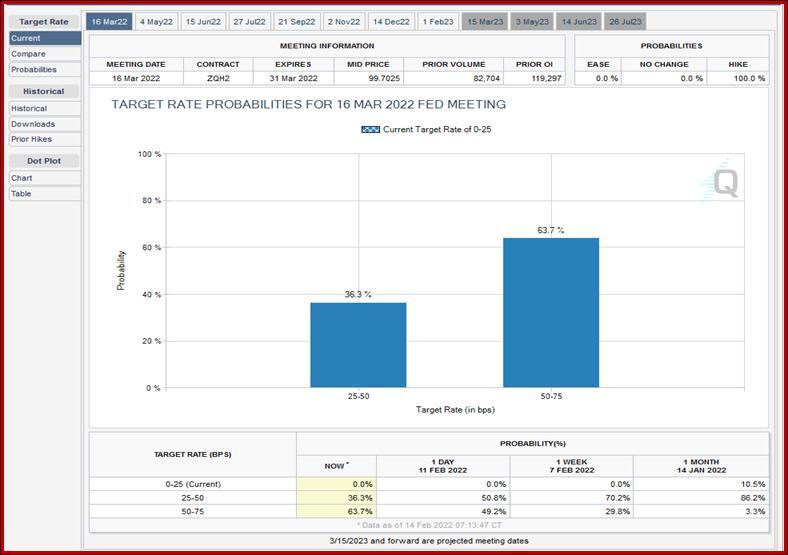
As for that Fed meeting behind closed doors, we will not get any transcripts but it seems we must get an announcement. They can’t meet without telling us something, can they? A hike today is unlikely in the extreme, assuming this unscheduled meeting is like the last one. But let’s not be silly--there is only one message: the March rate hike is a done deal. We will not know whether it’s 25 or 50 bp until the day. Those who watch the CME Fed funds say the numbers are jiggling around all over the place. Here is the latest–it shows a probability of over 60% of Fed funds at 50-75% by the March meeting, vs. less than 50% on Friday (and 3.3% a month ago).
This is an excerpt from “The Rockefeller Morning Briefing,” which is far larger (about 10 pages). The Briefing has been published every day for over 25 years and represents experienced analysis and insight. The report offers deep background and is not intended to guide FX trading. Rockefeller produces other reports (in spot and futures) for trading purposes.
To get a two-week trial of the full reports plus traders advice for only $3.95. Click here!
This is an excerpt from “The Rockefeller Morning Briefing,” which is far larger (about 10 pages). The Briefing has been published every day for over 25 years and represents experienced analysis and insight. The report offers deep background and is not intended to guide FX trading. Rockefeller produces other reports (in spot and futures) for trading purposes.
To get a two-week trial of the full reports plus traders advice for only $3.95. Click here!
Author

Barbara Rockefeller
Rockefeller Treasury Services, Inc.
Experience Before founding Rockefeller Treasury, Barbara worked at Citibank and other banks as a risk manager, new product developer (Cititrend), FX trader, advisor and loan officer. Miss Rockefeller is engaged to perform FX-relat

















