The Australian Dollar eyes its March low

AUD/USD rebounds on Monday, trading around 0.6900 after falling to 0.6855 on Friday, approaching its March low of 0.6834. Despite this recovery, the Australian Dollar (AUD) remains under pressure against the US Dollar (USD), following one of its worst weekly performances in recent months.
The Aussie faces a combination of unfavorable factors, including a less hawkish-than-expected message accompanying the Reserve Bank of Australia (RBA) rate hike last week, robust US economic data and deteriorating risk appetite across financial markets.
Monday's rebound comes amid a slightly more favorable environment following the release of Chinese inflation data. However, investors remain cautious ahead of upcoming US economic releases, which could reinforce expectations of further interest rate hikes by the Federal Reserve (Fed).
RBA rate hike fails to convince investors
The RBA raised its benchmark interest rate by 25 basis points (bps) to 4.85% last week, its highest level since 2008. However, the decision, which would typically support the Australian Dollar, triggered a negative reaction in the foreign exchange market. The main reason lies in the less hawkish-than-expected nature of the hike. The decision passed by a six-to-three vote, revealing significant divisions within the monetary policy board.
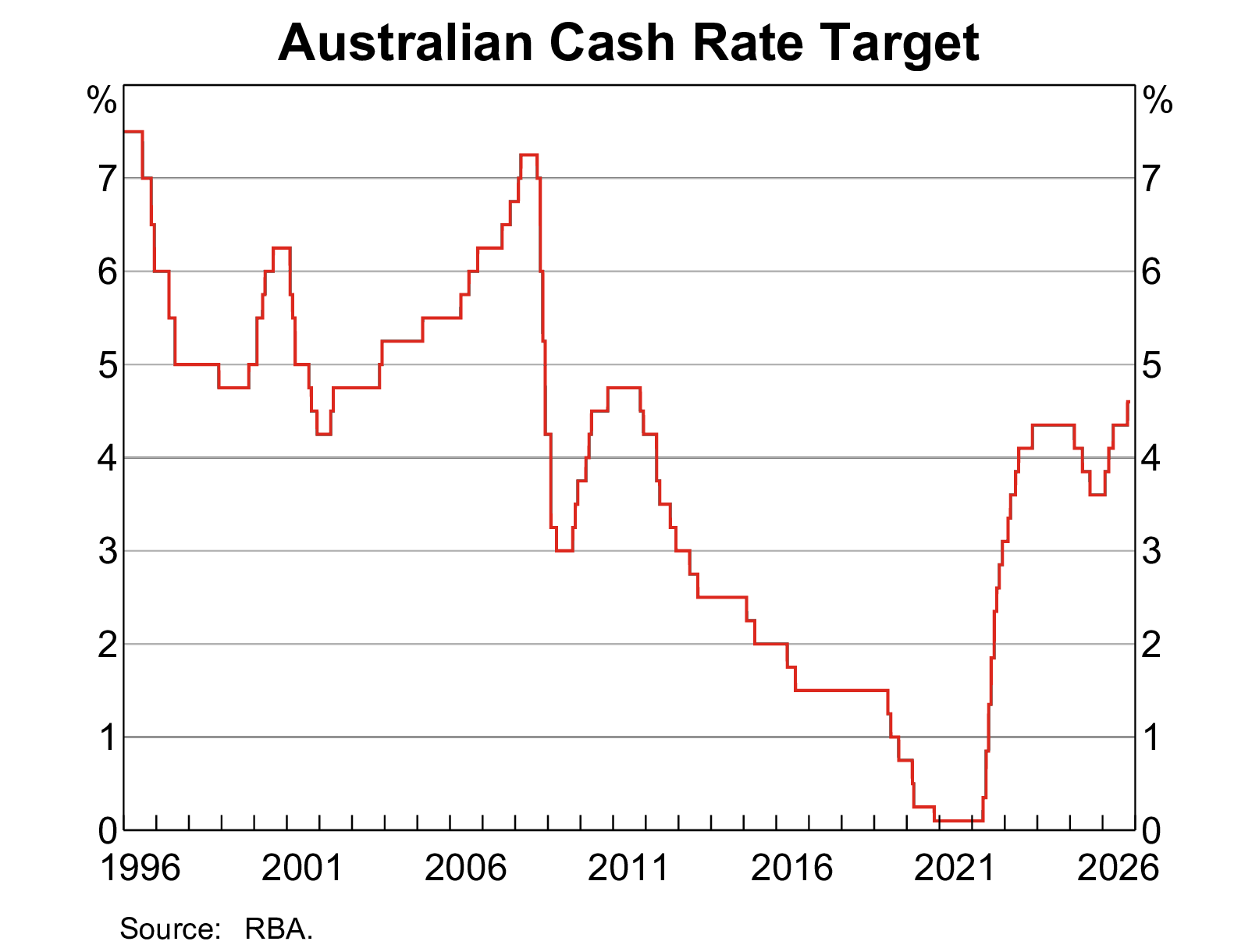
Furthermore, RBA Governor Michele Bullock maintained uncertainty over future policy decisions, saying the central bank was “basically preserving our options” and adding, “I don’t know what the next move will be.” These comments fueled speculation that Australia's monetary tightening cycle could be approaching its end, despite inflation remaining elevated.
CommSec’s Equity Market Commentator James Gruber explained the shift in market expectations in comments reported by News Australia: “The split decision to hike in November has led some investors to think interest rates may have peaked. Markets are now pricing in a rate cut by December 2027.” This reassessment contrasts with expectations of further US interest rate hikes, reducing the relative appeal of the Australian currency.
US Dollar benefits from strong employment data
The strength of the US Dollar represents another major obstacle for AUD/USD. The latest US labor market data showed that Nonfarm Payrolls (NFP) increased by 165K in October, significantly exceeding expectations of 65K. Meanwhile, the Unemployment Rate declined to 4.1% from 4.2% previously. These figures suggest that the US economy remains resilient enough to allow the Fed to maintain a restrictive monetary policy stance.
According to the CME FedWatch tool, markets now assign nearly an 80% chance to another 25-basis-point interest rate hike at the December meeting.
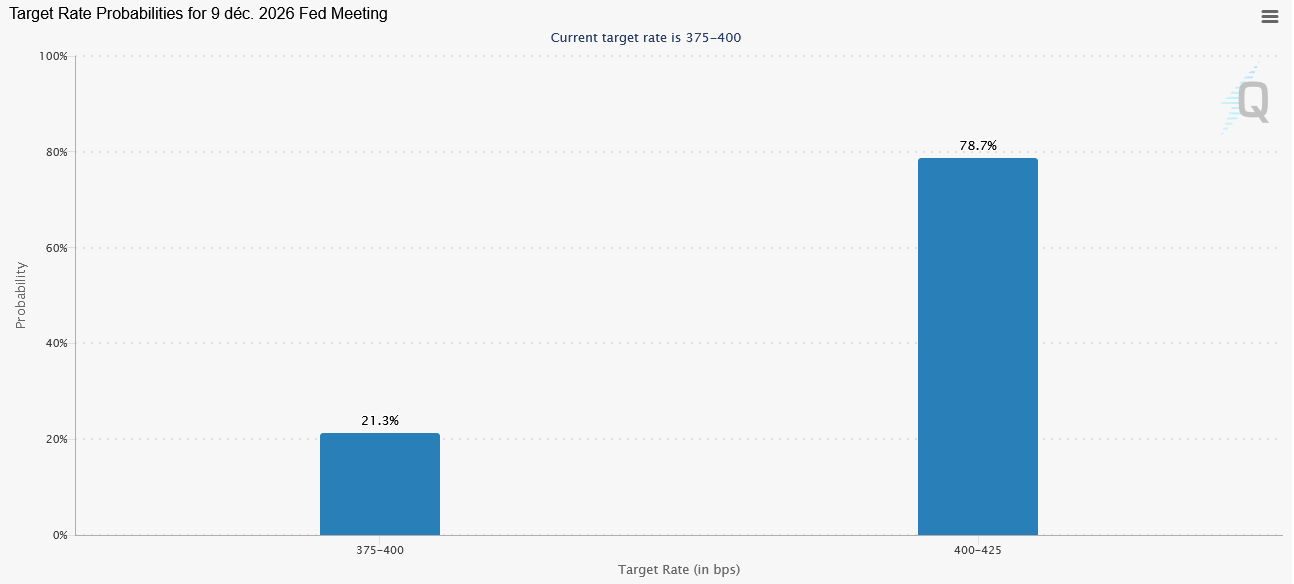
Attention therefore turns to Tuesday's US Consumer Price Index (CPI) report, followed by Friday's Producer Price Index (PPI). Higher-than-expected inflation could reinforce expectations of further monetary tightening and provide additional support to the US Dollar, increasing downward pressure on AUD/USD. Conversely, softer inflation figures could weaken the Greenback and encourage a recovery in the Australian Dollar.
Risk aversion and China also influence the Aussie
Beyond monetary policy, the Australian Dollar is suffering from deteriorating sentiment across financial markets. Concerns about technology stock valuations and the profitability of artificial intelligence investments have triggered significant selling pressure across global equity markets. This environment particularly weighs on the Australian Dollar, which is traditionally sensitive to risk appetite and global growth expectations.
Societe Generale highlighted the spillover from equity market turbulence into foreign exchange markets: “FX spillovers from the selloff in stocks surfaced in the AUD, the SEK and NZD in G10.” Against this backdrop, another correction in US equity indices could accelerate selling pressure on cyclical currencies as investors seek exposure to safer assets.
China, Australia's largest trading partner, nevertheless provides some limited support to the Aussie on Monday. Chinese Consumer Price Index (CPI) rose 0.7% YoY in October, compared with 0.9% in September and expectations of 0.8%. Meanwhile, the Producer Price Index (PPI) accelerated to 5.7% YoY, exceeding forecasts of 5.3%. These figures offer some encouraging signals regarding China's price dynamics but do little to dispel concerns about domestic demand and the country's economic outlook.
Global risk sentiment and upcoming US economic data are therefore likely to remain the main drivers of the Australian Dollar's near-term direction.
AUD/USD remains vulnerable to a retest of the March low
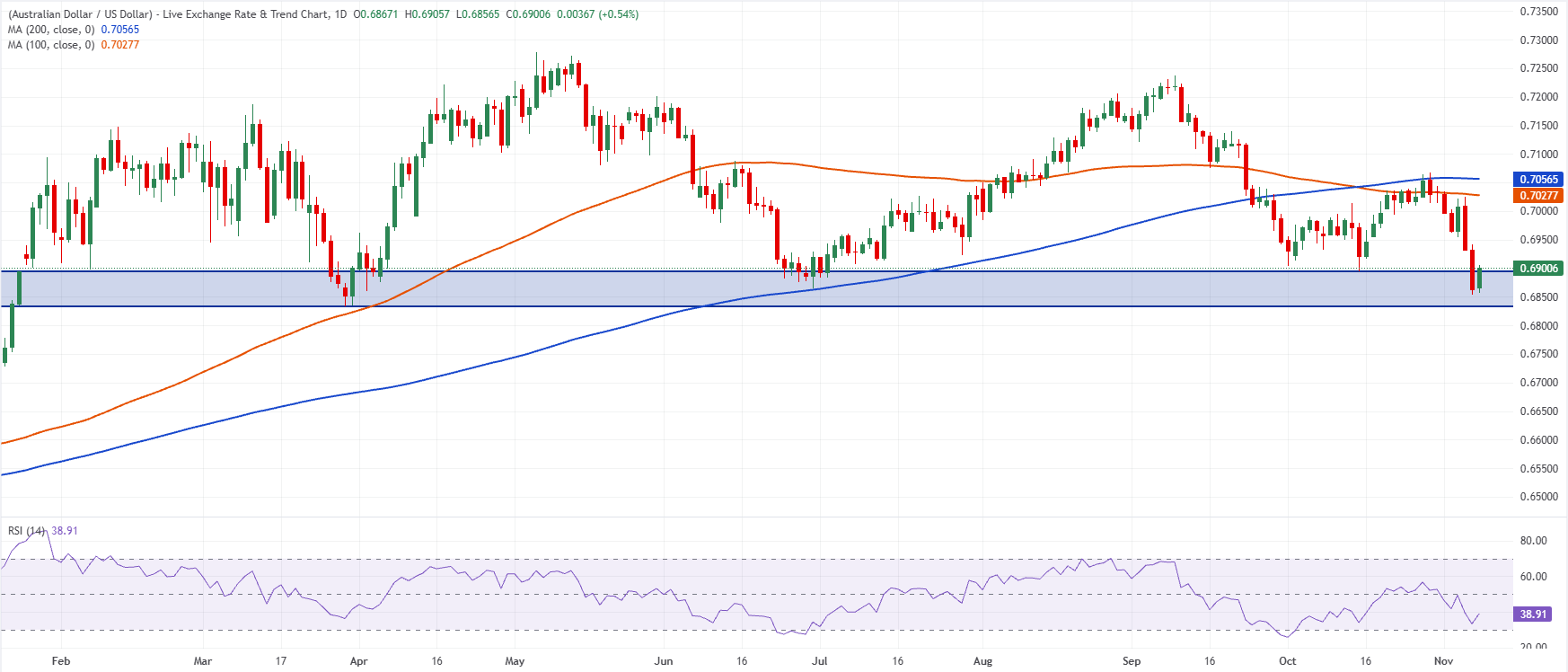
On the daily chart, AUD/USD maintains a bearish bias following its recent decline below the 100-day and 200-day Simple Moving Averages (SMAs), currently located around 0.7028 and 0.7057, respectively. The pair fell to 0.6855 on Friday, approaching the March low of 0.6834, before finding support and rebounding toward 0.6900 on Monday.
Buyers are now attempting to reclaim the former support level around 0.6894. A sustained recovery above this threshold could ease immediate bearish pressure and open the door to a rebound toward the mentioned moving averages, followed by the October peak at 0.7068. However, a sustained move above this latter resistance area would be necessary before considering a more convincing bullish reversal.
In the meantime, the daily trend remains tilted to the downside. Failure to hold above 0.6894 could revive selling pressure, bringing Friday’s low at 0.6855 back into focus before triggering another test of the March low at 0.6834. A break below this level would strengthen the case for a deeper correction, particularly if upcoming US inflation data provide additional support to the US Dollar.
Author

Ghiles Guezout
FXStreet
Ghiles Guezout is a Market Analyst with a strong background in stock market investments, trading, and cryptocurrencies. He combines fundamental and technical analysis skills to identify market opportunities.