Silver turns strategic as critical minerals reshape supply chains
Silver is no longer trading only as a monetary hedge. In early 2026 it is increasingly behaving like a strategic material, shaped by industrial policy and supply chain security rather than by inflation headlines alone.
The latest shift comes from Washington’s renewed focus on critical minerals. The idea of building strategic reserves is expanding beyond oil into the metals that power electrification, defense technology and manufacturing sovereignty. In that framework, silver becomes more relevant than markets typically assume.
Its role is not just symbolic. It sits at the intersection of energy transition, electronics and geopolitical competition. That positioning gives silver a premium profile that is closer to strategic metals than to classic precious assets.
Critical minerals are becoming a new macro category
Global commodity pricing is entering a new regime where the key question is not only how much supply exists, but who controls it, processes it and can access it during stress.
That is what the critical minerals narrative is about.
The United States and its allies are increasingly treating mineral supply chains as national security infrastructure. The objective is to reduce dependency, build redundancy and prevent strategic vulnerability in sectors tied to defense, energy systems and advanced manufacturing.
This approach shifts the market from price discovery to risk discovery.
In such an environment, metals begin to trade with a political premium. The premium is not only embedded in futures curves. It is embedded in long term investment flows, mining policy, refining capacity expansion and procurement strategy.
Silver fits this transition because it is both an industrial input and a macro hedge. Few commodities can play both roles.
Silver is a critical industrial metal hidden inside a precious wrapper
Silver is often categorized alongside gold, but its demand structure is fundamentally different.
A large and rising share of global silver consumption is tied to industrial applications. Solar panels, high conductivity electronics, advanced circuitry, medical components, automotive systems and defense equipment rely on silver because it is difficult to substitute without performance loss.
As electrification accelerates, demand becomes less cyclical and more structural.
This is precisely the condition that transforms a commodity into a strategic asset. When demand is anchored in technology and infrastructure, supply issues are not solved by a brief price move. They require capacity, processing, and time.
That makes silver sensitive to supply chain stress in a way that gold is not.
Supply chains are the vulnerability, not the geology
Silver is not rare in geological terms. The constraint is not the amount of metal in the ground. The constraint is the pipeline that turns reserves into usable industrial material.
Mining supply is slow to respond. Grades decline, costs rise, and permitting becomes politically difficult.
Refining and processing also matter. Even if global mine output exists, it still needs to flow through the right channels at the right time. This becomes a geopolitical issue when refining and manufacturing are concentrated in a limited set of countries.
The same problem that defines rare earths and battery metals also applies to silver, even if the market does not talk about it as openly.
That gap between perception and reality is where a strategic premium can emerge.
Capital flows will increasingly treat silver like an industrial hedge
In the old framework, investors treated silver as gold with higher volatility. In the new framework, silver becomes gold plus industrial leverage.
That subtle shift matters.
When monetary uncertainty rises, gold captures the hedge flow. But when industrial policy becomes the key macro theme, silver becomes more attractive because it carries optionality. It benefits from macro fear and from technological expansion.
This dual identity is the defining feature of the 2026 cycle.
If strategic stockpiles become a recurring policy tool, markets will reassess which commodities belong in the category of critical materials. Silver will likely be pulled into that re rating process, even if it is not formally labeled in the same way as lithium or rare earths.
The Renko structure confirms accumulation above a strategic pivot
The technical structure reinforces the macro story.
Silver’s Renko sequence shows a market that is volatile but controlled, respecting key levels rather than losing structure. The 90.00 zone stands out as a central pivot. Price has rotated around it repeatedly, confirming that buyers treat it as value rather than as a breakdown point.
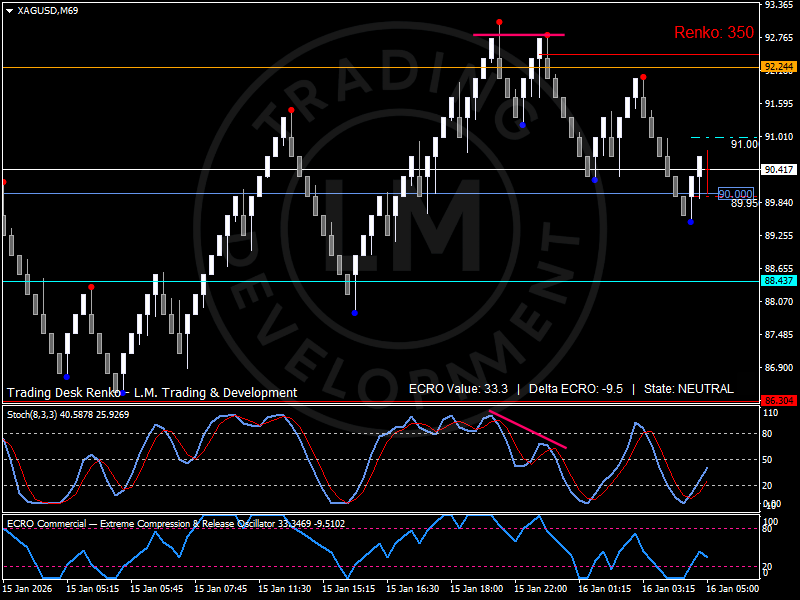
Above that pivot, 91.00 acts as the near term activation level. A sustained hold above 91.00 would signal that the market is rebuilding momentum after the recent correction.
The upper resistance remains near 92.24, aligned with the previous supply cap where the market rejected highs earlier in the week. That area represents the ceiling of the current structure.
In this context, the price action looks like strategic accumulation rather than speculative exhaustion. Pullbacks remain relatively orderly, and the oscillators point to rebuilding momentum rather than collapse.
ECRO and Stochastic dynamics are also consistent with this interpretation. The market has shifted into a neutral state after a heavy swing, while momentum begins to re accelerate from the base. This is often the signature of a consolidation that is preparing for the next leg rather than distributing.
Outlook for 2026: Silver may trade geopolitics more than inflation
Going into 2026, silver is likely to price three overlapping forces.
First, industrial demand continues to rise as electrification expands and solar installations remain structurally resilient.
Second, supply chains remain politically sensitive, which increases the value of secure sourcing.
Third, macro policy credibility remains under pressure globally, which keeps the hedging bid alive across precious metals.
This combination is unusually supportive.
It suggests that silver is not only trading inflation risk. It is trading security of industrial inputs and geopolitical competition over strategic materials.
That is why silver deserves to be treated as a strategic metal, not only as a precious metal.
Conclusion
Silver is entering 2026 with a stronger identity. It is no longer just a leveraged version of gold. It is increasingly a strategic industrial commodity tied to electrification, defense technology and supply chain security.
As critical minerals politics intensify, metals that sit inside key technologies will gain a structural premium. Silver is one of them.
The Renko structure supports this shift. Price is consolidating above the 90.00 pivot, rebuilding momentum with resistance near 92.24 and an activation level around 91.00.
In a world where commodities are increasingly priced by access and control, not only by scarcity, silver looks less like a trade and more like a strategic allocation.
Author

Luca Mattei
LM Trading & Development
Luca Mattei is a market analyst focusing on FX, metals, and macroeconomic trends. He develops trading tools for retail and professional traders, coding indicators and EAs for MT4/MT5 and strategies in Pine Script for TradingView.

















