Silver tracks industrial participation as manufacturing expectations stabilize

Key takeaways
- Silver trades near the 57.0–57.6 participation zone as investors evaluate the latest manufacturing signals across Europe, the United States and Asia.
- Manufacturing expectations are gradually stabilizing, supporting industrial metals through improving production activity while financing conditions and energy costs continue shaping business confidence.
- Industrial fabrication, electrification and technology investment remain the principal structural demand channels supporting silver.
- The Renko structure has entered a Compression phase, indicating that participation is rebuilding while markets await stronger confirmation from the global manufacturing cycle.
Silver follows the manufacturing cycle
Silver enters Friday's session with market attention increasingly centered on the industrial economy.
This week's macro calendar has progressively shifted the focus away from inflation releases and toward manufacturing conditions across the major economies. The European Central Bank delivered an unchanged policy decision, while investors continue evaluating how manufacturing activity is responding to evolving financing conditions, energy prices and business confidence.
For silver, this transition carries particular importance.
Industrial production remains the dominant transmission channel connecting macroeconomic activity with physical demand.
Every improvement in factory utilization supports fabrication demand.
Every increase in technology investment strengthens consumption across electronics, automation and power infrastructure.
Every expansion in manufacturing activity reinforces participation across industrial metals.
Silver therefore continues reflecting the quality of the production cycle rather than the direction of monetary policy alone.
Manufacturing expectations continue improving across major economies
Recent macroeconomic releases describe a manufacturing environment that is becoming progressively more balanced.
The Eurozone manufacturing sector has continued recovering from the contraction that dominated much of the previous two years. Factory output has improved, production expectations have strengthened and inventory rebuilding has gradually returned across several industrial sectors. Reuters also notes that activity has benefited from easing cost pressures and a recovery in new orders, providing a firmer foundation for industrial production.
In the United States, manufacturing activity has remained above the expansion threshold, indicating that industrial demand continues supporting production despite higher financing costs. Markets now await the latest PMI figures to evaluate whether this stabilization can extend into the second half of the year.
Japan continues contributing positively to the global industrial picture. Factory production has expanded at its fastest pace in several years, supported by electronics, advanced manufacturing and export-oriented industries, although logistics and energy costs continue influencing business planning.
Together, these developments suggest that manufacturing expectations are becoming more stable across the major industrial economies.
Industrial demand continues defining silver's identity
Silver occupies a unique position within the industrial economy.
- Electrification.
- Power grids.
- Semiconductors.
- Industrial electronics.
- Automation.
- Artificial intelligence infrastructure.
- Solar installations.
Each sector contributes to fabrication demand through different investment cycles.
This diversification increases the resilience of industrial participation because demand develops across multiple technologies simultaneously.
The Silver Institute continues projecting another annual market deficit, while mine supply expands only gradually. Supply elasticity therefore remains limited even as fabrication techniques continue improving material efficiency.
A modest improvement in industrial demand can therefore generate a disproportionately larger effect on market participation whenever available supply adjusts more slowly than consumption.
This interaction remains one of silver's defining structural characteristics.
Manufacturing quality matters as much as manufacturing growth
- Industrial participation depends on more than production volumes.
- Energy costs influence operating margins.
- Credit availability shapes investment decisions.
- Inventory rebuilding determines procurement activity.
- Business confidence influences capital expenditure.
- Each transmission channel contributes to the pace at which fabrication demand develops.
The current macro environment therefore supports a gradual rebuilding of industrial participation rather than an immediate acceleration.
Markets continue evaluating the quality of manufacturing recovery across regions while monitoring how businesses respond to financing conditions and input costs.
Silver naturally reflects these adjustments because industrial demand represents the largest component of its long-term consumption profile.
Technical structure
The Renko chart illustrates a market transitioning into a participation rebuilding phase.
Following the advance toward the 60.6 area, silver has entered an orderly consolidation above the long-term EMA200, preserving the broader recovery established during recent weeks.
Price currently trades below the EMA9 and EMA21, reflecting moderation in short-term participation while maintaining the broader structural framework.
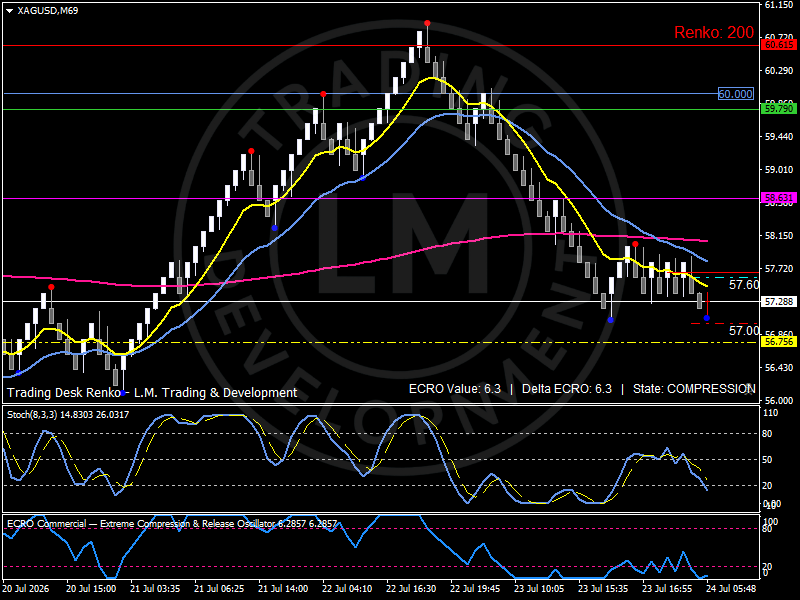
The EMA200 continues rising beneath current prices, confirming that the medium-term trend remains constructive despite the recent consolidation.
The most significant signal comes from the ECRO, which currently reads 6.3 and has entered a confirmed Compression regime.
Participation has returned to very low levels.
Energy is gradually rebuilding.
Delta ECRO has improved to +6.3, indicating that institutional participation is beginning to recover from the recent compression phase.
The stochastic oscillator continues rotating lower toward oversold territory, remaining consistent with a market redistributing participation before its next directional expansion.
Immediate participation develops between 57.0 and 57.6.
Initial resistance emerges near 58.6, followed by the broader participation objective around 59.8–60.0.
The technical structure remains aligned with a market waiting for stronger confirmation from the global manufacturing cycle.
Bird's eye view
Silver continues functioning as an industrial participation asset.
Manufacturing expectations are gradually stabilizing across the major economies.
Industrial fabrication remains supported by electrification, technology investment and infrastructure development.
Supply elasticity continues limiting the market's ability to respond rapidly to changes in fabrication demand.
The Renko structure mirrors this macro environment through a confirmed Compression phase, where participation is rebuilding while investors wait for the next catalyst capable of reactivating industrial momentum.
Outlook
Silver enters the final trading session of the week with manufacturing expectations becoming the dominant macro reference for industrial metals.
Upcoming PMI releases, the evolution of industrial orders and business investment will continue shaping fabrication demand during the coming weeks.
As long as manufacturing participation continues improving and supply elasticity remains constrained, silver is likely to remain closely linked to the quality of the global industrial cycle rather than short-term fluctuations in monetary policy.
Author

Luca Mattei
LM Trading & Development
Luca Mattei is a market analyst focusing on FX, metals, and macroeconomic trends. He develops trading tools for retail and professional traders, coding indicators and EAs for MT4/MT5 and strategies in Pine Script for TradingView.