Silver enters industrial divergence phase after Fed Minutes

Key takeaways
- Silver trades under tactical pressure as the Fed Minutes reinforce the higher‑for‑longer framework and sustain real‑yield constraints across precious metals.
- Industrial divergence remains the dominant theme: copper continues leading the industrial complex while silver struggles to attract equivalent institutional participation.
- Macro liquidity, yield pressure and selective industrial flows keep silver inside a compressed participation structure centered around the 75.0–75.6 region.
- Shipping and industrial systems remain operationally active, confirming that silver weakness reflects macro repricing, not industrial deterioration.
Silver pricing reflects a fragmented industrial environment
Silver enters the May 21 session inside a market increasingly shaped by industrial divergence, yield pressure and uneven participation across the broader metals complex.
The Federal Reserve Minutes released yesterday reinforced the higher for longer framework already visible after recent inflation data. Treasury yields remain elevated, macro liquidity conditions continue tightening and the Dollar retains relative stability across the broader market environment.
This creates a more difficult backdrop for silver than for copper.
Silver operates simultaneously as:
- an industrial input
- a precious metal
- a macro liquidity asset
And these layers are currently pulling in different directions.
Copper continues functioning as the primary industrial leader across the commodity complex. Silver instead remains trapped inside a weaker participation framework where industrial support is still insufficient to fully offset macro pressure coming from yields and positioning adjustments.
The latest EcoModities™ Multi-Timeframe Scanner highlighted this divergence clearly, with copper remaining in aligned continuation mode while silver continues trading under tactical pressure despite resilient industrial conditions.
This divergence now represents the dominant narrative across the silver market.
Yields continue to limit broader metals participation
The Minutes release maintained the broader macro structure already visible across rates markets.
Real yields remain elevated, Treasury pressure continues influencing capital allocation and precious metals participation remains selective rather than aggressive. Markets continue reassessing how long restrictive monetary conditions may persist, particularly after the recent inflation data surprised to the upside.
For silver, this matters because the metal remains highly sensitive to financing conditions and industrial growth expectations at the same time.
The scanner continues identifying US10Y strength as one of the primary constraints across precious metals positioning.
This explains why silver continues lagging copper despite broader industrial continuity.
Industrial systems remain active. Shipping flows remain functional. Commodity transportation continues moving through the global network. Yet institutional participation continues favoring metals with more direct exposure to infrastructure and electrification themes.
Silver therefore remains caught between:
- industrial support
- macro caution
- yield pressure
- selective participation
Without achieving full directional alignment.
Copper leadership continues exposing silver weakness
One of the clearest signals across the current commodity landscape is the persistence of copper leadership.
Copper continues attracting stronger participation because markets still view electrification, infrastructure investment and industrial transmission as long duration structural themes. Industrial beta therefore remains concentrated around assets directly linked to manufacturing throughput and energy transition systems.
Silver has not yet received the same degree of institutional involvement.
This matters because silver typically performs best when industrial participation broadens across the full metals complex. The current environment instead reflects selective industrial concentration.
The broader market still appears willing to allocate aggressively toward:
- electrification infrastructure
- industrial scarcity themes
- transmission metals
- supply chain investment
While silver remains partially constrained by its precious metals identity and its sensitivity to yields.
This creates a fragmented industrial framework where silver reacts to industrial momentum without fully absorbing the same participation intensity visible across copper.
Industrial flows remain active across the global system
Shipping and logistics data continue reinforcing the idea that the industrial system itself remains operationally active.
The Shipping Radar currently classifies the broader transportation environment as:
Extreme stress
With freight, flow and risk signals remaining elevated across multiple layers of the shipping network.
Crude tanker strength remains firm, LNG routing sensitivity persists and industrial transportation activity across Asia and Europe continues showing resilience despite higher volatility conditions.
These conditions matter because they confirm that the current weakness in silver does not originate from a collapse in industrial activity.
The issue instead is the uneven distribution of participation inside the industrial commodity space.
Markets continue favoring assets with:
- direct infrastructure exposure
- clearer industrial scarcity dynamics
- stronger transmission leverage
- tighter supply elasticity
Copper continues fitting this profile more cleanly than silver under the current macro regime.
Australia data reinforced growth sensitivity concerns
The latest Australia employment figures also contributed to the broader repricing process overnight.
Employment Change printed at -18.6K against expectations for positive growth, while unemployment rose to 4.5%. These figures reinforced concerns surrounding industrial momentum and global growth sensitivity across commodity markets.
Silver remains particularly exposed to these shifts because it operates at the intersection between manufacturing expectations and macro liquidity conditions.
This keeps the metal highly reactive whenever markets begin reassessing the durability of the industrial cycle.
The result is a market environment where silver participation remains cautious even while industrial systems preserve operational continuity.
Technical structure: Silver compresses around the 75 participation zone
Silver continues operating inside a compressed rotational framework centered around the 75.0–75.6 participation region.
This area currently functions as the primary organizational layer of the market, where price repeatedly pauses, rotates and rebuilds engagement following short term directional moves.
The broader structure remains defensive but orderly.
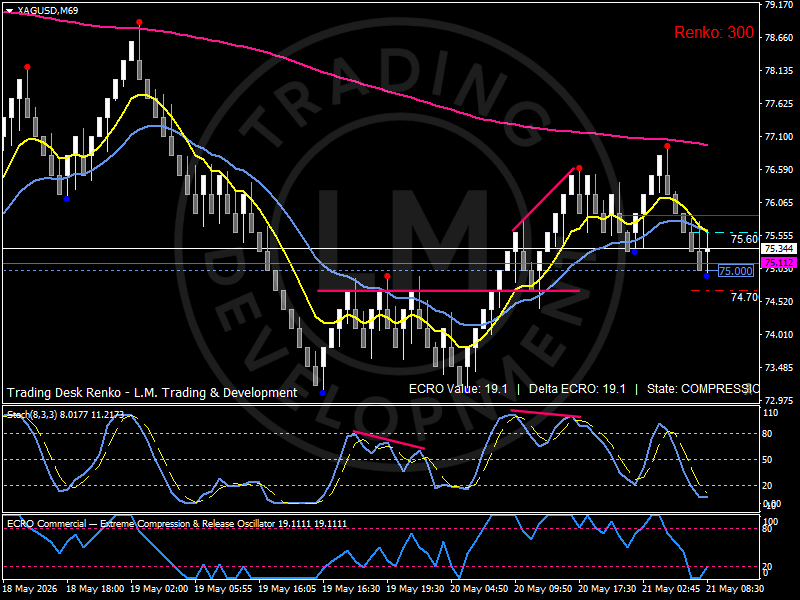
Resistance develops near 76.0–76.5, where previous upward extensions lost continuity and generated renewed selling pressure. The upper structural boundary remains positioned near 77.1, where the long term participation layer continues capping broader recovery attempts.
Support remains concentrated around 75.0, followed by the deeper participation region near 74.7. This zone continues functioning as the primary short term stabilization layer across the current framework.
The EMA configuration still reflects broader macro pressure, with short term averages rotating beneath the long term structural layer while directional momentum progressively compresses after the latest recovery attempt.
The Renko sequence shows alternating phases of recovery and rejection while maintaining coherent rotational behavior across the broader structure. Lower participation highs remain visible despite periodic industrial re-engagement.
The ECRO indicator currently stands near 19 with a positive delta around 19, reflecting a compressed state where downside pressure is gradually slowing while directional energy begins stabilizing.
This configuration remains consistent with a market consolidating inside a fragmented industrial environment while awaiting stronger participation alignment.
Bird’s eye view: Silver market map
Market Regime: Fragmented industrial participation under macro yield pressure.
Regime Pivot: 75.0–75.6.
Upper Participation Zone: 76.0 → 77.1.
Expansion Layer: Acceptance above 77.1 strengthens broader industrial continuation conditions.
Support Structure: 75.0 → 74.7.
Pressure Zone: Sustained movement below 74.7 increases downside continuation risk.
Systemic Indicators to Watch: Copper leadership, real yields, industrial flows, manufacturing sensitivity and Dollar positioning.
Outlook
Silver continues operating inside a market shaped by industrial divergence, macro yield pressure and fragmented participation across the broader metals complex.
Copper remains the dominant industrial leader while silver continues struggling to attract the same level of institutional involvement despite resilient industrial flows and active transportation conditions.
Federal Reserve policy expectations and elevated yields continue limiting aggressive upside participation across precious metals while industrial systems preserve operational continuity.
The next directional phase for silver depends on whether industrial participation broadens enough to overcome the current macro constraints coming from yields and positioning.
As long as copper leadership remains isolated and real yields stay elevated, silver may continue rotating inside the current compressed framework while markets reassess the balance between industrial momentum and macro pressure.
Author

Luca Mattei
LM Trading & Development
Luca Mattei is a market analyst focusing on FX, metals, and macroeconomic trends. He develops trading tools for retail and professional traders, coding indicators and EAs for MT4/MT5 and strategies in Pine Script for TradingView.