|

Recession trades to the rescue

S&P 500 finally turned south in line with the medium-term outlook, in reaction to the wildly underwhelming JOLTS data. Job market deterioration is finally getting reflected as per the Mar/Apr timeing for issues to arrive that I discussed earlier. Unemployment claims rising and finally non-farm payrolls would come to reflect that.

Today‘s employment change is first such a sign, but all eyes are on Friday‘s non-farm payrolls. The bears are aligning for a pleasant surprise as buy the dippers are bound to get increasingly overpowered. Expect more risk-off in bonds and the surge in precious metals to continue at its own pace higher (my star pick for 2023).

Keep enjoying the lively Twitter feed via keeping my tab open at all times – on top of getting the key daily analytics right into your mailbox. Combine with Telegram that never misses sending you notification whenever I tweet anything substantial, but the analyses (whether short or long format, depending on market action) over email are the bedrock. So, make sure you‘re signed up for the free newsletter and that you have my Twitter profile open in a separate tab with notifications on so as to benefit from extra intraday calls.

Let‘s move right into the charts.

Gold, Silver and miners
Gold

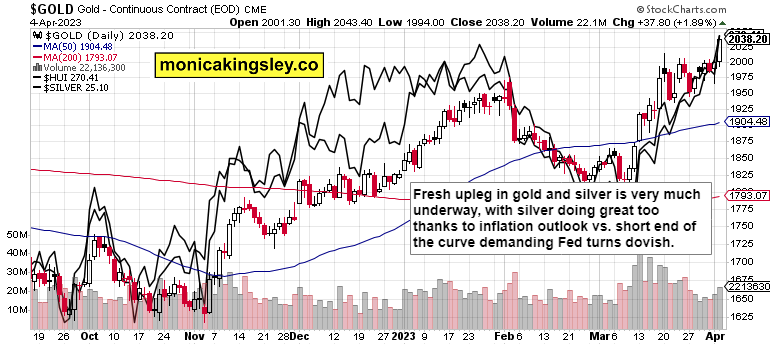
Very fine recession reaction – lower yields sending down the dollar as the Fed can‘t remain this restrictive, the market thinking goes. Silver doing well as inflation is undefeated.

Crude Oil
WTIC

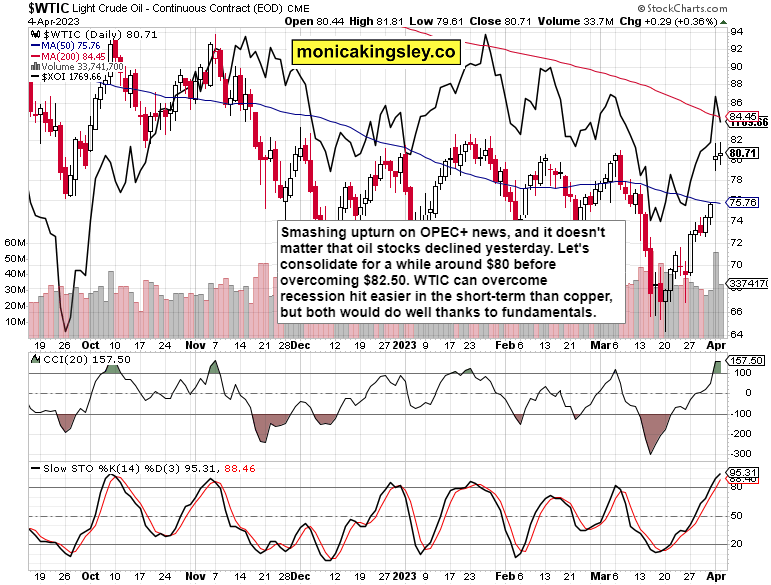
Oil is consolidating high ground, and would be far less hurt than copper through the recession jitters. Well, I say jitters, but markets obviously have to overcome the misguided no landing first. In doing so, they may very well start questioning the soft landing too...

Author

Monica Kingsley

Monica Kingsley

Monicakingsley

Monica Kingsley is a trader and financial analyst serving countless investors and traders since Feb 2020.


More from Monica Kingsley
Share:

Editor's Picks

AUD/USD keeps the red near 0.6950 after weak Aussie jobs data

AUD/USD holds losses near 0.6950 on disappointing Australian jobs data, extending the previous day's retracement slide from the monthly high and hitting a fresh weekly low during Thursday’s Asian session. Meanwhile, declining US bond yields drag the US Dollar away from the April 2025 high, touched after Wednesday's hot US CPI, helping limit losses for the currency pair.

USD/JPY slides back below 158.00 as USD reverses post-CPI gains

USD/JPY extends the previous day's pullback from a three-week high, attracting follow-through selling and sliding below 158.00 during Thursday's Asian session. Traders remain on high alert amid speculation that authorities will step in to prop up the Japanese Yen. The US Dollar, meanwhile, reverses Wednesday's hot CPI-led gains to April 2025 highs as US bond yields retreat on China bond-buying talk, further pressuring the pair.

Gold shrugs off hot US PPI as risk aversion drives bond yields lower

Gold attracts fresh buying on Thursday as weakness across global equities, driven by mounting concerns over AI-related investments, triggers a sharp pullback in US Treasury yields and drags the US Dollar lower from fresh year-to-date highs.

Ripple clings to $1.30 support as downside risks intensify

Ripple is stuck in a bearish trend, trading near $1.30 on Thursday. The remittance token’s bearish shift reflects the broader cryptocurrency market, which remains under heavy selling amid concerns about accelerating inflation in the US.

Budget preview: Is Healey impressing the bond market?

There is less than 2 weeks to go before the Chancellor delivers his first budget. Unusually for the UK, the economic and financial backdrop to this budget is upbeat. UK bonds have been rallying, the FTSE 100 is the top performing major stock index this week, and the Pound is also stabilising versus the Dollar.

Has Bitcoin really escaped the macro forces it was built to fight?
Over 17 years ago, Satoshi Nakamoto designed Bitcoin (BTC) on the back of a global financial crisis as an alternative to the global monetary system outside the control of central banks, governments and traditional intermediaries. This raises a key question: has Bitcoin really become independent of the macroeconomic forces it was built to challenge?















