RBA preview: A decisive hike to keep inflation in check

The RBA is likely to deliver a hawkish 25bp hike on 29 September as persistent inflation pressures, resilient labour demand and higher energy costs strengthen the case for keeping policy restrictive. That should offer some support for AUD, which is suffering from a deterioration in the external environment but still offers solid fundamentals.
The RBA is set to lean hawkish
We expect the Reserve Bank of Australia to deliver a decisive 25bp rate hike in the cash rate to 4.6% on 29 September, reflecting an economy that continues to run hot across multiple fronts. Labour market conditions remain tight, second-quarter GDP growth surprised to the upside, and recent inflation readings have come in stronger than expected. While the housing market has shown signs of cooling, we expect the RBA to emphasise that inflation risks remain tilted to the upside and that further vigilance is required to ensure price pressures return sustainably to target.
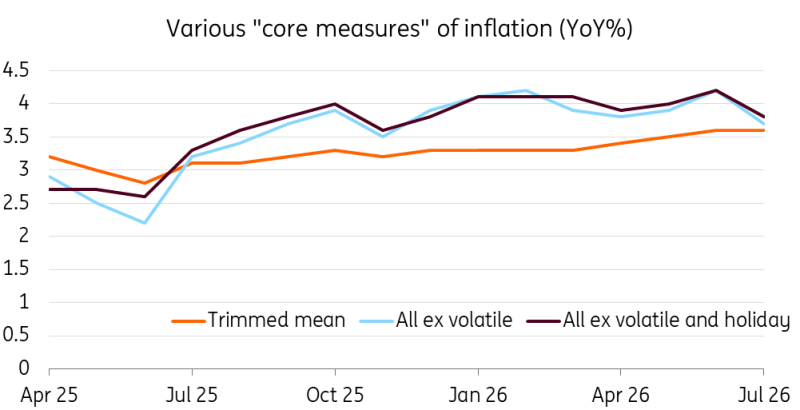
Core inflation is turning out to be stickier
What has strengthened the case for a hike
Inflation risks remain tilted to the upside following the escalation in the US-Iran conflict. While Australia is a major exporter of LNG and thermal coal, it remains heavily reliant on imported oil products such as diesel, petrol and jet fuel. Higher global oil prices have already lifted domestic fuel costs, raising input costs across transport, mining and agriculture and adding to food price pressures. The RBA estimates that a 10% increase in fuel prices could add more than 0.3ppt to headline inflation over one to two quarters, with indirect effects from production and transport costs contributing a further 0.2-0.25ppt. Even if crude oil prices moderate as we expect, domestic fuel prices are likely to remain relatively sticky, keeping inflation risks skewed to the upside.
Trimmed mean inflation remains stubbornly high, likely holding at 3.6% year-on-year in August for a third consecutive month. This suggests core inflation accelerated in 3Q rather than eased, challenging the RBA's expectation that trimmed mean inflation would slow to 3.3% by year-end. With renewed supply-side disruptions and higher fuel and food prices, the path back to target appears increasingly difficult.
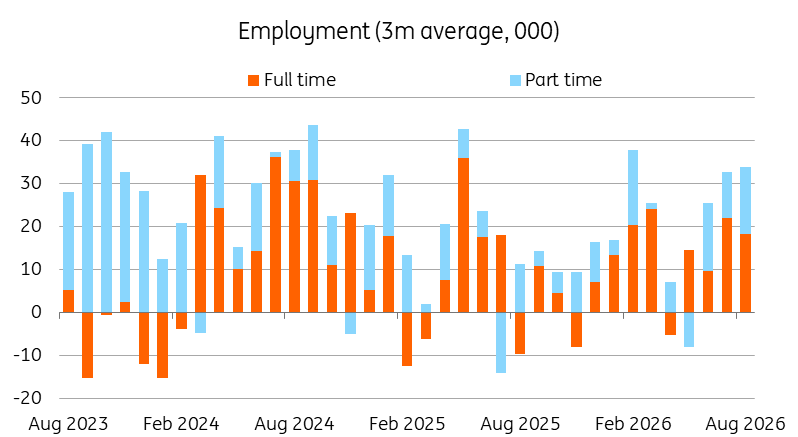
Labour demand remains strong. Despite the rise in the unemployment rate to 4.6%, labour market conditions remain tight. Full-time employment growth strengthened in both July and August, while three-month average job creation accelerated to 34k, the strongest pace since the onset of the US-Iran conflict in February. The participation rate also rose to a record-high 67.1%, suggesting labour supply is increasing but is still being absorbed by robust hiring demand. The combination of strong employment growth and elevated participation points to continued labour market resilience and raises the risk that wage and underlying inflation pressures remain persistent.
Labour market remains resilient
RBA to help AUD weather turmoil
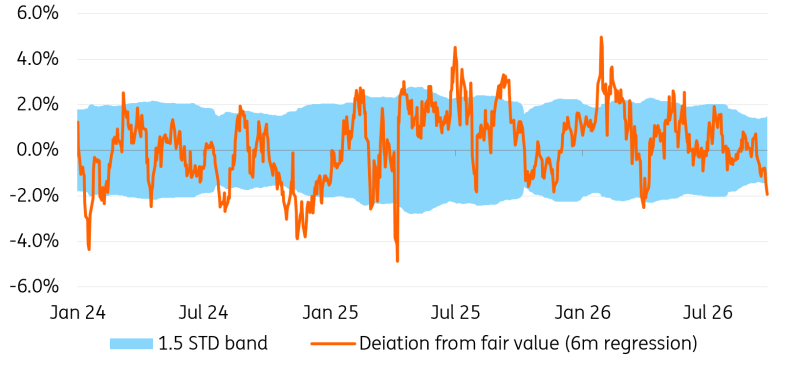
The Australian dollar has had a rough week, hit by poor risk sentiment and the global bond selloff. Our short-term fair value model (chart below) indicates AUD/USD is now undervalued beyond the 1.5 standard deviation band, suggesting a higher bar for further depreciation.
AUD/USD decline looks overdone
Clearly, the USD leg of the story is the big question mark. An October hike by the Federal Reserve could keep USD well in demand and delay any AUD/USD recovery further. But if we are right in expecting the next Fed hike only in December, we think AUD can top the G10 scorecard in a USD correction.
That’s because AUD fundamentals remain strong and should improve further with a September rate hike by the RBA. Incidentally, there is less room for a dovish repricing in the AUD curve compared to the USD curve. Markets are pricing in 22bp for the RBA next week, and another 40bp after that, spread over the next nine months. The Fed funds futures curve currently embeds 90bp by July 2027. As we currently forecast only one hike by both the RBA (next week) and the Fed (December), the rate differential should turn more positive for AUD/USD.
We are revising our year-end target for AUD/USD from 0.73 to 0.72. In the very near term, a test of sub-0.700 levels is the risk, but we think an RBA hike can prevent a retest of the roughly 0.690 June lows.
Author

ING Global Economics Team
ING Economic and Financial Analysis
From Trump to trade, FX to Brexit, ING’s global economists have it covered. Go to ING.com/THINK to stay a step ahead.