Q3 growth in advanced economies: Solid despite shocks

Growth looks to have held up in Q3 despite successive shocks (see our analysis), as it did in 2025 and H1 2026. A longer Middle East conflict has fed into more persistent inflation; drought has worsened in many countries, and interest rates have risen further – at the short end, with both the ECB and the Fed raising policy rates in September, and even more at the long end.
However, our nowcasts show that growth is bending without breaking in most advanced economies. GDP figures (due on 29 October in the US and 30 October for the euro area and its member states) are expected to confirm that. In the Euro area, momentum looks stable (excluding Ireland, whose GDP is volatile). In Germany, growth has been uninterrupted since Q4 2025, while France is likely to have returned to growth after stagnating in H1. In the US, growth is likely to have gathered pace, according to the GDP Now, still driven by AI, but increasingly by other sectors as well.
Euro area: Resilience beneath the surface
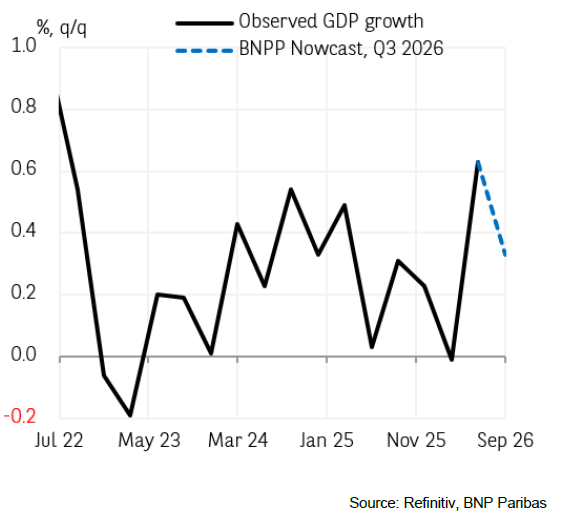
Our nowcast points to growth slowing to 0.3% in q/q, though the pace is stable excluding Ireland (Irish GDP is volatile and had markedly boosted the Q2 figure). Excluding Ireland, growth should hold at its H2 average, a sign of the bloc’s underlying resilience. Also, momentum has broadened to a growing number of sectors (see our analysis). While industrial production stalled over the summer, services remained buoyant. The services PMI rebounded sharply in Q3 and sits firmly in expansion territory (53.0 in September). Improving job-related survey data (PMI and European Commission surveys) and a stable unemployment rate (6.4% in August) hint at more hiring in Q3 – a support for household consumption that partly offsets purchasing-power losses from persistent inflation. Corporate investment is underpinned by buoyant new investment lending (8.7% y/y In August, 12-month cumulative).
France: Growing, nevertheless
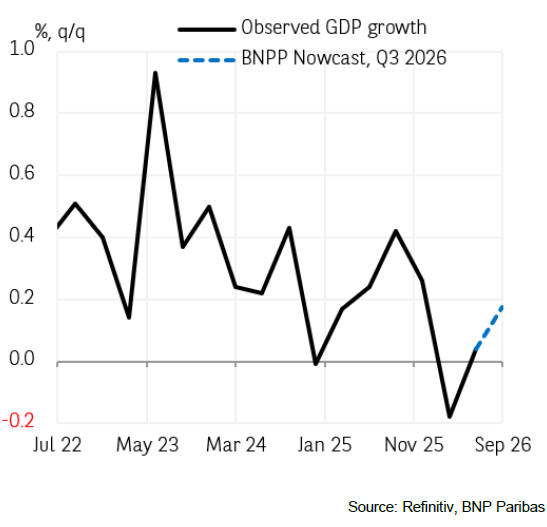
The succession of shocks does not appear to have prevented France from returning to growth in Q3, at 0.2% q/q, according to our nowcast. One-off factors accounted for the stall in activity in H1. In Q3, the drought worsened and industrial production remained subdued. However, market services production rebounded in July and August, notably in business services, restaurants, digital and real estate. The latter points to residential investment recovering after a weak H1. Corporate investment likely followed, as reflected in buoyant credit flows and AI-related investment. Household consumption is likely to have improved slightly on higher electric vehicle sales.
Germany: Growth still solid
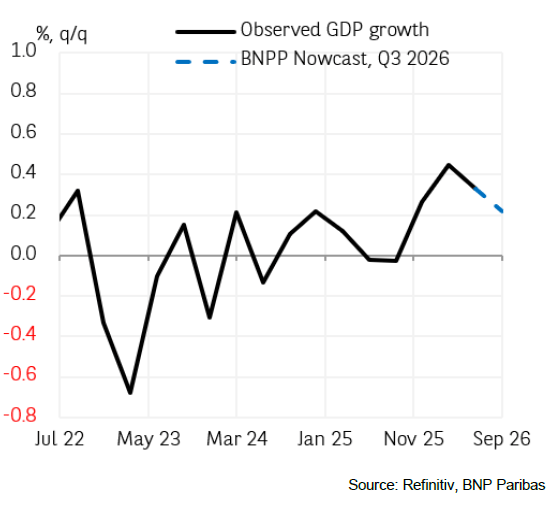
The H1 rebound in activity is moderating but continues. Our nowcast points to a fourth straight quarter of growth in Q3, at 0.2% q/q (after 0.3% in Q4 2025, 0.4% in Q1 2026, and 0.3% in Q2). Manufacturing activity eased slightly, according to the September PMI survey (53.9, down 0.4 m/m). Government spending will remain growth-supportive, with defence and infrastructure outlays gaining traction. Infrastructure spending continues to underpin activity in public works, which stands at its highest since November 2021 (2.5% 3m/3m in August). Exports (4.4% y/y between January and August) remain the main growth engine, helped by a pivot towards Europe (7.2%).
United States: An expansion undeterred by inflation
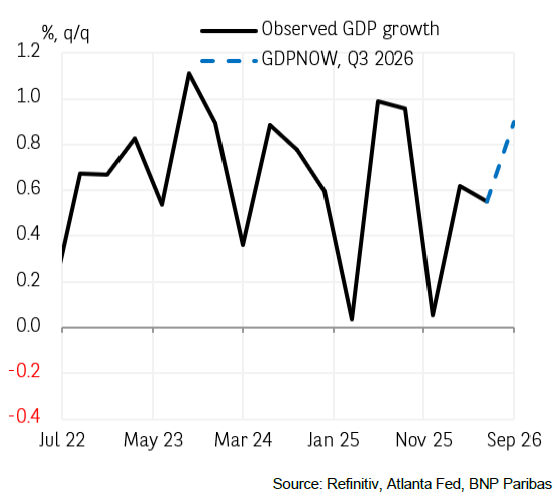
Growth is likely to have gathered pace in Q3. The Atlanta Fed’s GDP Now points to a 3.5% annualized growth rate (AR), close to our own 3.7% forecast (0.9% non-AR) and up from 2.2% in Q2. Domestic demand remains the engine. Consumption is weathering the pickup in inflation, while the AI-driven capex cycle remains robust – as reflected in retail sales and nondefence capital-goods orders (excl. aircraft). As a result, growth in final sales to private domestic purchasers[1] should print above 4% AR again. By contrast, external trade should remain a drag on growth, reflecting AI-related import needs. Survey data point to momentum that is both solid and broad-based. The ISM indices have remained firmly in growth territory (54.9 quarterly average for manufacturing and services alike). At the same time, they highlight persistent price and supply-chain pressures.
Author

BNP Paribas Team
BNP Paribas
BNP Paribas Economic Research Department is a worldwide function, part of Corporate and Investment Banking, at the service of both the Bank and its customers.