People aren't seeing the real de-dollarization

It's not a "black swan" event. In fact, it's playing out right before our eyes and was entirely predictable. The world is slowly but surely spurning the dollar.
But most people haven't noticed.
De-dollarization might seem like a wild conspiracy theory, but it is happening. Countries worldwide are trying to limit their exposure to the greenback, and the dollar’s clout is slowly ebbing.
No, the dollar isn’t on the verge of collapse due to a major trauma. It’s more like death by a million papercuts.
Nassim Taleb, best known for his book The Black Swan, said in a post on X that “people are not seeing the real de-dollarization in progress.” He pointed out that global transactions are still generally labeled in dollars “as an anchor currency.”
“But central banks (particularly BRICS) have been storing, that is putting their reserves, in Gold.”
In other words, the dollar still serves as the primary medium of exchange, but more and more countries are turning to gold as a store of value. As author Richard Turrin put it, “The US will tout the USD's high percentage use in trade all the way to the bottom.”
Turrin pointed out that the “dollar's high percentage in trade settlements is increasingly meaningless" for two reasons.
- Gold holdings show reserve storage.
- Migration of trade to alternate currencies isn't captured on SWIFT statistics.
This trend toward storing wealth in gold instead of dollars makes sense given the U.S. government’s persistent evaluation of its currency that seems to be accelerating.
Luke Gorman, founder and president of Forest for the Trees confirmed Taleb’s point with a graph, noting that this de-dollarization trend has been in play for more than a decade and “got much louder post-2022 sanctioning of Russian FX reserves.”
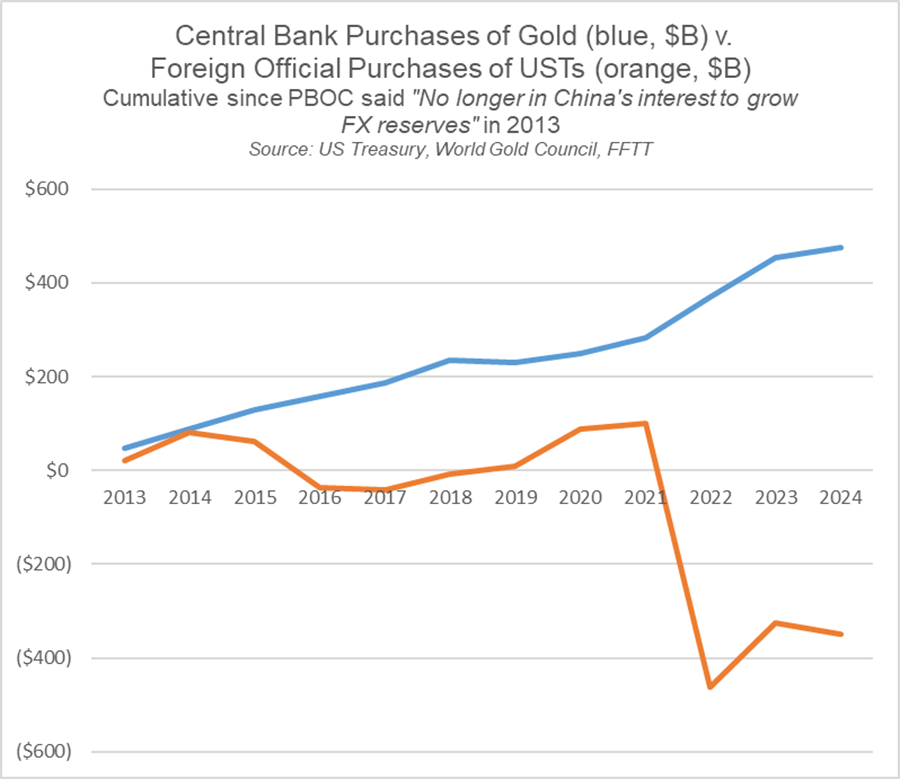
In fact, dollar reserves globally have dropped by 14 percent since 2002. And as the graph shows, de-dollarization accelerated after the U.S. and her Western allies aggressively sanctioned Russia and froze the country’s assets after it invaded Ukraine.
Geopolitical and financial analyst Angelo Giuliano posted the same graph asserting, “De-dollarization is happening.”
“The US dollar Ponzi scheme is collapsing...the US exorbitant privilege to print endless amount of paper toilet currency is over.”
He noted that gold hit yet another all-time high on Sept. 12, saying, “This is only the beginning.”
Dollar weaponization undermining the Dollar
All of these experts confirm that the United States’s weaponization of the dollar is undermining its strength and role as a reserve currency.
A recent Atlantic Council report on the falling percentage of dollar reserves pointed out dollar weaponization was a factor behind this trend.
“In recent years, and especially since Russia’s invasion of Ukraine and the Group of Seven (G7)’s subsequent escalation in the use of financial sanctions, some countries have been signaling their intention to diversify away from dollars."
The U.S. and its allies not only froze Russian assets, but they also locked the country out of the SWIFT financial system.
The Society for Worldwide Interbank Financial Telecommunication (SWIFT) system serves as the global economy’s superhighway. In effect, it operates as a global financial messaging service, facilitating cross-border payments. Since the dollar serves as the world reserve currency, SWIFT effectively facilitates an international dollar system.
This gives the U.S. a great deal of leverage, as the Russians discovered.
This wasn’t the first time the U.S. used SWIFT and the dollar as a stick to advance its foreign policy goals. In 2014, the Obama administration locked several Russian financial institutions out of SWIFT as relations between the two countries deteriorated over Ukraine and Crimea.
A few years later, the Trump administration threatened China in an attempt to force that country to join in sanctioning North Korea.
Whether you think the sanctions were justified or not, it’s important to remember that other countries are watching. They realize that dependence on dollars makes them vulnerable to
U.S. manipulation and this is one of the reasons many countries are trying to diversify away from the USD.
Think about it -- if you are concerned that the U.S. could pull the "dollar rug" out from under you, why not pull out from the dollar system first?
This appears to be what is slowly happening. Again, it is death by 1 million paper cuts.
According to a 2023 Invesco survey, a “substantial percentage” of central banks expressed concern about how the U.S. and its allies froze nearly half of Russia’s $650 billion gold and forex reserves.
Central banks turning to Gold
We see this shift toward gold in persistent central bank gold buying.
According to the most recent World Gold Council survey released in June, 29 percent of central banks plan to add more gold to their reserves in the next 12 months. The WGC said it was the highest level since the survey began in 2018.
Only 3 percent said they had plans to decrease gold reserves.
Earlier this year, the World Gold Council said the continuation of gold buying supports its expectation that "2024 will be another solid year of central bank gold demand."
"Last year central banks placed great emphasis on gold’s value in crisis response, diversification attributes, and store-of-value credentials. A few months into 2024 the world seems no less uncertain meaning those reasons for owning gold are as relevant as ever."
Last year, central bank gold buying fell just 45 tons short of 2022’s multi-decade record.
According to the World Gold Council, central banks net gold purchases totaled 1,037 tons in 2023. It was the second straight year central banks added more than 1,000 tons to their total reserves.
Central bank gold buying in 2023 built on the prior record year. Total central bank gold buying in 2022 came in at 1,136 tons. It was the highest level of net purchases on record dating back to 1950, including since the suspension of dollar convertibility into gold in 1971.
The skyrocketing price of gold confirms the wisdom of these central bankers. And it is a tangible sign that the dollar is losing value - and status.
To receive free commentary and analysis on the gold and silver markets, click here to be added to the Money Metals news service.
Author

Mike Maharrey
Money Metals Exchange
Mike Maharrey is a journalist and market analyst for MoneyMetals.com with over a decade of experience in precious metals. He holds a BS in accounting from the University of Kentucky and a BA in journalism from the University of South Florida.